







From field to forecast: How Trapview is revolutionizing pest management in agriculture



The 2025 edition of Fruit Attraction marked Trapview's debut at one of the most important events for the global fruit and vegetable industry.


Developed and managed by the Slovenian company EFOS (Environment and Food Safety), the brand’s agricultural pest monitoring and forecasting solutions showcased Trapview’s support of digital and sustainable agriculture and were positively received by the audience.
One of the stars of the brand—registered in both Europe and the US—was Trapview Scouting, a smart pest monitoring platform that uses manual traps.
The new app saves professionals time and effort by identifying pests, providing meteorological data, and helping with monitoring efforts. This holistic approach allows growers to analyze data and make informed decisions without the need for manual counts.
Sustainability and innovation—Trapview’s pillars
FreshFruitPortal.com talked to Andrea L. Launeck, Regional Sales Director for Southwest Europe of Trapview. He explained that with the experience gained in different agricultural contexts, the brand seeks to strengthen its role as a technological partner for a more resilient, sustainable, and efficient fruit and vegetable production.
"Our technology allows crop protection to be data-driven, maximizing existing protection tools and benefiting both crops and the environment," said Launeck.
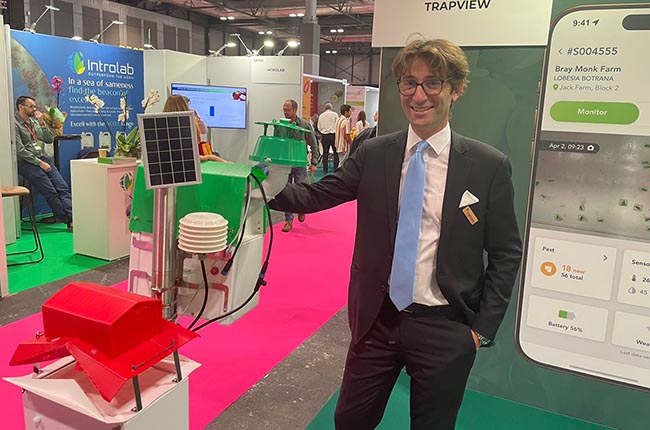
The executive noted that Trapview is used for the digital control of more than 60 pest species, including lepidopterans and dipterans, such as the Mediterranean fruit fly and the olive fly. He stressed that it is not just about pest monitoring, but also about prevention.
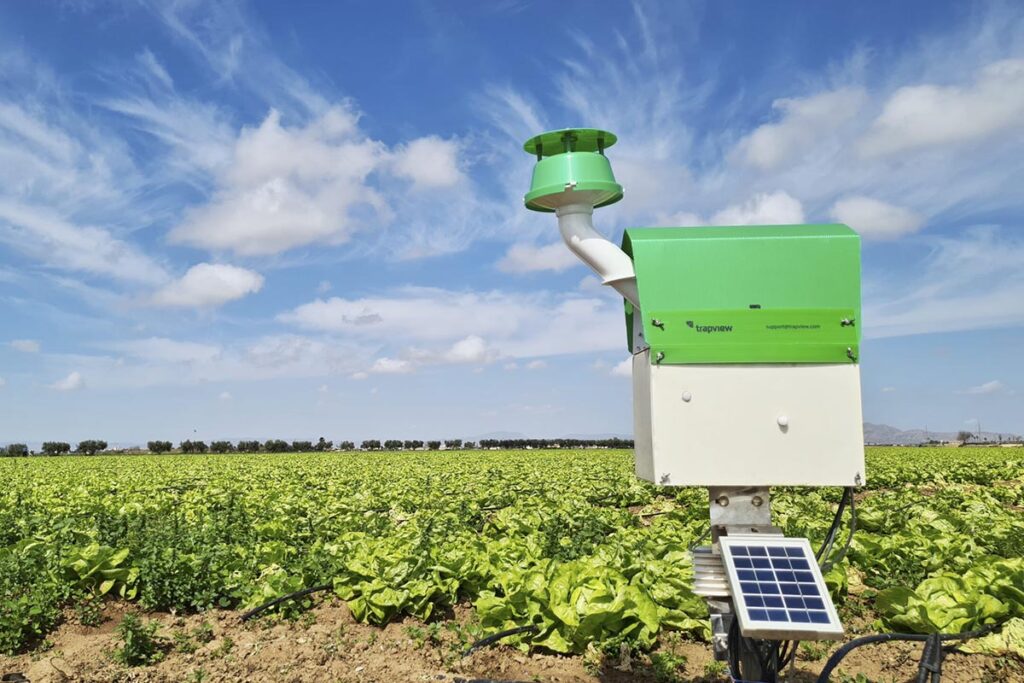
"It is an integrated solution that combines hardware and software. We have automated traps, each with a battery powered by a solar panel," Launeck said.
Data-driven pest control and prevention for agriculture
Trapview traps detect pests, monitor their development, and predict their evolution daily, providing farmers with accurate data and forecasts to make informed decisions.
All operations are automated: captures are sent daily to the Trapview app, which offers precise monitoring data, population trend analysis, and forecasts of the different stages of insect development.
In this way, users can simulate the impact of using phytosanitary products to decide if and when to apply them. Additionally, they receive meteorological information and weather forecasts. Authorized users—agronomists, cooperatives, or farmers—can visualize the situation in the field and easily define protection strategies from any device through the app.
"Trapview not only improves field management but also optimizes tasks. In one day, it gathers all the information that the technician, agricultural engineer, or plant defense manager needs. You can observe growth day by day or week by week," commented Launeck.
He explained that the tool has a temperature and humidity sensor, two cameras, and a central unit with a SIM card.
"Every day, a photo is taken and stored in the cloud. The set of images provides us with reliable data over time. With them, we can build predictive models of the population: if more insects are captured, how their development will be, and when a peak of larvae will occur at different stages," he added.
"We can also simulate treatments," he said. "For the farmer, it is more than a physical trap: it is a tool that tells them how to make more efficient use of defense inputs, whether biological, chemical, or with useful insects," he emphasized.
According to Launeck, the ideal is not to have just one trap, but a network of them to cover a wider area. He detailed that one trap can monitor 20 hectares.
"A large company can have, for example, 50 traps, and a small one, between 5 and 10," Launeck said.
Trapview is distributed in more than 50 countries around the world. It is used in crops such as corn, tomato, and grape, where it significantly reduces labor costs, pesticides, and other resources necessary for pest management.
Since its launch, Trapview has supported the production of 50 million tons of food, saving 500,000 hours of work and 48,600 tons of CO₂.
Related stories
Planasa shines a light on its varietal innovation at Fruit Attraction 2025
Hectre celebrates its AI-powered orchard and packing solutions' explosive growth in Chile








Subscribe to our newsletter