Kenya’s avocado boom: Industry to hit record production amid shipping and regulatory headwinds
 Add Fresh Fruit Portal to Google
According to a recent report by the US Department of Agriculture (USDA)’s Foreign Agricultural Service, Kenya is poised to achieve a historic milestone in its avocado output. The forecast sits at a staggering 694,000 metric tons for the 2025/26 season—the highest ever recorded for the country.
But despite the record-breaking production on the horizon, the document also warns of the effects of the significant logistical disruptions in the Red Sea, which, compounded by stricter domestic export controls, may dampen Kenya's pace of international shipments.
More land, better yields, and new byproducts
The East African nation’s latest projection is a substantial upward revision from its previous estimate of 585,000 metric tons, reflecting the rapid pace at which the industry is scaling.
Several factors have converged to drive this "green gold" rush, the USDA said.
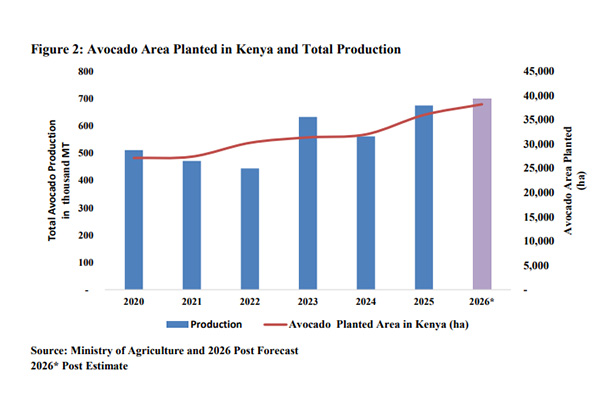
First, there has been a consistent expansion in the total area harvested, as thousands of hectares of trees planted over the last five to seven years reach full maturity. Additionally, improved productivity among small-scale and commercial growers alike has also helped. They've benefited greatly from better access to high-quality seedlings and more advanced agronomic practices.
Interestingly, said the agency, Kenya’s fresh green boom has created a secondary industry: avocado oil. As growers look for ways to monetize lower-grade fruit that does not meet export standards for the fresh market, processing has skyrocketed.
Avocado oil production increased significantly from 3,326 metric tons in 2024 to 10,188 metric tons in 2025—a threefold increase in just one year. This surge is driven by robust demand in high-income international markets where the product is prized for its health benefits and culinary versatility.
Kenya faces export challenges at home and abroad
But despite record-breaking production numbers, the USDA said the 2025/26 Kenyan avocado season is paradoxically likely to decrease due to geopolitical instability and domestic policy pressure.
Disruptions in the Red Sea have severely impacted the primary shipping route for Kenyan avocados bound for the European market, increasing transit times and freight costs. This shift has forced exporters to reconsider their logistics, with many opting for longer, more expensive routes around the Cape of Good Hope. This has not only thinned profit margins but also challenged the shelf-life and quality of the fruit.
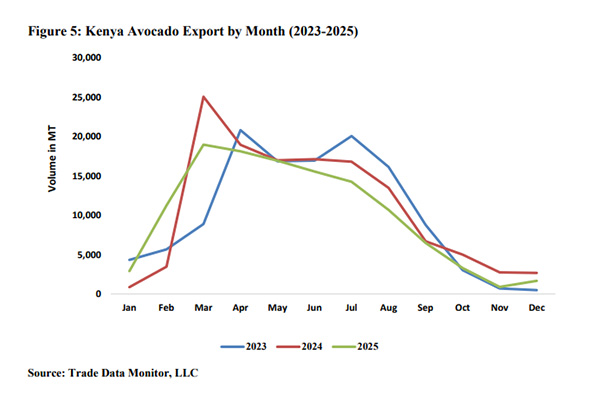
On the home front, the Kenyan Agriculture and Food Authority has implemented more stringent export controls designed to protect the "Brand Kenya" reputation. These involve rigorous checks to ensure only mature, high-quality fruit enters the international market.
While the USDA said these controls are essential for long-term market stability, they have contributed to the short-term slowdown in export volumes as the industry adjusts to the tighter oversight.
Looking ahead, the North American agency remains optimistic about the sector’s trajectory. For the 2026/27 season, production is forecast to continue expanding, rising by nearly five percent to approximately 727,000 metric tons. Exports are also expected to rebound as logistics stabilize, with a projected 7.4 percent increase to 130,000 metric tons.
A shifting export map
The East African country’s export landscape continues to be dominated by European and Middle Eastern markets, but the cards are shuffling.
According to the USDA, the Netherlands remains the undisputed leading destination for Kenyan avocados, accounting for 24 percent of total export volume in 2025. However, the numbers might be deceptive, as the country serves as a critical entry point and redistribution hub for the broader European Union.
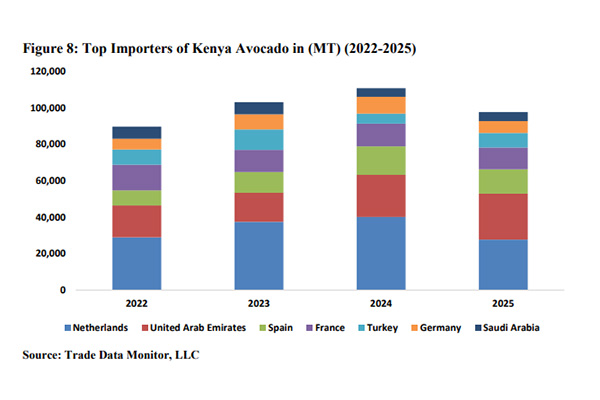
Within the region, Spain and France together account for approximately 11 percent of exports, while Türkiye and Germany each receive roughly five percent of shipments.
The United Arab Emirates ranks second in export volume, with a 19 percent market share, reflecting the growing importance of the Middle East as a premium market.
The USDA also emphasized the dominance of the Hass variety in Kenyan exports, accounting for over 74 percent of production in 2025. The cultivar is specifically favored for its durability during long-distance transport.
*Images are referential; graphs courtesy of USDA.
Related stories
With the help of Kenya, Nigerian avocados seek to be the next African sensation
Kenya, New Zealand emerge as key actors in China's growing avocado market