








Huckleberry Signals is helping the fresh produce supply chain turn scattered data into answers



Fresh produce companies generate more data than ever, yet teams still spend critical time hunting for basic answers across ERPs, warehouse systems, BI tools, spreadsheets, emails, and institutional knowledge that lives in a few people’s heads.


In a business where timing drives margins, waiting hours or days for information means missed opportunities and costly decisions.
Huckleberry Signals, a software company founded by produce industry data veteran Joe Vargas and data architect Amanda Kuelker, has a different approach. Rather than adding another dashboard or report, the company has built what it calls an intelligence layer for grower-packer-shippers: one that connects existing systems, aligns shared business definitions, and delivers fast, trustworthy answers through Huck, an AI-powered conversational analyst.
Huckleberry Signals: AI built from the soil up
The platform was designed for the realities of perishables, where market conditions shift quickly, and teams often operate from multiple versions of the truth. By the time an answer is assembled, the market window has often moved.

“Most teams are stuck looking in the rearview mirror because their systems don't work in sync,” said Joe Vargas, CEO of Huckleberry Signals. “We built Huckleberry to change that. By layering in commodity and company-specific context, we move you from simply knowing what happened to knowing exactly what to do next. We sync your fragmented data so you can move from a question to a profitable decision in seconds.”
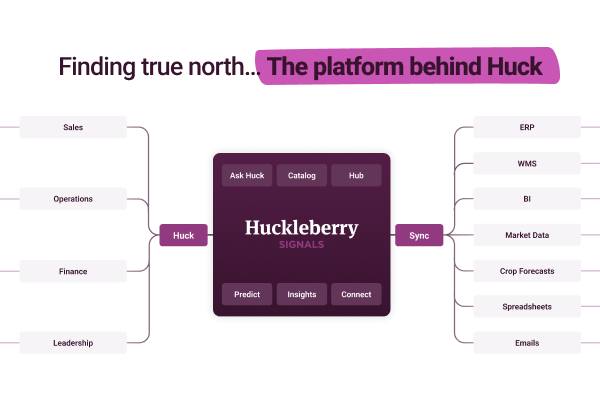
Huckleberry Signals sits above the systems companies already use. It connects ERP, warehouse management, BI tools, spreadsheets, and third-party market data into one governed layer. Users ask Huck questions in plain language and receive answers grounded in their own data.
Unlike generic AI tools, Huck is built on a governed data foundation. If the data needed to answer a question is missing, Huck flags it rather than guessing.
“I’ve spent my career as an AI veteran, and I know that in an industry as demanding as perishables, you can't just sprinkle AI on top of a broken process,” said Amanda Kuelker, Huckleberry Signals CTO and co-founder. “We are data architects first, building the rock-solid foundation this industry lives and dies by.”
By getting the definitions and quality right from the start, she explained, the firm can apply AI as a mission-critical engine for real work, turning it from a tech novelty into a practical interface integrated into the industry's very DNA for moving goods.
The company said many of the first use cases are not advanced forecasting but what leaders describe as “memory” questions, e.g., “Where will I be short this week if production levels are 20 percent below estimate?” or “What inventory is at risk this week, and what customers should I reach out to?” Questions that previously required ad hoc reports or manual searching can now be answered in seconds, the company said.
*All images courtesy of Huckleberry Signals.
Related stories
A sting in the tail for European Foulbrood: AI tool aims to sharpen bee disease diagnostics
This AI-powered data-collecting robodog is both a grower’s coworker and an autonomous agronomist










Subscribe to our newsletter