








Agronometrics in Charts: The encouraging bipartisan effort striving to open global markets for US blueberries



Each week, the series ‘Agronometrics In Charts’ looks at a different horticultural commodity, focusing on a specific origin or topic, and visualizing market factors that are driving change. Check out our entire archive.

A bipartisan coalition of 26 lawmakers, led by Representatives Rick Larsen (D-WA-02) and Dan Newhouse (R-WA-04), has called on the Office of the US Trade Representative and the Department of Agriculture to prioritize blueberry trade in ongoing negotiations with key Asia-Pacific partners.
In a formal letter sent September 17, the group urged action to eliminate longstanding barriers that have limited US blueberry exports to Japan, South Korea, and Vietnam.
The key role of Asia in the US blueberry market
The document emphasizes that the US is the world’s leading producer of blueberries, and that opening these growing foreign markets is essential for supporting American growers, rural jobs, and long-term agricultural competitiveness.
Lawmakers are specifically pressing for the removal of Japan’s tariff on frozen blueberries, for fresh US blueberries to gain entry into the South Korean market, and for reductions in Vietnam’s high tariff rates on imported fruit. These, the Congress people say, are seen as major roadblocks to expansion in a region with rising demand and a growing consumer base for high-quality fruit.
“The US is the world’s top blueberry-producing nation, and increasing exports to markets in the Asia-Pacific region supports producers in our districts and states, creating good agricultural jobs,” the lawmakers wrote.
Expanding the US blueberry brand
For growers in Washington state, one of the country’s top blueberry-producing regions, the stakes are especially high. Blueberries play a vital role in the state’s economy, and local producers have expressed strong support for the congressional push.
Bryan Sakuma of Sakuma Bros. Farms in Burlington noted the significance of lifting trade barriers in markets like Japan, where he also has family roots.
“US blueberries are among the best in the world, and I am optimistic that longstanding barriers in markets like Japan, Korea, and Vietnam can finally be addressed. Doing so will open new opportunities for growers, strengthen the farm economy, and help reduce our agricultural trade deficit.”
Chad Don, a grower from Grandview and board member of the North American Blueberry Council (NABC), emphasized the direct impact on prices and livelihoods.
“Access to strong export markets is critical to maintaining healthy prices and sustaining family farms. Addressing Japan’s tariff on frozen blueberries, securing access for fresh blueberries into Korea, and lowering Vietnam’s high tariff rates are all essential steps to ensure Washington fruit remains competitive against global suppliers.”
Kasey Cronquist, president of the NABC, put the numbers in perspective: the US blueberry industry generates $9.1 billion in economic activity each year and supports more than 61,000 jobs nationwide.
“We strongly support the bipartisan congressional letter urging the administration to address longstanding trade barriers in key markets like Japan, Korea, and Vietnam,” he said. “Eliminating tariff and nontariff barriers will expand opportunities for family farmers, strengthen the agricultural economy, and ensure the US blueberry industry can thrive globally.”
An effort stretching across the aisle
What makes this initiative stand out is its bipartisan and bicameral backing. Alongside Larsen and Newhouse, the letter was signed by lawmakers from both parties and both chambers. Their unified support signals that agricultural trade, especially for high-value crops like blueberries, is a shared priority, not a partisan one.
Representative Larsen stressed the importance of congressional and executive coordination. “Congress and the administration must continue to work together to create jobs by breaking down barriers that prevent US blueberries from competing in important global markets,” he said.
Representative Newhouse echoed that message: “Expanding market access for American products remains a top priority of mine in Congress, and that includes making sure our blueberries can be enjoyed around the world.”
As trade negotiations in the Indo-Pacific region continue, the lawmakers are urging swift administrative action to include blueberries in the conversation. With US growers facing increasing international competition and squeezed domestic margins, expanding exports could make the difference between profit and loss for family farms.
The letter signals a coordinated and growing effort to ensure that American agriculture, and blueberries in particular, aren't overlooked in the global trade agenda.
Ultimately, the message from Congress is clear: US blueberry growers produce a world-class product. Now it’s time for trade policy to match that quality by opening the doors to markets where demand is strong and rising.
With bipartisan leadership and broad industry support, the push to put blueberries on the global stage is gaining momentum and may soon yield significant economic benefits for growers nationwide.
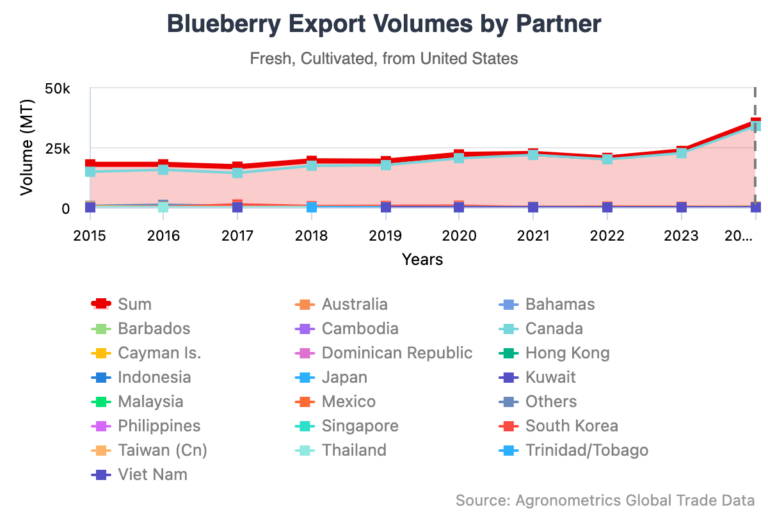
Source: USDA Market News via Agronometrics.
(Agronometrics users can view this chart with live updates here)
Related stories
US blueberries are now cleared for the South African market
Naturipe Farms kicks off Summer with delicious blueberries








Subscribe to our newsletter