Over 4 million boxes checked: Inside the SAG/USDA fresh fruit inspection site in Cabrero, Chile


A new season began at the Inspection Site in Cabrero, Southern Chile. There, the South American country’s Agricultural and Livestock Service (SAG) works in conjunction with the US Department of Agriculture Animal and Plant Health Inspection Service (USDA-APHIS), and local industry brand Frutas de Chile to certify fresh fruit destined for the United States.

“The work carried out by SAG at the site is highly relevant for the export of fruit and horticultural products destined for the United States, since entry into that market requires a prior phytosanitary inspection by our service, which is carried out exclusively at these inspection sites,” said SAG’s Regional Deputy Director, Carolina Contreras.
In these facilities, SAG officials, along with a USDA inspector, verify compliance with phytosanitary and traceability regulations for fresh fruit under the Pre-Shipment Program.
The Cabrero inspection site: The southernmost in the world
This program is a comprehensive agreement signed by SAG, USDA-APHIS, and Frutas de Chile. The document aims to enforce on-site compliance with phytosanitary regulations established by the US market, thus facilitating the entry of Chilean products, including fresh fruit.
Since its opening in January 2017, more than 38 million boxes of fresh fruit and flowers have been certified. Among the most inspected categories, the site mainly deals with blueberries and apples, followed to a lesser extent by cherries, Asian pears, persimmons, onions, peonies, and bulbs.
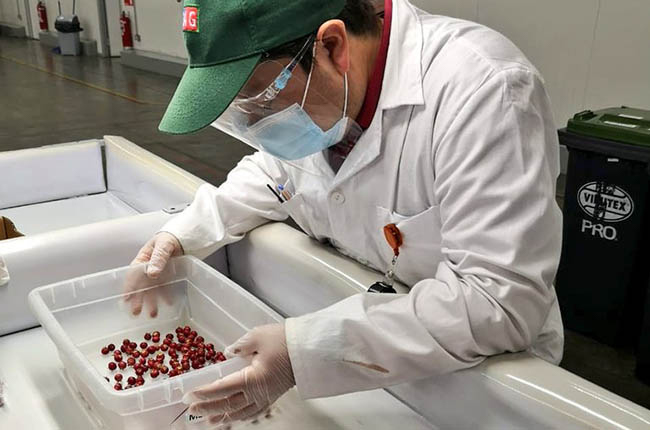
“Frutas de Chile is responsible for administering the Inspection Site and for providing the personnel to carry out the mobilization of the cargo for inspection, thus supporting the export process of our country's fruit sector,” detailed the head of Administration of the Cabrero Site, Rodrigo Nacarate.
The Cabrero Site is one of seven located in Chile and is the southernmost in the world. During the 2024-2025 season, more than four million boxes (equivalent to more than 24,000 tons) were inspected.
Of those, 81 percent corresponded to fresh blueberries, 10.4 percent to apples, 1.5 percent to Asian pears, and 1.2 percent to cherries. The rest responded to categories such as kiwis, tulip bulbs, peonies, and red currants.
*Main photograph SAG.
Related stories
Frutas de Chile President on US Tariff exemptions: 'A pity' key exports were excluded





Subscribe to our newsletter