

Morocco's citrus production is on the rise with mandarins leading exports, USDA says


The US Department of Agriculture (USDA) is forecasting an increase in Morocco’s citrus production during the 2025/26 season.

According to the agency’s latest Citrus Annual report, the upward trend is driven by better climatic conditions, a productive tree cycle resulting in higher fruit yields, and the support of public policies for the sector.
The production of mandarins and tangerines would reach 1.15 million metric tons, the document reads, representing a growth of four percent compared to the previous season.
Meanwhile, orange production will remain steady, with production expected to increase to 970,000 metric tons, representing only a one percent year-on-year increase.

Lemons and limes, on the other hand, are projected to experience year-on-year growth of six percent, reaching 48,000 metric tons.
The American agency says Morocco’s citrus producers have reported a promising season, despite the two-week delay in its start. However, the USDA puts its forecast into perspective, noting that this year’s production remains below the historical peak recorded in 2018/19 and is only slightly above the five-year production average.
Mandarins lead Morocco's citrus exports
Mandarins remain the star of Morocco’s citrus sector.
For the 2025/26 season, shipments are projected at 550,000 metric tons, representing a two-percent increase compared to the last campaign. Growth is driven by greater fruit availability and better calibers, especially sizes 4 and 5.
The European Union and Russia remain the leading destinations for Moroccan mandarins. However, the map is shifting, says the USDA. Exports to West Africa are growing, led by Senegal, Mauritania, and the Ivory Coast. Likewise, the North African country is facing greater competition from Chile during the early export window.
Oranges and juice: stability and increased processing
For oranges, the USDA projects exports will remain stable compared to last season, with shipments at around 85,000 metric tons.

The agency says stalled growth may be due to strong competition from Egypt and Türkiye, two markets that enjoy lower production costs.
For its part, orange juice production is forecast to increase to 6,500 metric tons, thanks to the expansion of processing capacity, which would allow for a continued reduction in concentrate imports.
State support for the sector
The report highlights the government incentives for Morocco's citrus production and export, including subsidies, phytosanitary support, and support for new investments in packaging plants.
The USDA notes that in 2025, the North African administration supported small-scale farmers through dedicated per-hectare aggregation incentives. Per hectare, citrus growers received $225 for small, aggregated areas, $150 for medium-sized areas, and $75 for large areas. Incentives were larger for organic citrus growers, who received $300, $200, and $100 per hectare, respectively.
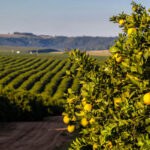
*All images are referential
Related stories
Global blueberry industry 2025 recap: The year of the "Blue Renaissance"
South Africa's orange growers elated over US tariff exemption, but lament the exclusion of mandarins



Subscribe to our newsletter