

Agronometrics in Charts: Nova Scotia wild blueberry harvest plunges 55% after devastating 2025 drought


Each week, the series ‘Agronometrics In Charts’ looks at a different horticultural commodity, focusing on a specific origin or topic, and visualizing trade market factors that are driving change. Check out our entire archive.

Written by Pablo Cortés, from Agronometrics.
Nova Scotia’s wild blueberry industry says it will require additional financial assistance from the provincial government if production is to recover this year, following one of the most damaging droughts in recent years.
Severe dry conditions during the summer of 2025 reduced the province’s wild blueberry crop by approximately 55 percent, according to the Wild Blueberry Producers Association of Nova Scotia (WBPANS). The prolonged lack of rainfall caused berries to shrivel and drop prematurely, leaving large portions of the crop unharvestable.
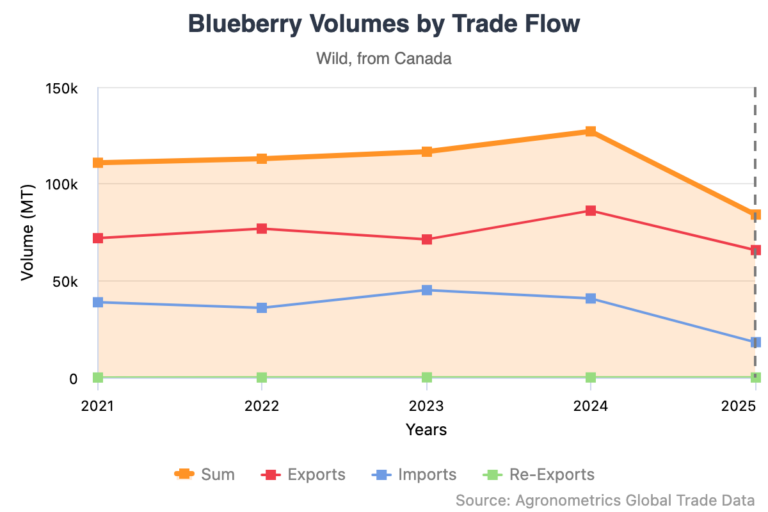
Source: USDA Market News via Agronometrics.
(Agronometrics users can view this chart with live updates here)
Cumberland County and the Parrsboro region were among the hardest hit areas, where drought conditions significantly curtailed yields and contributed to higher prices for wild blueberries. While reduced supply has supported pricing in some markets, the financial strain on growers has been substantial.
“We are still seeing strong demand in Europe and the US, which are our biggest export markets,” says Janette McDonald, Executive Director of WBPANS. “Given those signals, we are hopeful that pricing will stay strong for 2026, but we just need the crop to be there.”
Wild blueberry growers seek relief
The drought has compounded existing challenges for growers who had already invested heavily in production inputs such as pollination services, fuel, fertilizers, and pest management. McDonald notes that even with crop insurance, many farms are facing significant losses.
To help ease the burden, WBPANS waived its levies for growers and contributed $100,000 toward crop insurance premiums. The provincial government matched that contribution, but McDonald says further support is still needed.
“There are some wild blueberry farms that were just so hard hit that, even with crop insurance and stabilization programs, they are still facing major losses,” she adds. “We really would welcome financial support from the government, and we know that’s a difficult request.”
Weather uncertainty remains the industry’s biggest concern heading into the next growing season. While increased moisture in the fall has improved conditions, growers are watching winter weather closely.
“More snow would be great—a nice blanket of insulation,” McDonald says, noting that freeze-thaw cycles could negatively affect plant health and regrowth. “There are still unknowns around what the drought has done to the plants themselves.”
Unlike many cultivated crops, wild blueberries cannot be easily replanted if fields are damaged.
Following major flooding in 2023 and the 2025 drought, long-term planning has become increasingly complex for producers. As a result, the industry is exploring management practices aimed at improving resilience, including mulching, mowing, and alternative field strategies, alongside continued research into plant health and climate adaptation.
“What can we do to really protect the industry and move it forward?” McDonald says. “Those are the questions we’re working through as we assess how repeated weather extremes may shape the future of wild blueberry production in Nova Scotia.”
Related stories
Global Trade Data reveals soaring 2025 import volumes post-shutdown










Subscribe to our newsletter