

Agronometrics in Charts: Peru rains tighten United States mango market, driving prices up

Each week, the series ‘Agronometrics In Charts’ looks at a different horticultural commodity, focusing on a specific origin or topic, and visualizing trade market factors that are driving change. Check out our entire archive.

The United States mango market is entering a more delicate phase of the winter season, as rainfall in northern Peru begins to constrain export volumes and reshape short-term supply expectations.
Recent field reports from growing areas such as Motupe and Piura indicate that persistent February rains have reduced exportable volumes and affected fruit quality. While harvesting and exports have not stopped, sustained humidity has increased phytosanitary pressure, resulting in higher cosmetic staining and lower pack-outs.

Infrastructure remains operational, and shipments to the US continue. However, fewer cartons are meeting export standards, and that reduction is beginning to be felt in destination markets.
Exporters report that some packing houses are closing earlier than expected due to lower throughput. At the same time, reduced availability is lending support to wholesale pricing in both the US and Europe. The current firmness reflects real supply contraction rather than speculative demand.
The data shows just how sharply volumes have shifted this season. After peaking near 81.5 million lbs. in January–February 2024-25, Peruvian shipments to the United States mango market appear materially lower so far in 2025-26, with January volumes trailing well below last year’s highs.
That tightening is already reflected in prices. While 2024/25 saw prices dip close to $0.48/lb. During the peak supply window, 2025/26 prices have remained elevated, holding around $0.66–$0.77 per pound in recent weeks.
In short, lower seasonal throughput from Peru is translating into a firmer price structure compared to last year’s peak-volume period, confirming that the mango market is responding quickly to constrained supply.
Meanwhile, Mexico’s seasonal ramp-up is expected to gradually rebalance supply in the coming weeks. As Peru’s weather-affected window closes, the US market will increasingly depend on Mexican volumes to stabilize availability.
In the near term, the United States mango market appears firm but not overheated, supported by weather-driven supply tightening and steady demand. The trajectory will depend largely on how quickly Mexican shipments scale and whether additional weather disruptions emerge in key producing regions.
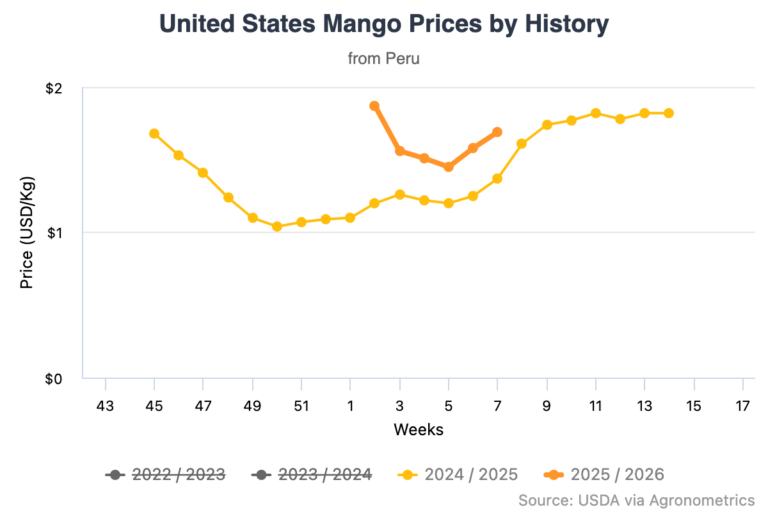
Source: USDA Market News via Agronometrics. (Agronometrics users can view this chart with live updates here)
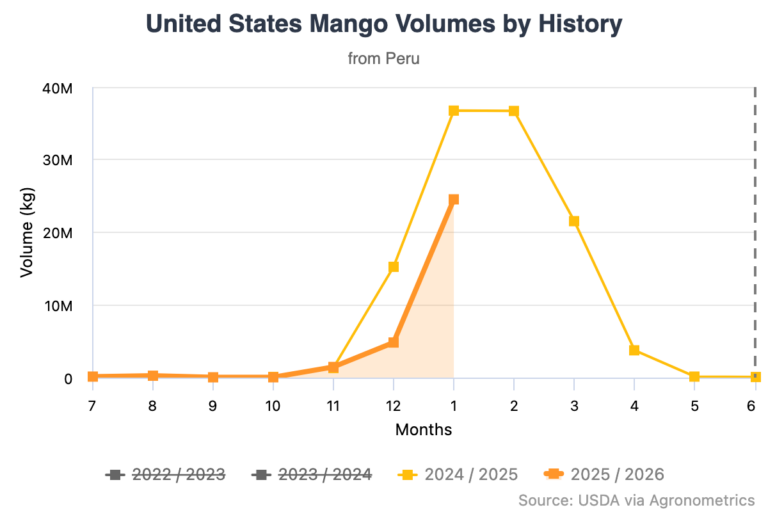
Source: USDA Market News via Agronometrics. (Agronometrics users can view this chart with live updates here)
Related stories
São Paulo mango season ends strong: Volume rebounds despite disease and industrial slump






Subscribe to our newsletter