

Agronometrics in Charts: Peruvian avocado industry navigates massive 38 percent supply surge to secure stable prices

Each week, the series ‘Agronometrics In Charts’ looks at a different horticultural commodity, focusing on a specific origin or topic, and visualizing trade market factors that are driving change. Check out our entire archive.

The Peruvian avocado industry continues to expand, with rising export volumes reflecting both improved productivity and stronger international demand. As shipments grow, industry leaders are increasingly focused on maintaining market balance and ensuring that supply growth aligns with global demand.
Peru exported 722,754 tons of Hass avocados in 2025, representing a 38 percent increase year-on-year, according to trade commission PromPerú. This growth reflects the sector’s continued development and expanding presence in international markets.
Importantly, the increase has not been driven by the rapid expansion of planted area. Instead, industry representatives emphasize that gains have come primarily from productivity and orchard management improvements.
Arturo Medina, general manager of ProHass, noted that the expansion reflects “consistent improvement in productivity, technical management, and commercial planning rather than a substantial rise in surface area.”
In fact, the total area planted with avocados remained relatively stable at 83,529 hectares in 2025, suggesting that higher yields and improved coordination across the industry have been the main drivers of export growth.
Peruvian avocado industry looks to Asia
While Europe remains dominant, Peru has been gradually diversifying its export destinations. Shipments to the United States increased by more than 50 percent, while exports to Asian markets rose nearly 40 percent, reflecting growing demand in countries such as China, Japan, and South Korea. Industry leaders increasingly view Asia as a key long-term growth market.
According to Medina, “Asia is no longer a complementary market, but a strategic growth axis for Peruvian avocado.” Efforts to expand into these markets have included improving phytosanitary standards and adapting logistics to support longer shipping distances. As export volumes increase, industry participants emphasize the importance of coordination across the supply chain to maintain stable market conditions.
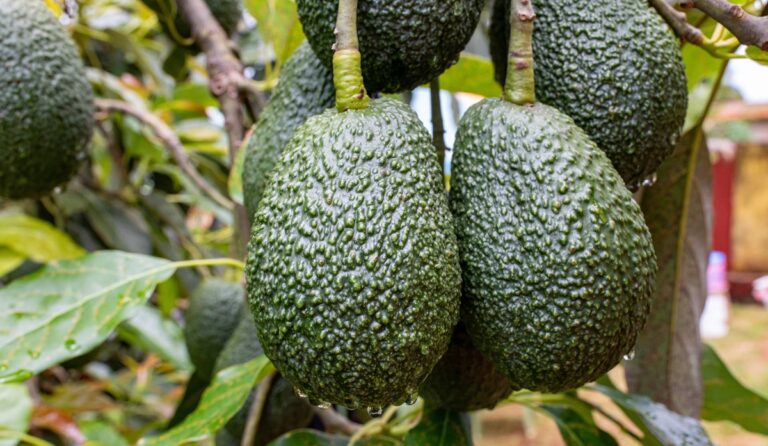
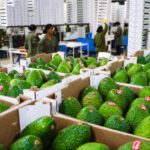
Photo courtesy of ADEX
The increased fruit volume also poses challenges for market planning. "The Hass avocado market is quite strong at the moment, but from mid-March on, effective collaboration with distribution channels will be essential to maintain prices," said Fernando Hidalgo, manager of Cultivemos.
Managing shipment timing and destination diversification will continue to play a key role in maintaining price stability. The Peruvian avocado sector is increasingly characterized by greater coordination, diversified markets, and improved productivity, according to PromPerú. The country’s ability to expand exports while maintaining market stability highlights the industry's growing maturity.
At the same time, balancing supply growth with demand will remain a key priority as production continues to increase in the coming years. For exporters, the focus is shifting from rapid expansion to strategic market management—ensuring that the rising Peruvian avocado supply can be absorbed smoothly across global markets.
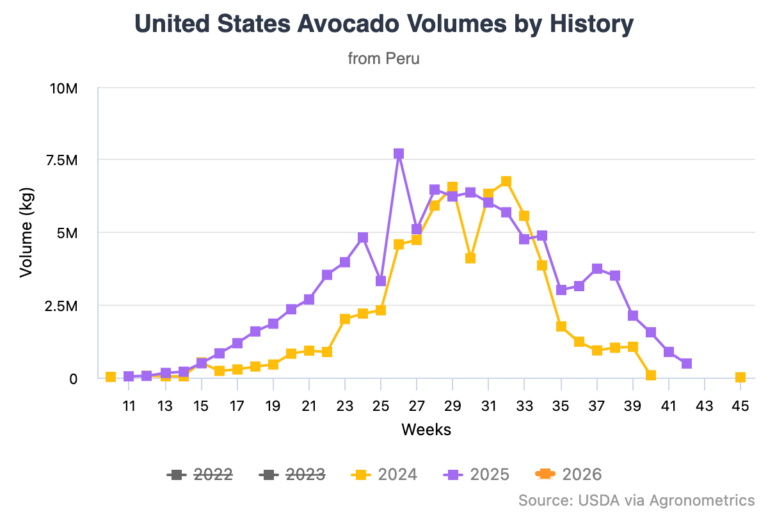
Source: USDA Market News via Agronometrics. (Agronometrics users can view this chart with live updates here)
*All photos are referential.
Related articles
Peruvian avocado industry reinforces national strategy against new cadmium limits
Peruvian avocado industry eyes up to 20 percent growth
Peruvian export boom breaks records, with shipments passing 3 million tons in 2025








Subscribe to our newsletter