








Agronometrics in Charts: Mexican berries secure dominance with projected 4 percent production rise in 2026




Each week, the series ‘Agronometrics In Charts’ looks at a different horticultural commodity, focusing on a specific origin or topic, and visualizing trade market factors that are driving change. Check out our entire archive.

Mexico is on track to strengthen its position as the leading supplier of fresh berries to the United States, with production expected to grow by four percent in 2026.
According to a March 11 report from the US Department of Agriculture’s Global Agricultural Information Network (GAIN), the country’s total output of blueberries, raspberries, blackberries, and strawberries will reach approximately 1.2 million metric tons.
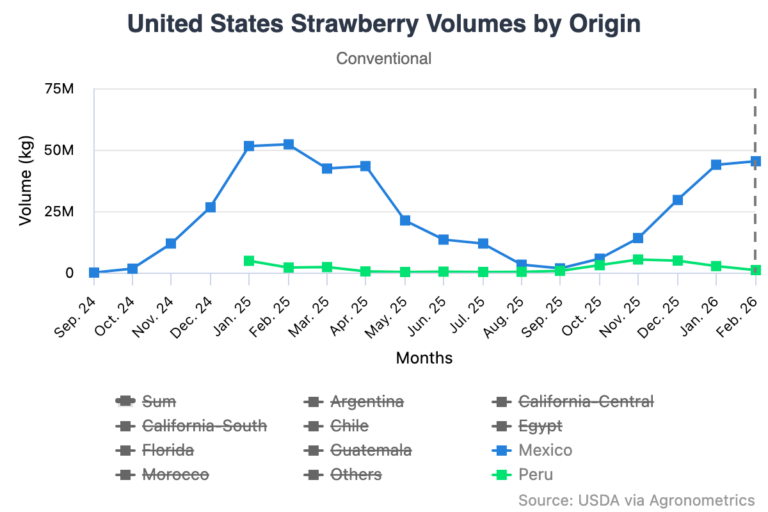
Source: USDA Market News via Agronometrics. (Agronometrics users can view this chart with live updates here)
This steady growth reflects a broader transformation within Mexico’s berry industry. Producers are investing in improved plant varieties, adopting modern cultivation techniques, and refining harvest schedules to better align with high-demand periods in international markets. These changes are not only boosting yields but also helping growers capture premium prices.
At the center of this expansion are key producing states, including Baja California, Sinaloa, Jalisco, and Michoacán. The San Quintín region in Baja California stands out as a major contributor. In 2025 alone, it produced more than 112,000 metric tons of strawberries, second only to Michoacán, which remains the country’s top producer.
Strawberries continue to dominate Mexico’s berry sector, accounting for 54 percent of total production. However, blueberries are emerging as a fast-growing segment. Mexican growers are increasingly targeting premium export windows, particularly in the spring, when competition from countries like Peru is lower in the US market.
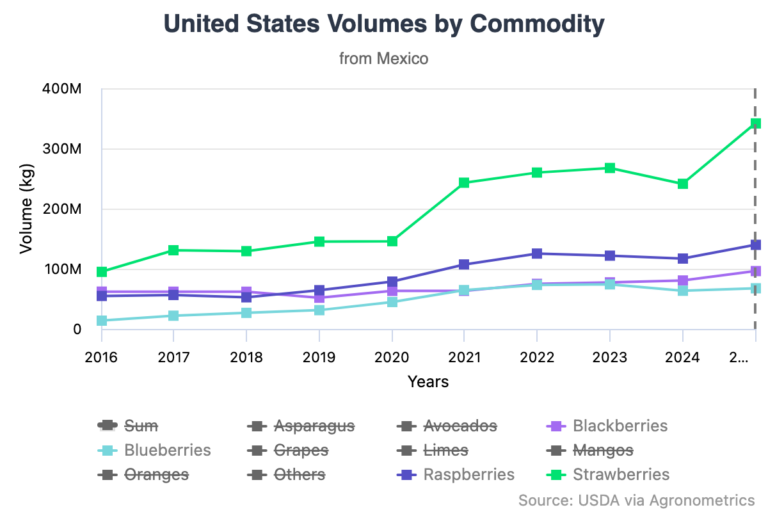
Source: USDA Market News via Agronometrics. (Agronometrics users can view this chart with live updates here)
Seasonality also plays a key role in the industry. Berry production in Mexico is concentrated in two main periods: from late winter to early summer (January through June), and again in late autumn (November to December). Output typically declines during the summer months, when supplies reach their lowest levels of the year.
Despite strong growth prospects, the sector remains vulnerable to environmental pressures. Climate conditions, especially water availability, continue to shape production outcomes. Prolonged drought across northern and northwestern regions during 2024 and early 2025 led to tighter irrigation controls and increased competition for water resources.
Relief came in mid-2025, when improved rainfall helped replenish reservoirs and ease drought conditions heading into 2026. Even so, producers are not taking risks lightly. Many are investing in more efficient irrigation systems, protected agriculture, and drought-resistant crop varieties to safeguard future output.
With these efforts in place, Mexico is well-positioned to maintain its dominance in the US berry market. The combination of strategic investment, favorable timing, and adaptive farming practices continues to drive the industry forward, ensuring that growth remains both steady and sustainable.
*All images are referential.
Related articles:
Blueberries and raspberries drive Mexico’s berry production expansion
Red raspberries may help cognitive and metabolic health
Florida's $3.1 billion freeze damage: Citrus, berries, and sugarcane face massive losses








Subscribe to our newsletter