

Agronometrics in Charts: Strait of Hormuz disruption sends fertilizer prices skyrocketing 30 percent


Each week, the series ‘Agronometrics In Charts’ looks at a different horticultural commodity, focusing on a specific origin or topic, and visualizing trade market factors that are driving change. Check out our entire archive.

Global fertilizer flows have tightened sharply following disruptions in the Strait of Hormuz, a key route for nitrogen and sulfur exports critical to agricultural production.
The closure of the passage has halted close to half of global urea exports, pushing prices up by nearly 30 percent in recent weeks.
Nitrogen fertilizers like urea are applied just before planting, leaving farmers with little room to delay or adapt.

“If you had sat us down before and said, ‘What’s the nightmare scenario?’ it would be this exact event during this exact time of year,” Josh Linville, global fertilizer supervisor at American financial services company, StoneX, told National Public Radio.
The disruption is spreading across the supply chain. Production depends heavily on natural gas, and several major producers, including India, Pakistan, and China, are facing constraints as gas supplies tighten. At the same time, sulfur exports, critical for phosphate fertilizers, have also been disrupted, compounding the pressure on global fertilizer availability.
Even countries with strong domestic production remain exposed. According to Farm Bureau data, the United States imports roughly 18 percent of its nitrogen fertilizer to meet seasonal demand and is expected to face a shortfall of around two million tons of urea this spring.
With supply uncertain and costs rising, farmers are being forced into difficult decisions. Some may shift away from fertilizer-intensive crops toward alternatives, while others may scale back planting altogether.
“There aren’t a lot of easy answers to this problem,” Veronica Nigh, chief economist at the Fertilizer Institute, told NPR.
Fertilizer shortage is not a short-term problem
Even if trade flows resume, recovery is expected to take time. Fertilizer production operates with limited spare capacity, and rebuilding supply chains could take months.
The broader implications extend beyond agriculture. Fertilizer is a foundational input in food production, and disruptions at this scale increase the risk of lower yields and tighter food availability in the months ahead.
While food insecurity is often associated with food imports, it is also closely tied to access to essential agricultural inputs. The disruption is also driving up transport and trade costs.
Freight rates for oil tankers have risen by more than 90 percent since late February. Bunker fuel prices have nearly doubled, while war risk insurance premiums have surged, with some insurers withdrawing coverage altogether for vessels operating in the Persian Gulf.
As a result, shipowners are being forced either to suspend transits or absorb sharply higher insurance costs, with premiums rising several times over for each voyage. These higher transport and insurance costs are feeding through to fertilizer prices and, in turn, to agricultural production and exports.
According to the United Nations, higher fertilizer costs influence planting decisions, including crop choice and total area planted, and affect input use and yields, with impacts materializing over time.
The current situation illustrates how disruptions linked to the conflict can transmit across interconnected commodity markets. Energy, fertilizers, and food are closely linked through production and trade, meaning constraints in one area can quickly affect others, with implications for food security, trade, and development outcomes.
The scale of these effects will depend on how long disruptions persist. Current trends point to increasing pressure across commodity markets and supply chains.
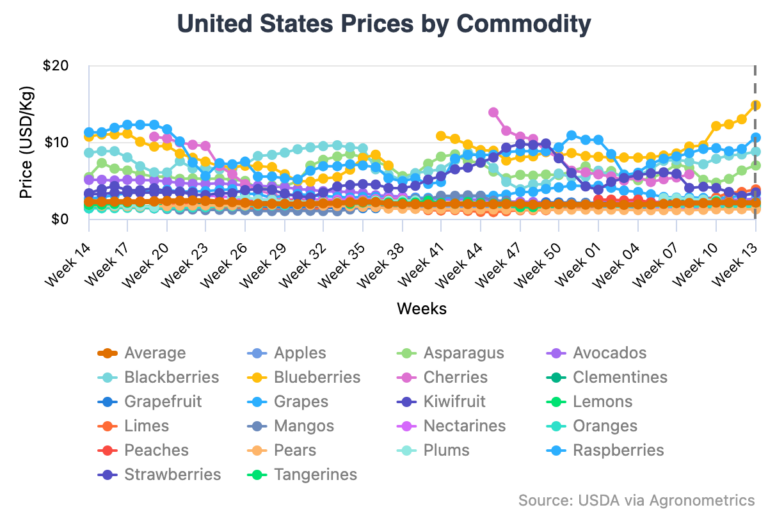
Source: USDA Market News via Agronometrics. (Agronometrics users can view this chart with live updates here)
Related articles:
FAO warns of severe global food security risks from disruption to Strait of Hormuz





Subscribe to our newsletter