








New robotic strawberry harvester hopes to address labor shortages



With a global market valued at about $20 billion, the world’s appetite for strawberries continues to grow at a juicy six percent CAGR rate. However, the sector faces multiple struggles, with water and labor shortages weighing down on producers.


Robotic harvesting has long been studied as an alternative, but the challenge for these machines lies in identifying lower-hanging or “hidden” berries. A new approach developed by researchers at Washington State University seeks to address these hurdles.
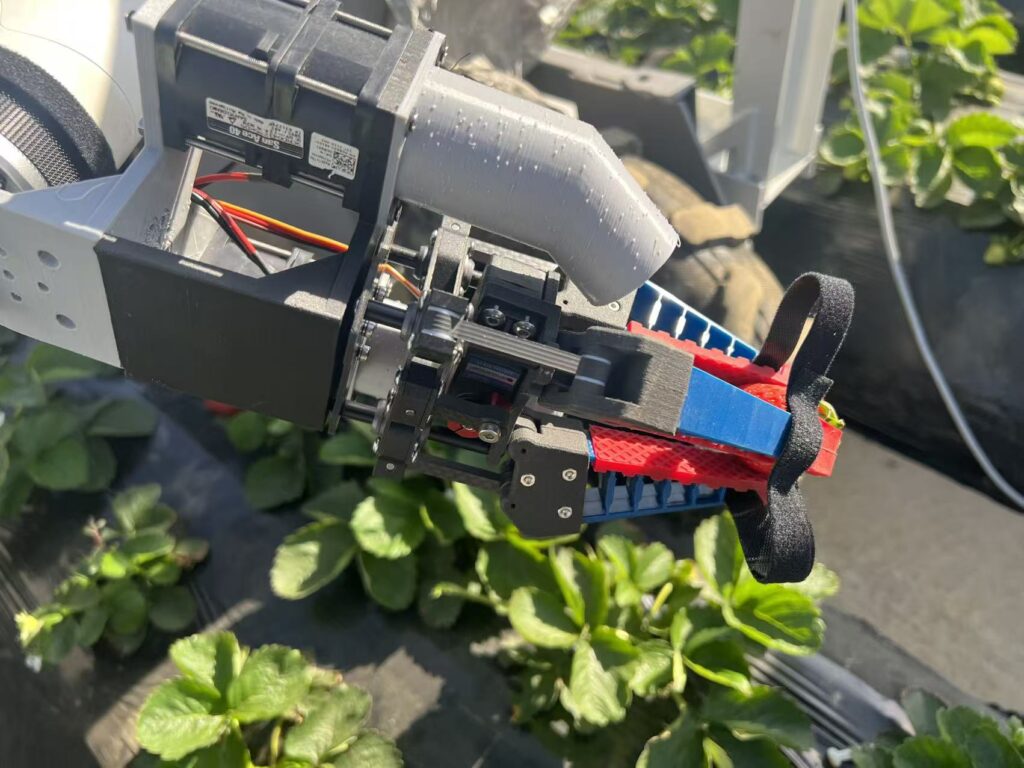
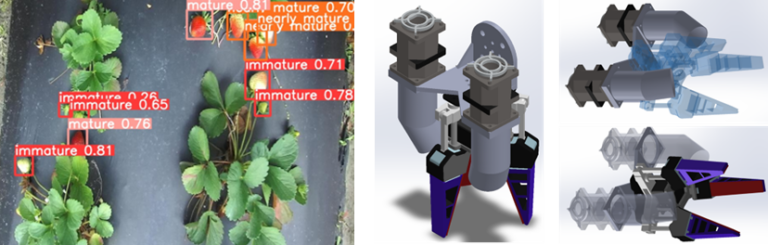
The new robotic strawberry harvester uses a combination of sensors as its “eyes,” AI models that serve as the “brain,” and mechanical arms. Cameras identify and locate ripe strawberries, and the robotic arms gently pick the fruit, pulling and twisting it from the vine, then depositing it into containers.
The study was published in July in Computers and Electronics in Agriculture. Lead author Zixuan He conducted the research while at the WSU Department of Biological Systems Engineering and is now a postdoctoral researcher at Aarhus University in Denmark. Co-authors include Manoj Karkee, currently at Cornell University with an adjunct role at WSU, and Qin Zhang, professor emeritus at WSU.
“As researchers, we focus on functionality and efficiency, and when it comes to robotic picking, those terms translate into: Can I pick most of the fruit? Can I pick in different kinds of planting systems? And then, how quickly can I pick individual fruit?” Karkee tells FreshFruitPortal.com.
One innovative feature being developed involves using air assistance in the form of fans to expose strawberries and improve visibility and accessibility for the robotic picker.
“Initial tests show that this can boost success rates by 10 to 15 percent,” Karkee reports.
Farming in the age of AI
The advent of AI-driven harvesting machines raises questions about job displacement within the industry. However, Karkee feels differently.
“This technology is about filling the labor gap and ensuring safer working conditions," he says. "It’s not about replacing people but alleviating the industry's reliance on vulnerable, physically demanding jobs.”
“Farmers face significant challenges in recruiting enough workers for harvesting, planting, and other labor-intensive tasks,” he adds. “Our technology aims to fill this gap while reducing the risks associated with manual labor, such as injuries and exposure to toxic chemicals.”
Indeed, farm labor shortages continue to be a critical issue worldwide, exacerbated by the hazardous and physically demanding nature of jobs that involve pesticide application, climbing ladders, or working in extreme weather conditions.
Potential for refinement
The research team has successfully demonstrated prototype systems capable of harvesting a significant percentage of strawberries, although Karkee notes that there is room for improvement.
"Currently, our robots can pick about 70 to 80 percent of the fruit in a field, with the goal to push that closer to between 90 and 95 percent," he says.
Additionally, the team is working to accelerate the picking speed from over 10 seconds per fruit to just a few seconds, significantly boosting productivity.
The team is now exploring optimal configurations of the air assistance aspect of the robot, including size, placement, and airflow patterns, as part of a forthcoming USDA-funded project.
“We’re writing a grant proposal to the USDA to develop a grid of small fans and further optimize airflow and robotic speed. Once funded, we expect to begin real-world testing and validation in the coming months.”
*All photos courtesy of Zixuan He.
Related articles
Triple-digit heat hits lettuce, broccoli, and strawberry harvests in California







Subscribe to our newsletter