








Cherry market prices fall from grace as imports surge ahead of Lunar New Year
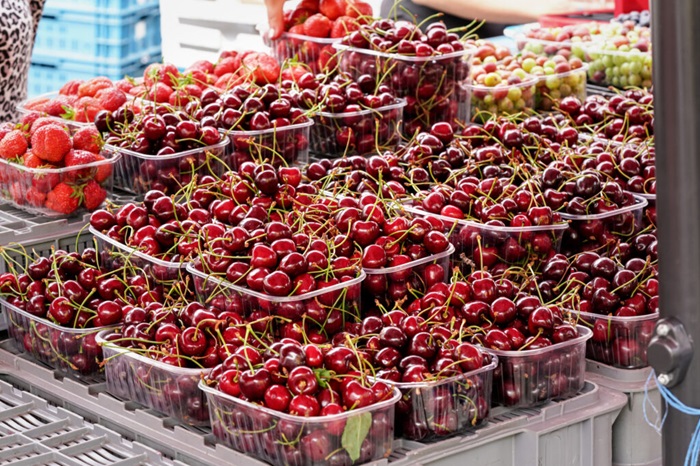



The Chinese cherry market is looking at a changing landscape, as imported prices in key Chinese wholesale and retail markets have dropped sharply ahead of the Lunar New Year.


In Xuchang, a major inland consumption market, retail prices for premium cherries fell more than 50 percent from early-season levels by late January, local news outlet Xuchang Morning Post reports.
Similarly, in the port city of Qingdao, wholesalers reported prices about 20 percent lower year-on-year, according to LangJing News, with sales volumes rising sharply as the holiday approaches.
Supply surge reshapes the cherry market
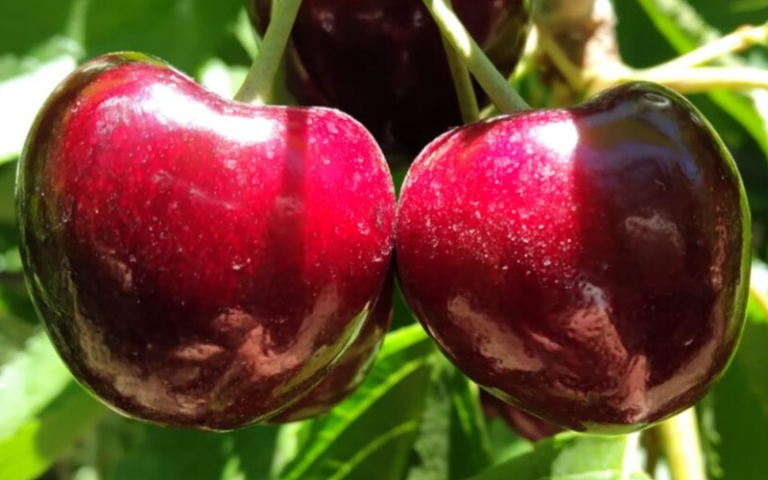
On January 28, supermarkets and fruit shops in Xuchang were selling JJ and JJJ caliber cherries for less than 27 yuan (about $4) per pound compared with earlier prices of 45 to 91 yuan per pound (about $7 to $13).
JJ and JJJ calibers are among the largest sizes in the cherry market, usually measuring between 28-30 mm and 30-32 mm, respectively.
Some retailers priced cherries as low as 18 yuan ($2.60) per pound, effectively ending what local media described as the era of selling cherries “by the piece.”
“A 5.5-pound box of JJ cherries for 99 yuan, and a box of JJJ for 128 yuan ($18.46). They’re bigger, plumper, and incredibly sweet. Perfect for stocking up for yourself or as gifts for family and friends,” said a staff member at a local fruit shop, adding that sales had increased following the price drop.
The Chilean cherry sector experienced a production surge this season, reaching about 655,000 metric tons, with more than 90 percent shipped to China.
Additionally, expanded ocean freight capacity, higher shipping efficiency, and more advanced cold-chain technology reduced per-unit transportation costs, allowing cherry market prices to fall rapidly as volumes arrived.
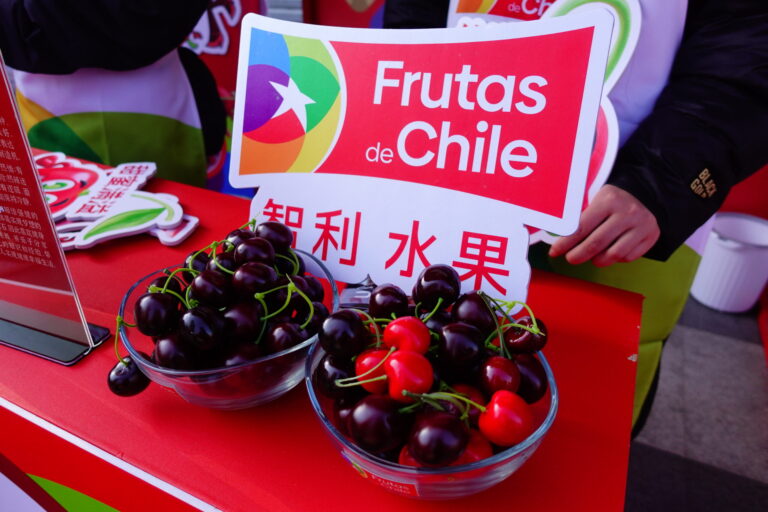
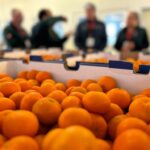
Photo courtesy of Frutas de Chile.
Qingdao volumes rise as prices ease
At Qingdao Dongfang Dingxin International Agricultural and Sideline Products Trading Center—the largest fruit wholesale market in Shandong Province—traders reported brisk activity in the cherry market section, with products mainly from Chile and New Zealand.
“Single J Lapins cherries are priced at around 80 to 90 yuan ($11.54 to $12.98) for a five-in-box, while premium 3J and 4J Lapins can go for 230 to 240 yuan ($33.17 to $34.61). This year’s sales have increased by 30 percent to 50 percent compared to last year,” said Wang Haitao, a merchant at the cherry market. A five-in-box equals about 5.5 pounds.
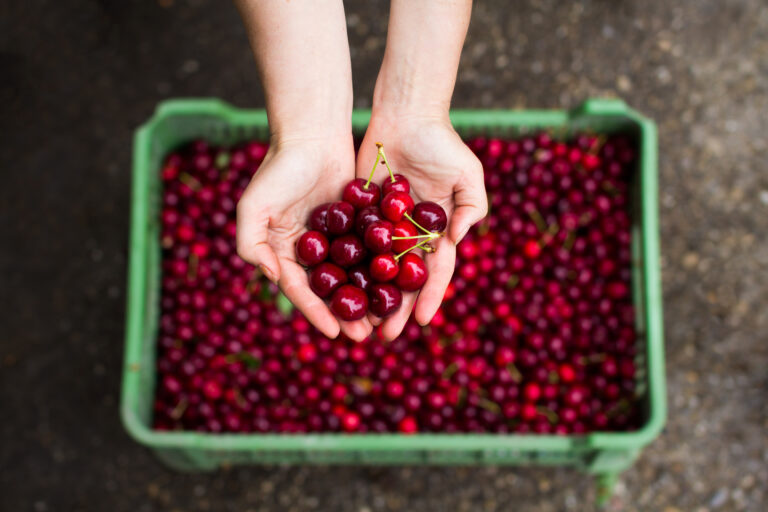
Another merchant, Xie Qin, said throughput had reached industrial scale. “We can sell three to four container loads a day, with each container weighing over 20 tons, totaling about 100 tons,” she said.
The ample supply has drawn buyers from the surrounding regions of the cherry market. “I came from Yantai and bought three to four pallets of cherries today, about four to five tons. They’ll likely sell out in three to four days,” said buyer Li Youshui.
Chilean cherries arrive mainly by sea to ensure volume availability, while New Zealand cherries move largely by air to preserve freshness, traders said. The diversified logistics mix has supported a steady supply through the peak holiday window.
Logistics at the service of the cherry market
The broader imported fruit category has also benefited from transportation improvements. In addition to cherries, durians have remained strong sellers ahead of the holiday. A new direct air cargo route from Qingdao to Bangkok now complements existing land and sea routes.
“Now, with the addition of air transport, along with land and sea transport, the logistics channels are more diverse. We sell about half a container of durians a day, roughly 10 tons,” said market merchant Jiang Jinsheng.
Market management said it began preparing for the seasonal surge weeks in advance.
“Before the peak season arrived, we led merchants to visit growers and cooperatives in key production areas, including apple and pear regions in Xinjiang, as well as Southeast Asian countries like Thailand and Vietnam,” said Yuan Ming, manager at the Qingdao Trading Center.
Customs authorities also streamlined clearance procedures.
“We have established a ‘green channel’ for the declaration and inspection of imported fruits, implementing a clearance model of ‘priority declaration, priority inspection, and priority release,’” said Hao Ruoxian, an inspector with Jimo Customs under Qingdao Customs, adding that average clearance times have dropped by more than 30 percent.
Related stories
Why Chilean cherries might need more than good quality to thrive in China this season
Beyond China: Chilean cherries arrive in the US and Europe amid market expansion
Agronometrics in Charts: Chile's cherry season expects smaller yield but better fruit






Subscribe to our newsletter