Agronometrics in Charts: El Niño could push Peru's agricultural export losses to $1.5B

 Add Fresh Fruit Portal to Google
Each week, the series ‘Agronometrics In Charts’ examines a different horticultural commodity, focusing on a specific origin or topic and visualizing the trade market factors driving change. Check out our entire archive.
A severe El Niño is now the most likely outlook for Peru's 2026-27 summer season (December to March), and a new analysis indicates the country's farm exporters will face the heaviest losses in 2027. Preciso Consultoría estimates that Peru's 20 leading agricultural exports, which made up 86 percent of the sector in 2025, could lose 969,000 tons and $1.498 billion in FOB value across 2026 and 2027 compared with a scenario without the phenomenon.
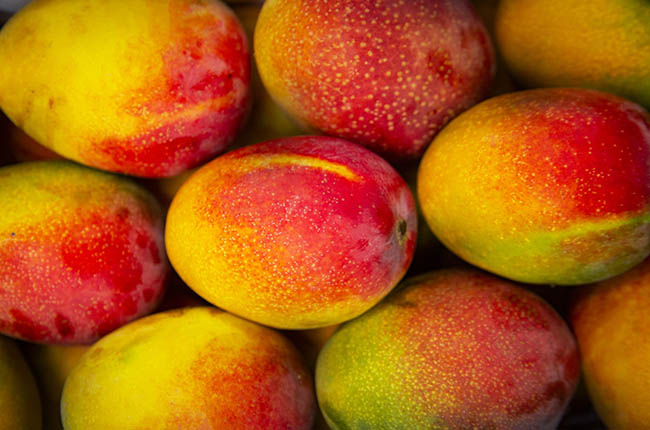
Image is referential via Shutterstock.
Top 20 export volumes are projected to be seven percent below the no-El Niño scenario in 2026 and 14 percent below in 2027. The damage peaks in the second year for two reasons: crops that flowered under this year's heat will be harvested in 2027, and the November–April rains are expected to add disease and logistical disruption. Export value in 2027 would reach about $11.3 billion, versus $12.4 billion without the event. Prices are projected to rise from $2.61 to $2.75 per kilogram (2.2 lbs.), offsetting only part of the drop and still leaving value nine percent below the no-El Niño scenario.
Heat-sensitive crops are hit hardest. PROMANGO estimates mango production at just 178,595 tons against a normal 557,440, and the report projects mango volumes 49 percent below trend in 2027.
Table grapes are projected to be four percent below trend in 2027, with Piura far more exposed to rain than Ica.
El Niño is usually associated with heavy rain and flooding on Peru's northern coast, and that region is projected to lose $458 million in export value in 2027. But most of the damage will happen elsewhere. The rest of the country is projected to lose $639 million, or 58 percent of the total, mainly from extreme heat and drought rather than rain.
The report identifies 2027 as the critical year and concludes that higher prices will not offset the lost volume.
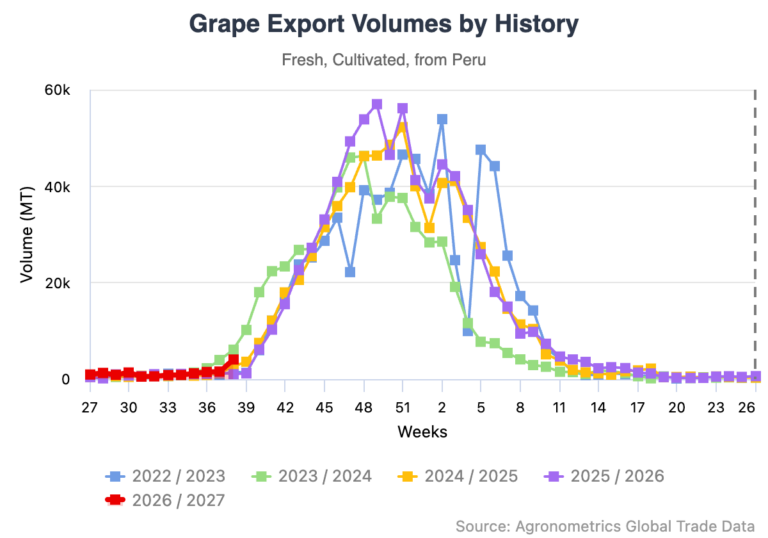
Source: USDA Market News via Agronometrics.
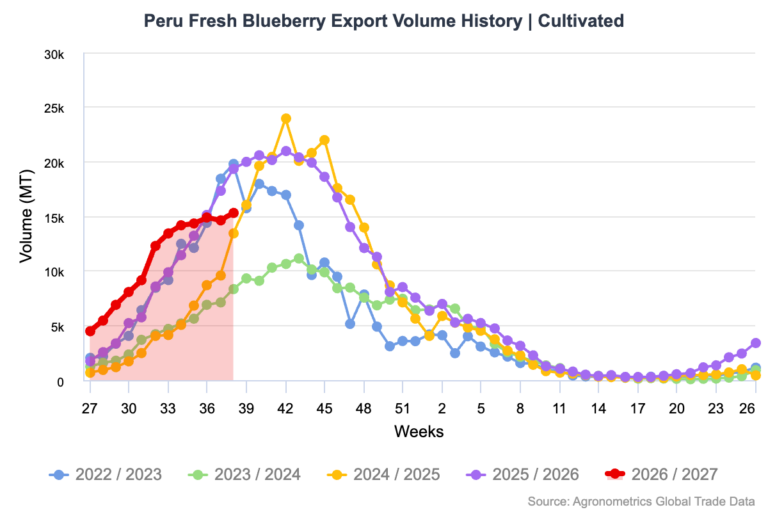 Source: USDA Market News via Agronometrics.
*Main photo is referential via Shutterstock | Graphs courtesy of Agronometrics
Related stories