


Each week, the series ‘Agronometrics In Charts’ examines a different horticultural commodity, focusing on a specific origin or topic and visualizing the trade market factors driving change. Check out our entire archive.
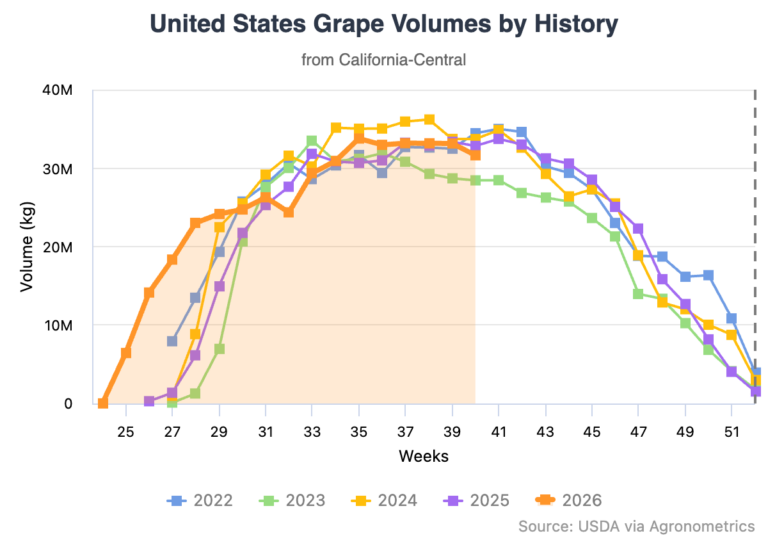
California's grape harvest as a whole keeps getting smaller, but table grapes are moving the other way. The USDA's National Agricultural Statistics Service (NASS) forecasts California table-type grape production at 1.15 million tons in 2026. That is 10 percent more than the 1.05 million tons harvested in 2025 and 13 percent above the 2022–24 average of 1.02 million tons.
This would be the third straight year of higher table grape output, rebuilding from a weak 2023. That August, the remnants of Hurricane Hilary hit the harvest and pushed production below 1 million tons for the first time since 2009. The recovery is not complete: the 2026 forecast is still about 12 percent below the 2018 peak of 1.3 million tons.
Over the longer run, table grapes have been the most stable part of the California crop. Since 2010, volumes have mostly stayed between 1.0 and 1.3 million tons. Over the same period, total California grape production has fallen 40 percent from its 2013 peak, mainly because growers are producing less wine-type and raisin-type fruit for processing. Table grapes therefore make up a growing share of the state's crop, about a quarter of the 2026 total.
Most of this fruit goes to the fresh market. If the fresh-market share matches last year's 84 percent, about 964,000 tons of the 2026 crop would be sold fresh. That is a meaningful increase in domestic supply heading into the California season.
Source: USDA Market News via Agronometrics.
 Source: USDA Market News via Agronometrics.
Graph courtesy of Agronometrics | Top image by Shutterstock.
Related stories
Agronometrics in Charts: 2026 retail food prices hold steady as farm-level returns weaken