


Agronometrics in Charts: An abnormal season in Peru
 Add Fresh Fruit Portal to Google
Each week, the series ‘Agronometrics In Charts’ examines a different horticultural commodity, focusing on a specific origin or topic and visualizing the trade market factors driving change. Check out our entire archive.
Analysis by Diego Bustos of Rupestris Consulting
Rainfall in the north, earlier harvests in the south, and increasing climatic pressures toward the end of October are shaping a season full of challenges, but also opportunities.
To date, export volume trends closely resemble those observed during the 2023/24 season, with shipments progressing rapidly. However, much remains to be seen regarding Piura's performance during the final stages of harvest, particularly in terms of fruit condition following the recent rainfall.
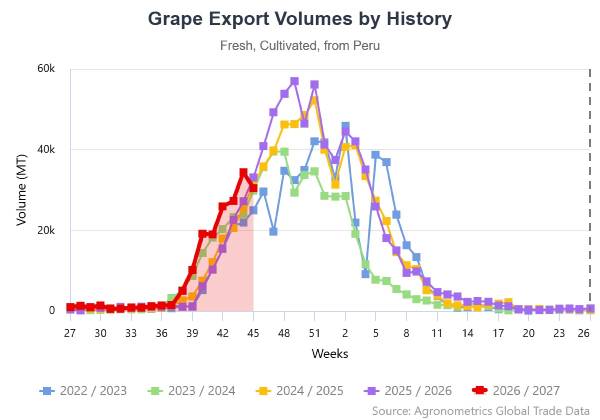
Source: Agronometrics Global Trade Data | Link
But Piura is not the only region to watch.
Ica, which accounts for nearly 50 percent of Peru's planted area, is running between 15 and 20 days ahead of schedule, depending on the location, driven by higher temperatures associated with El Niño.
This means we need to pay close attention to developments from week 46 onward, when the supply windows of Piura and Ica have historically overlapped.
The US remains an important market for Peru
Looking at destination markets, we see a clear preference for the United States, a geographically closer market (an important factor in preserving fruit condition), despite cold storage inventories remaining at levels similar to those recorded last year: 11,320,436 boxes recorded in October 31, 2026, versus 11,256,202 boxes recorded on the same day in 2025.
Interestingly, cold storage inventories declined by nearly 1.5 million boxes between October 15 and October 31 this year.
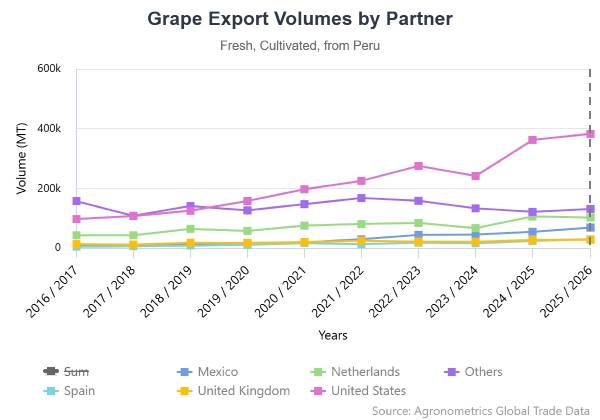
Source: Agronometrics Global Trade Data | Link
This is particularly relevant for Chile, which typically begins shipping significant volumes to the United States from week 5 onward, mainly from the northern growing regions of Atacama and Coquimbo. However, Chilean supply could also arrive earlier than usual due to the influence of El Niño.
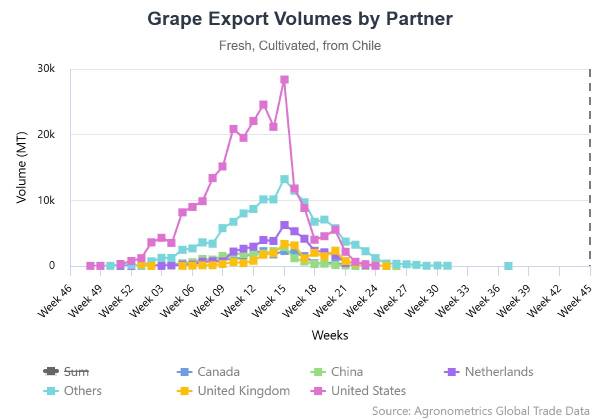
Source: Agronometrics Global Trade Data | Link
Traditionally, the transition between Peruvian and Chilean grape imports takes place in February. This season, everything suggest that this transition could occur earlier.
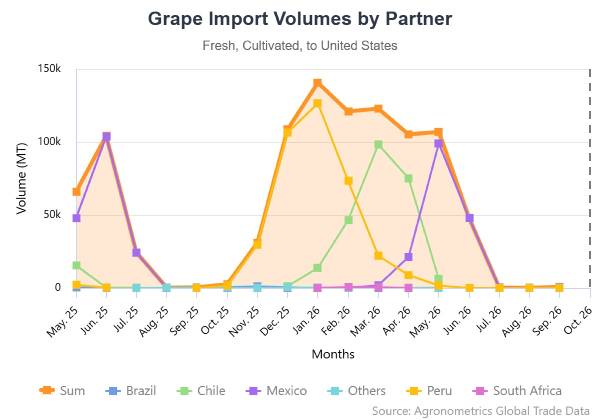
Source: Agronometrics Global Trade Data | Link
This is definitely a season worth watching closely.
There is still a lot to unfold, from harvest timing to increasing phytosanitary pressure and its potential impact on fruit condition.
*All graphs courtesy of Agronometrics
Related stories
El Niño could push Peru's agricultural export losses to $1.5B
Weather hits Peruvian blueberries hard: Export forecast falls over 20 percent year on year