



Three trends shaping the global blueberry outlook

 Add Fresh Fruit Portal to Google
As global blueberry production continues to expand, industry growth can no longer rely on supply availability alone, says RaboResearch in a recent November report.
While the sector retains significant consumption potential across both mature and emerging markets, growing volumes across the board have made it imperative to continue to capture growth.
To do that, the firm says it must diversify destination markets, deliver consistent eating quality at accessible price points, and capitalize on rising consumer awareness.
Global demand is becoming more diversified
North America and Europe remain the world’s largest blueberry destination markets, underpinned by established retail programs, year-round supply, and high consumer familiarity.
However, RaboResearch notes that the global import landscape is steadily shifting as other regions expand at a faster pace.
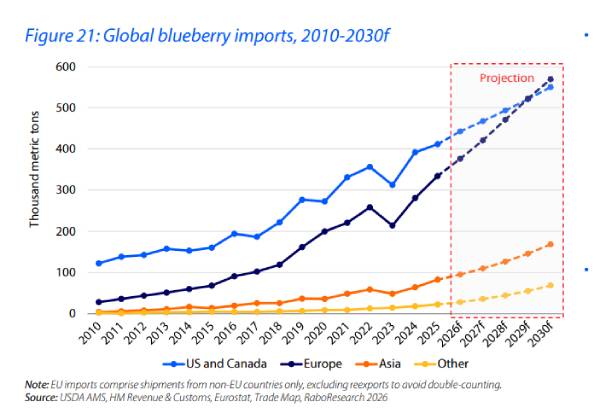
While import volumes into the US and Canada continue to grow, their combined share of global fresh blueberry imports is projected to fall from roughly 48 percent in 2025 to 41 percent by 2030. Over the same period, Europe could overtake North America as the largest importing region. Meanwhile, Asia and other emerging markets are projected to boost their combined share of global imports from approximately 12 percent to 17 percent.
For exporters, this diversification reduces reliance on single destinations, though unlocking growth outside traditional markets will require targeted investments in distribution, market access, consumer awareness, and affordable pricing.
Future growth depends on value and repeat purchases
In the US, blueberries have been the fastest-growing major fresh-fruit category by per capita availability. Combined fresh and frozen retail sales hit a record $3.8 billion in 2025, with fresh dollar sales outpacing the broader produce department.
Yet, per capita availability still trails established fruits, leaving substantial room for expansion.
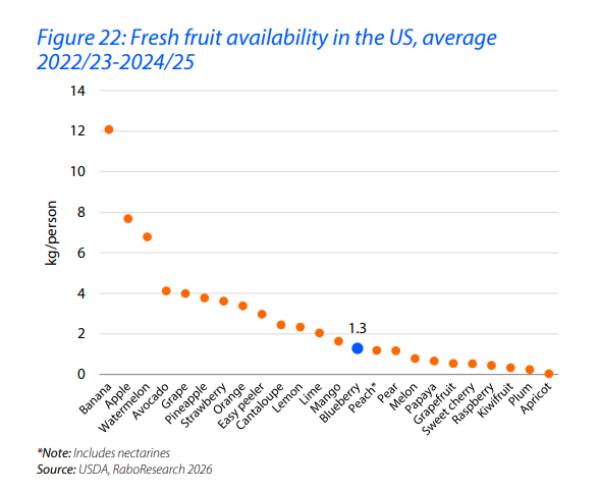
Because consumers already recognize the fruit's health benefits, RaboResearch emphasizes that the next phase of growth hinges on increasing household penetration, purchase frequency, and eating occasions. Pricing and quality are decisive factors: with a negative demand elasticity in the US, sustained price hikes risk triggering a nearly proportional drop in blueberry sales volumes.
Absorbing rising global volumes will therefore depend on offering consistent flavor and freshness, convenient formats, and larger value packs.
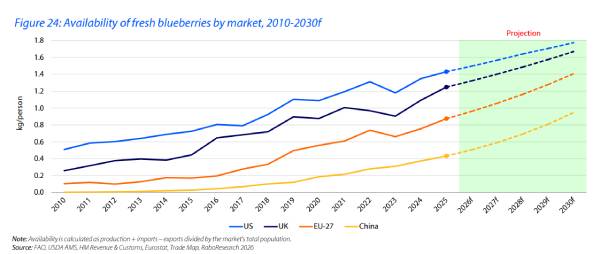
Similarly, low per capita availability in the EU and China highlights vast growth headroom, provided suppliers tailor packaging, pricing, and promotions to local consumers.
Online interest in blueberries is growing
Digital search trends offer further insight into future market potential.
According to Google Trends data analyzed by RaboResearch, online search interest for blueberries has grown steadily between 2021 and 2026 across English-, Spanish-, Portuguese-, and Italian-speaking markets.
Spanish-language search interest has expanded particularly fast and exhibits less seasonality than searches in English, French, or Italian. Given that several Spanish-speaking nations are major blueberry producers and exporters, this trend points to promising opportunities for boosting domestic consumption and regional trade.
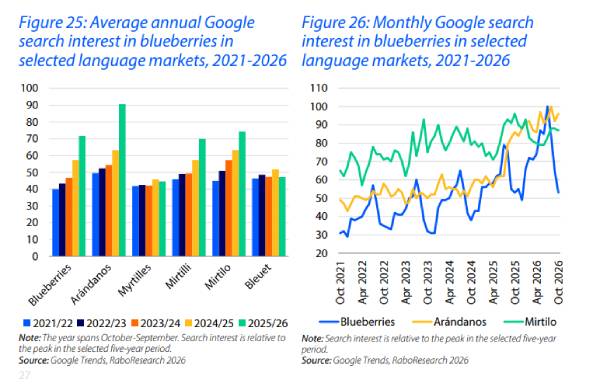
Conversely, online interest in French-speaking markets has remained relatively flat, aligning with France's low apparent consumption of 0.2 kg per capita compared to the EU average of 0.8 kg.
Finally, despite year-round retail availability in most markets, consumer search interest continues to peak during local harvest seasons, most notably in English-speaking North America.
*All graphs courtesy of Rabobank | Images are referential
Related stories
Weather hits Peruvian blueberries hard: Export forecast falls over 20 percent year on year