
USDA's next-gen apple robot targets 80 percent picking rate
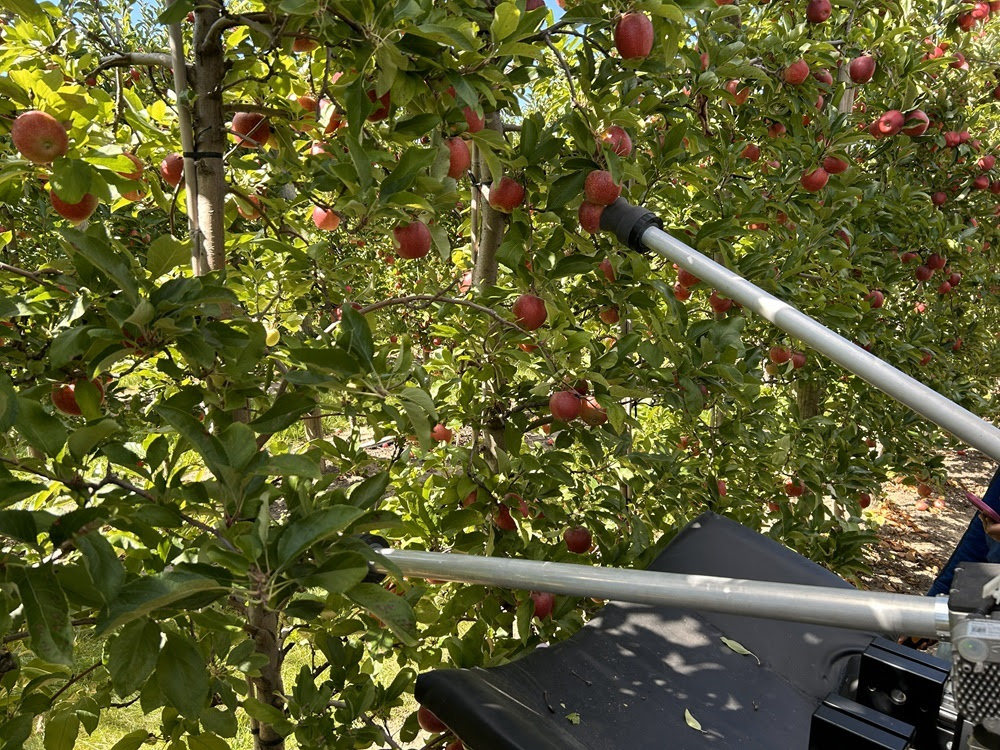

United States apple growers facing tight labor costs may soon have a new tool in the orchard: a harvesting robot that not only picks the fruit, but also sorts it in the field and works through high-density planting at a commercial scale.

Researchers at the USDA’s Agricultural Research Service (ARS) say recent trials show their dual-arm apple harvesting system marks a step forward in efforts to automate one of the most labor-intensive tasks in the country’s apple production.
Lead researcher Renfu Lu tells FreshFruitPortal.com the work is driven by structural challenges commonly faced by growers.
“We started our current project five or six years ago in response to the growth needs for reducing labor shortage, and the rising production costs,” he explains.
The project is funded under a USDA national program and later received support from the agency's National Institute of Food and Agriculture (NIFA) Specialty Crop Research Initiative. The effort also includes two undisclosed commercial companies and extensive field testing.
Two arms are better than one
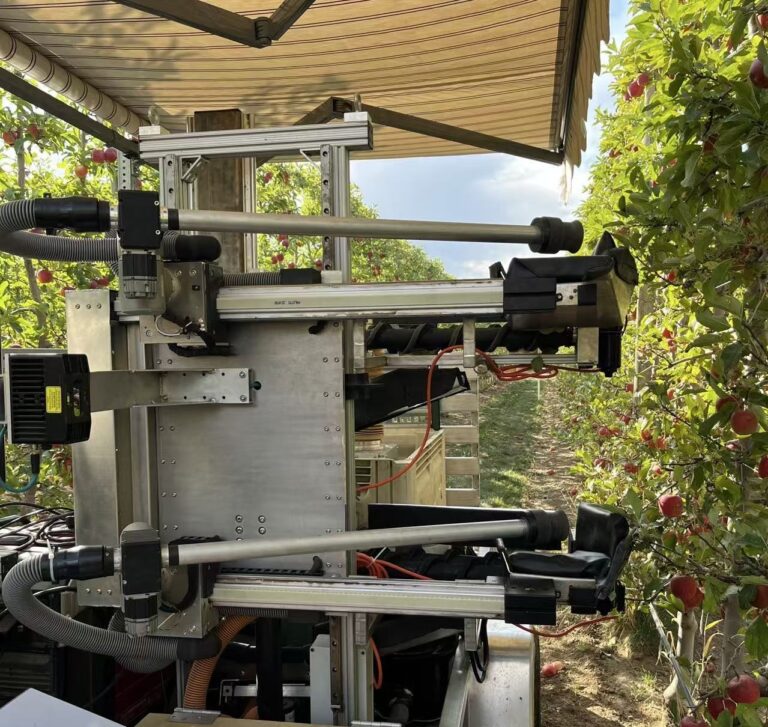
Early development focused on a single-arm harvesting robot paired with a vision system. Grower feedback, however, prompted the research team to adopt a more scalable design.
“Many growers came to me and said, ‘Well, it would be great if we could really integrate robotic harvesting with the in-field sorting to achieve the full harvest automation,’” Lu says.
The current system uses a modular design with two robotic arms sharing a single perception sensor. The robot relies on a vacuum-based manipulator to detach apples, a method Lu says helps reduce fruit damage while improving performance in clustered canopies.
According to the researcher, the team measures performance using three key metrics: successful picking rate, harvesting speed, and fruit quality. The latter refers to the potential damage caused by the robot when retrieving the apples. Field comparisons showed the dual-arm robot improved picking speed by 34 percent over the single-arm version.
The device currently averages four to five seconds per fruit picked, which Lu’s team expects to cut to two to three seconds per apple. That milestone would put robotic harvesting closer to human picking speed when breaks and handling time are considered.
Orchard architecture matters
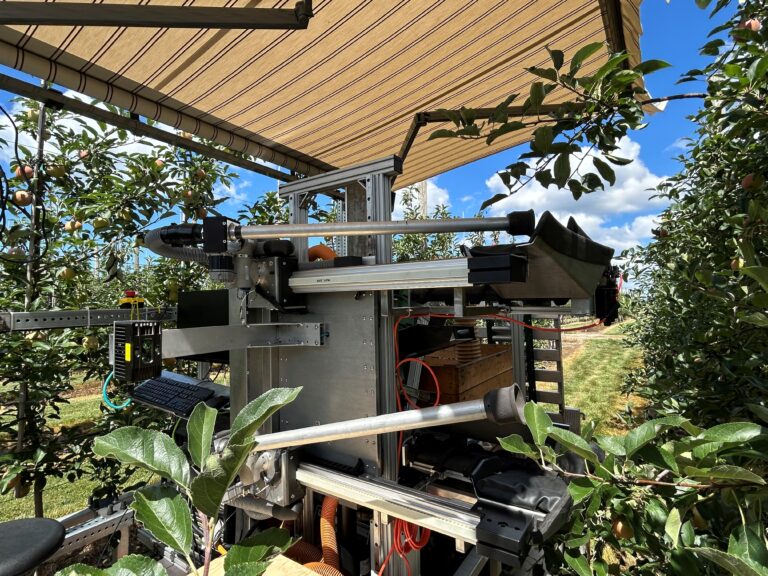
Field trials during the 2025 harvest season took place in commercial orchards in Washington, which produces more than 60 percent of US apples, according to Lu. Tests included a two-dimensional vertical fruiting wall orchard and a tall spindle planting, both high-density systems commonly viewed as more compatible with automation.
Results varied in more complex canopies. In Michigan orchards, where tree structure is often less uniform, the robot achieved picking rates ranging from 60 to 80 percent.
“The performance definitely is influenced by the structure of orchards,” Lu says, adding that the long-term goal remains 80 percent performance in typical high-density orchards across major apple-producing regions.
The system does not yet selectively harvest based on fruit maturity, but Lu said that function is under development using artificial intelligence models.
The team is also developing an autonomous mobile harvesting platform that integrates four modules and an in-field sorter capable of separating fruit into fresh and processing grades. The platform is designed to autonomously handle both empty and full bins and navigate orchards without requiring human intervention.
The technology has been licensed to Michigan State University, which has formed a startup to commercialize the system. Lu says the company has secured initial investment and is targeting commercial delivery within the next few years. However, cost remains central to adoption.
“If a grower cannot achieve cost-saving or labor-saving, they will not adopt the technology,” Lu stresses. “So we are very conscious—we want to build a robot module cost-effectively.”
Even with automation, the researcher expects human labor to remain part of harvest operations.
“Our goal is to achieve an 80 percent picking rate,” he adds. “Hence, remaining fruit, say 20 percent, will need to be picked by a human.”
*Photos courtesy of Renfu Lu.
Related stories




Subscribe to our newsletter