Wholesum advances organic innovation and sustainability in 2025 Conscientious Company Report
 Add Fresh Fruit Portal to Google
Wholesum, a third-generation leader in organic and Fair Trade Certified produce, has released its 2025 Conscientious Company Report, showcasing a year of record growth, innovation, and measurable progress across its sustainability and values-driven initiatives.
As the company approaches its 100-year milestone, the report-now in its tenth year-reflects a defining belief: that growth in organic agriculture can go hand-in-hand with environmental stewardship, social responsibility, and long-term resilience.
"2025 was a year defined not just by growth in volume, but by growth in strength, connection, and purpose," said brothers Ricardo and Theojary Crisantes, third-generation co-owners of Wholesum, who continue to carry forward their family’s legacy of sustainable agriculture and innovation. "We are expanding our reach while staying firmly rooted in the values that have guided us for decades."
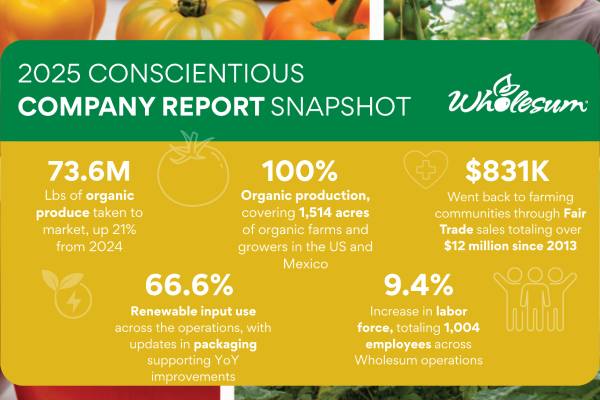
In 2025, Wholesum brought a record 73.6 million pounds of organic produce to market, a 21% increase from the prior year, supported by new US grower partnerships and expanded greenhouse production in Sonora. Despite industry-wide challenges including tariffs, climate variability, and supply chain disruptions, the company maintained a consistent supply of high-quality organic produce while continuing to invest in innovation, environmental responsibility, and community impact.
Wholesum: Innovation rooted in organic integrity
Wholesum continues advancing organic agriculture through science, natural systems, and product innovation.
Highlights include:
- 100% organic production across all farms
- Deployment of 3.5 million ladybugs and 152,000 beneficial insects for natural pest management
- 130,000 earthworms and more than 2,700 bumblebee habitats supporting crop health and pollination
- 32% growth in in-house seed production
A standout innovation from 2025 was Lil' Ones, Wholesum's novel tiny organic pearl tomato, which gained recognition within the organic produce space. "Innovations like Lil' Ones keep the category exciting and aligned with evolving consumer preferences," said Kristina Federico-Luna, Sales Manager at Wholesum.
Measurable environmental progress
Operational improvements and resource efficiency initiatives continued to reduce the company's environmental footprint.
Highlights include:
- More than 48 million gallons of water recirculated
- Ventilation upgrades in specific greenhouses leading to energy use reductions
- More than 1.4 million pounds of produce donated to community food organizations
- Launch of recyclable packaging pilots that eliminated more than 6,700 pounds of plastic in merely 5 weeks of the program
Investing in people and communities
With more than 1,000 employees across the U.S. and Mexico, Wholesum continued investing in employee development, well-being, and community impact.
Highlights include:
- 9.4% workforce growth
- Expanded participation in leadership and development programs
- First U.S.-based Wellness Month initiative
- Expanded shuttle transportation programs that reduced more than 1.34 million pounds of CO2 emissions through Fair Trade support
Fair trade in action
Fair Trade remains central to Wholesum's business model, ensuring growth translates into meaningful community investment.
Highlights include:
- $831,000 in Fair Trade premiums generated, a 14% increase from prior year
- 59% of total volume sold under Fair Trade terms
- More than $12 million in Fair Trade premiums generated since 2013
- More than 1,000 students supported through Fair Trade-funded education initiatives
Worker-led Fair Trade programs continued to fund scholarships, student and employee transportation, healthcare access, childcare, and other community resources across growing regions.
Guided by its purpose to nourish a healthy world, Wholesum continues to align its growth with the United Nations Sustainable Development Goals, with an ongoing focus on gender equity, renewable inputs, sustainable packaging, and resilient grower partnerships.
*All images courtesy of Wholesum.
Related stories
Kapi Kapi Growers new sustainability report focused on environmental, social, and governance
IBO Report 2025: These are the five trends to watch in the blueberry industry