









Climate change forces Chile's cherry industry to rethink how it grows its star crop
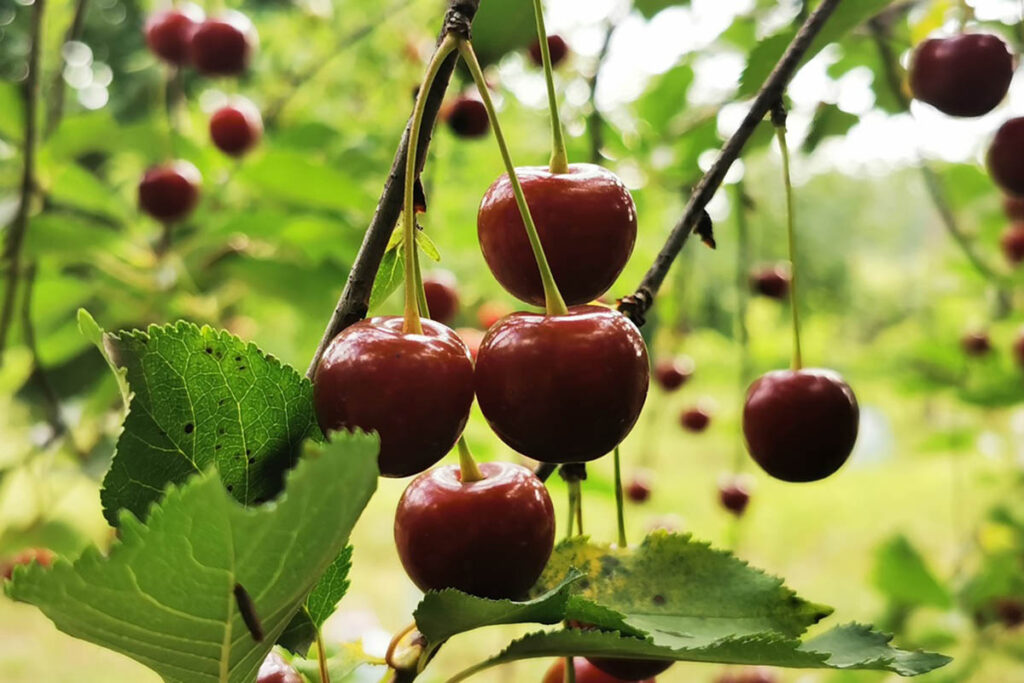



One of Chile’s most emblematic crops is suffering the consequences of climate change.


The country produces 97 percent of the Southern Hemisphere's cherry supply, but according to the University of Talca, exports have dropped by about 20 percent due to milder winters and hotter summers.
Experts have long sought strategies to address this climate change-derived problem. Developing and prioritizing weather-resilient varieties is one of them.
Marcelo Arriagada, technical director of the Cherry and Pome Fruit Unit at Andes New Varieties Administration (ANA Chile), says that variety selection has been crucial to maintaining the fruit’s quality and crop size at harvest.
“The important thing is to be able to bring genetics that thrive under those conditions of soil, climate, and cold availability, allowing to obtain a good product and thus harvesting a cherry that is to the liking of the Chinese market, which our main buyer,” the expert pointed out during the IX CherryExpo 2025, hosted by the Pome Fruit Center of the University of Talca and ANA Chile.
Chilean cherry exports are mostly comprised of traditional varieties such as Lapins, Santina, and Regina, which represent the majority of shipments to international markets.
“In recent seasons, new cherry varieties such as Sweet Aryana, Nimba, and Pacific Red have gained space. These are early harvest varieties with attributes of caliber, firmness, and sweetness that seek to consolidate and diversify export windows,” Arriagada said.
Climate change is impacting cherry exports
In the past, Chile exported between 135 and 150 million boxes per season, but numbers have changed significantly in recent years.
“Today they are lower, and we are talking about a drop of between 110 and 125 million boxes,” said the ANA Chile expert, who attributes this decrease to the shifting conditions of winter and summer in the Latin American country.
“There was a lot of rain during the flowering period, low temperatures, frosts, and even hail in some areas. Climatic conditions also affected the final fruit set,” he explained.
Climate change alters weather patterns, resulting in insufficient cold hours during key growing months. This influenced the crop's productive potential, as did the extreme summer heat, which stressed the plants.
Likewise, Luis Ahumada, general manager of Los Olmos Exporting Company, confirmed this decline and emphasized that prices could offset dwindling volumes.
“Even if production is 20 or 25 percent lower than last year, I estimate that prices should compensate for this decrease. We hope it will be a better season than the previous year,” Ahumada said.
For the general manager of Los Olmos, the 2025/2026 season will be key to gauging how the Chinese market responds to more moderate volumes and higher-quality fruit. However, he warns that, if the market doesn’t react favorably, cherries harvested from December onwards will face more difficult times.
AI could help against post-harvest risks
Given this scenario, Álvaro Sepúlveda León, a researcher at the Pome Fruit Center at the University of Talca, presented a project that uses Artificial Intelligence (AI) to minimize losses in cherries and apples due to climate change.
The research was developed in collaboration with the Foundation for Agrarian Innovation and presented at the IX CherryExpo 2025 in the Chilean city of Talca.
The initiative was carried out in commercial orchards in the Maule and O’Higgins regions, allowing the assessment of the fruit under real production conditions, both in the field and post-harvest, the stage at which damage manifests.
“What we were looking for was to assess if we could anticipate when the fruit would have a greater or lesser risk of presenting post-harvest problems,” Sepúlveda León explained.
The researcher used AI tools to detect patterns not readily identifiable by traditional models once the fruit is off the tree. This is critical for export, as many pallets of fruit arrive at their destination with damage already developing, directly affecting quality and commercial value.
The results revealed a clear correlation between climate change and internal fruit damage. According to the data, a winter with more cold hours reduces the risk of internal browning, while summers with high temperatures and stressful conditions increase it considerably.
This was especially evident in the monitored orchards, where differences among localities enabled the model to be refined.
Sepúlveda León said he and his team will further develop the model, along with a consultation platform, to create an early warning system that alerts producers when seasonal conditions increase damage risk.
“It is important to follow the season year after year, because spring and summer are becoming increasingly stressful due to high temperatures, as happened now. And that directly affects how the fruit arrives post-harvest,” he concluded.
Relates stories







Subscribe to our newsletter