








Agronometrics in Charts: Supply surge forces Chilean cherry industry to look beyond China




Each week, the series ‘Agronometrics In Charts’ looks at a different horticultural commodity, focusing on a specific origin or topic, and visualizing trade market factors that are driving change. Check out our entire archive.


The Chilean cherry industry is entering a new phase as rising production volumes, price pressures, and heavy reliance on the Chinese market push exporters to reassess long-term strategies. The 2025–2026 fruit season began with an earlier-than-usual harvest across several categories, including cherries. According to industry leaders, the season proved particularly challenging for growers as increasing supply coincided with weaker market returns.
“It’s been an extremely challenging season,” said Hans Leibbrandt, general manager of Chilean exporter Monfrut.
Leibbrandt warned that the current situation reflects more than a temporary setback. “This represents a shift in trend; it’s not just a single season, but essentially a turning point,” he said, noting that the industry must adapt to an environment defined by higher supply levels and lower returns.

The Chilean cherry industry has expanded rapidly over the past decade, supported by strong global demand and attractive returns in previous seasons. Large areas planted in earlier years are now reaching full production, significantly increasing export volumes. Industry projections suggest Chile’s planted cherry area could grow from roughly 83,700 hectares today to nearly 89,000 hectares by 2030, further boosting export capacity. This expansion has strengthened Chile’s position as the world’s largest exporter of fresh cherries, but it has also intensified competition in global markets and contributed to downward pressure on prices.
As supply continues to grow, some industry leaders believe the sector may need to accelerate orchard renewal and remove underperforming varieties.
“The sector should speed up the removal of unproductive orchards or varieties that no longer meet demand,” Leibbrandt said.
China continues to dominate Chile’s cherry export landscape, driven by strong consumer demand and the fruit’s association with gift-giving during the Lunar New Year holiday. In January 2026 alone, Chile exported $1.227 billion worth of cherries globally, with China accounting for approximately 88 percent of export value during the month. However, this concentration creates significant vulnerability to shifts in market timing and demand. During the most recent season, large volumes of cherries arrived in China earlier than usual after Chile experienced an early harvest. Combined with the later timing of the Lunar New Year, the influx of fruit contributed to weaker prices in the market.
While China remains the dominant destination, the United States has become an increasingly important market for Chilean cherries and plays a growing role in export diversification. The United States is currently the second-largest destination for Chile’s cherry exports, reflecting steady growth in winter demand among American retailers and consumers.
In 2024, shipments to the United States exceeded 3.9 million 5-kilogram boxes, supported by expanded retail promotions and increased consumer awareness of cherries as an off-season fruit in North America. Early-season shipments to the US have also shown strong growth, rising 63 percent year-over-year during the initial weeks of the campaign, as exporters sought to expand sales outside China. Despite this progress, volumes shipped to the US remain significantly smaller than those destined for China, highlighting the challenge of building alternative markets capable of absorbing large export volumes.
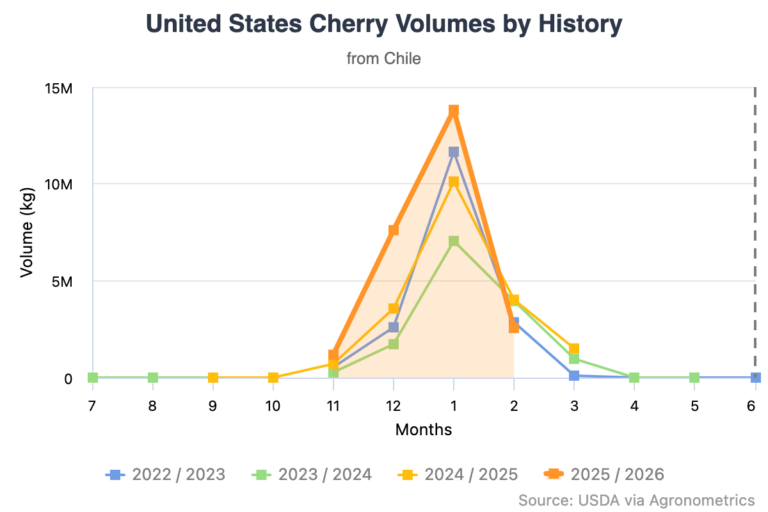
Source: USDA Market News via Agronometrics. (Agronometrics users can view this chart with live updates here)
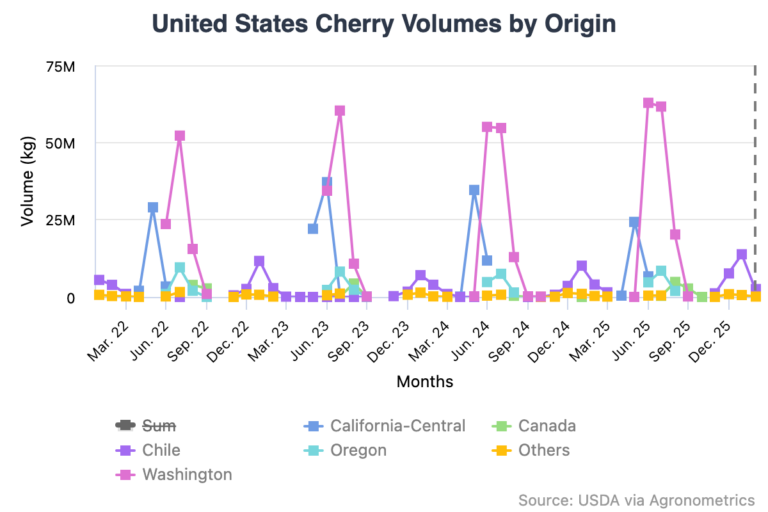
Source: USDA Market News via Agronometrics. (Agronometrics users can view this chart with live updates here)
As global supply increases, industry leaders say growers must focus on operational efficiency and market alignment. “Growers don’t control prices, so they must focus on controlling costs and maintaining quality,” Leibbrandt said.
In the coming years, the Chilean cherry industry is expected to place greater emphasis on market diversification, commercial planning, and orchard productivity. While China will likely remain the primary destination, expanding markets such as the United States could play a growing role in helping balance global supply. As production continues to rise, the industry’s ability to adapt to changing market dynamics may determine the long-term sustainability of Chile’s cherry boom.
The seventh edition of the Global Cherry Summit will be held on April 21, 2026, at the Monticello Casino Events Center in Santiago, Chile. Organized by the Chilean Cherry Committee and Yentzen Group, the event will feature key knowledge sessions offering reliable, up-to-date data to support informed decisions in an industry where every season can define the business.
At the event, you will have access to real-time market analysis, learn about consumption trends, how to evaluate effective commercial strategies, and understand logistical transformations.
For more info, contact
entradas@yentzengroup.com
Tickets available at https://www.globalcherrysummit.com/#tickets
Related articles
Chilean cherry industry urges caution as growers weigh switch to hazelnuts
Adaptation and quality: Lessons for the Chilean cherry industry after a challenging 2025/26 season
Why the Chilean cherry industry might need more than good quality to thrive in China this season
Chilean cherry industry adapts its strategy to serve an increasingly demanding Chinese consumer










Subscribe to our newsletter