Ecuador and the United States sign trade agreement to boost Ecuadorian agro-exports

 Add Fresh Fruit Portal to Google
Ecuador and the United States signed a Reciprocal Trade Agreement (RTA) to strengthen bilateral economic ties and open new opportunities for Ecuadorian exports.
The signing finalizes a negotiation process that began in May 2025, establishing a roadmap toward more balanced, competitive, and predictable bilateral trade, according to Ecuador’s Ministry of Production, Foreign Trade, and Investments.
As for imports from the United States, Ecuador agreed to a tariff reduction structure aimed at supporting productive modernization.
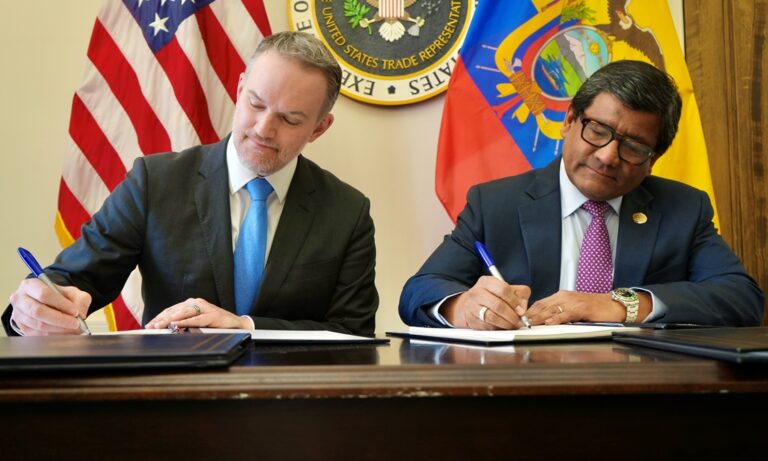
Ambassador Jamieson Greer of the Office of the US Trade Representative, alongside Ecuador’s Minister of Production, Foreign Trade and Investments, Luis Alberto Jaramillo, finalizing the negotiation process.
Agricultural machinery, industrial equipment, and construction machinery will be able to enter duty-free either upon the agreement’s entry into force or within reduced timeframes.
Reciprocal trade agreement: fruit among the beneficiaries
One of the main effects of the RTA will be the elimination of surcharges currently affecting 53 percent of Ecuador’s non-oil exports to the United States, equivalent to $2.786 billion in trade based on 2025 data.
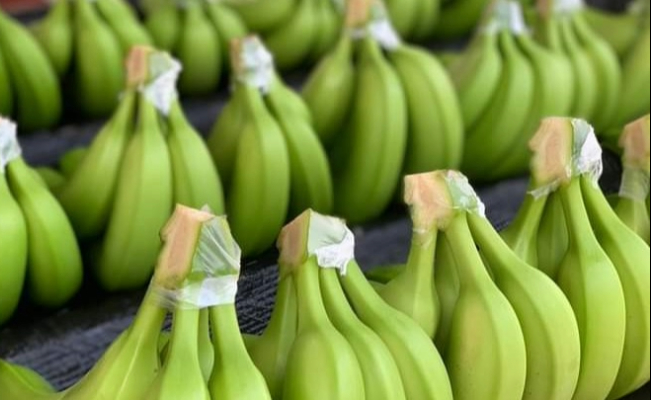
The agro-export sectors, including bananas, plantains, pineapple, mango, pitahaya (dragon fruit), ginger, and goldenberry, are among the primary beneficiaries, as the country’s agricultural industry will now operate under more competitive conditions.
Cocoa and coffee—both raw and processed—will also benefit, along with the floriculture sector, palm hearts, and various seafood products.

The agreement also includes strategic minerals such as gold and copper, as well as processed agro-industrial goods, industrial manufactures, and the forestry and timber sector.
In addition, the RTA provides for the removal of surcharges on 1,673 additional tariff subheadings, opening the door to greater diversification of Ecuador’s export supply to one of the world’s largest markets.
Fomenting modernization and access
The agreement also allows tariff reductions on parts, components, and industrial inputs from the US, aimed at lowering operating costs and improving the competitiveness of Ecuadorian companies.
In terms of financing, the RTA provides access to funding from institutions such as the Export–Import Bank of the United States (EXIM Bank) and the US International Development Finance Corporation (DFC), with the goal of supporting investments in sectors including energy, critical minerals, infrastructure, and technology.
It also incorporates trade facilitation measures and customs modernization efforts to reduce logistical time and costs, as well as environmental and sanitary standards aligned with international best practices.
Related stories:
Quality is the unequivocal response to Ecuador's dragon fruit oversupply crisis