








Agronometrics in Charts: Middle East conflict drives major cost surge for US fresh produce




Each week, the series ‘Agronometrics In Charts’ looks at a different horticultural commodity, focusing on a specific origin or topic, and visualizing trade market factors that are driving change. Check out our entire archive.


According to a recent Rabobank report, the ongoing Middle East conflict is generating significant ripple effects across global food systems, with the United States fresh produce sector experiencing rising cost pressures and supply chain volatility. Disruptions in the Strait of Hormuz, through which roughly 20 percent of global petroleum liquids transit, have contributed to higher oil and gas prices, driving up fuel, transportation, and cold chain costs.

Input costs are also rising. Approximately 25–30 percent of global nitrogen (N) fertilizer exports pass through the region, alongside significant volumes of phosphate (P) fertilizers and nearly 20 percent of global ammonia shipments, thereby increasing exposure to supply disruptions and price volatility. Fertilizers can account for 40–50 percent of variable production costs in many cropping systems, amplifying the impact on grower margins.
Packaging represents an additional area of exposure. The Middle East supplies roughly one-third of the world's traded naphtha, a key feedstock for plastics, while an estimated $20–25 billion in petrochemical products transit through the region annually. Disruptions are driving up costs for plastic materials widely used in fresh produce packaging.
Logistics conditions are becoming more challenging, with rising freight and insurance costs. Early market indications point to increases of around $4,000 per container on certain routes, highlighting the scale of cost inflation in global shipping.
On the demand side, Rabobank indicates that sustained high energy prices could push inflation above 3 percent in major economies, reinforcing consumer price sensitivity. In the US market, this may translate into softer demand for higher-value fresh produce categories and increased pricing pressure across the value chain.
Overall, the combined effects of higher input costs, logistical inefficiencies, and evolving consumer behavior could contribute to a more constrained and volatile operating environment for the US fresh produce sector.
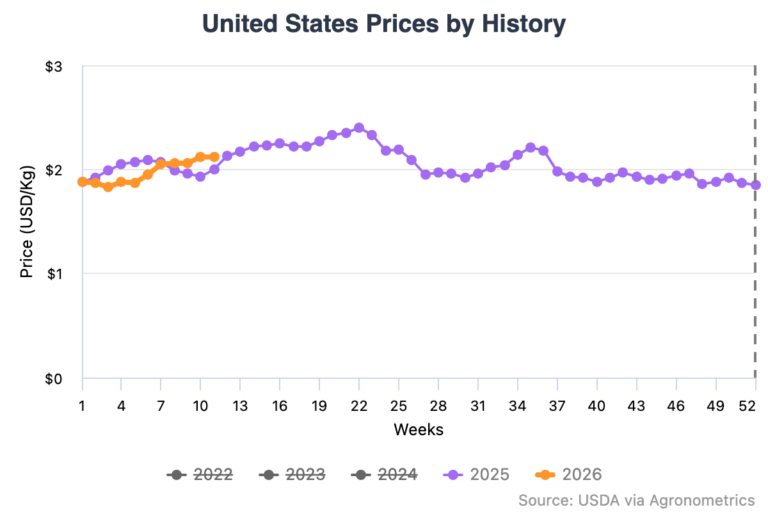
Source: USDA Market News via Agronometrics. (Agronometrics users can view this chart with live updates here)
Related articles:
Shipping crisis halts Middle East routes for India's largest fruit export, bananas
Global shipping crisis: Middle East conflict triggers rerouting, massive surcharges










Subscribe to our newsletter