Agronometrics in Charts: US apples gain momentum, but weather risks threaten a bountiful season
 Add Fresh Fruit Portal to Google
The US apple market is showing solid momentum in 2026—export demand is rising, domestic supply remains strong, and overall consumption is steady. But behind that stability, weather patterns are introducing real uncertainty that could shape how the season plays out.
Apples remain a steady part of the American diet, with availability at 41.3 pounds per person in 2024/25, according to the US Department of Agriculture (USDA), in line with long-term trends. Fresh apples make up a large share, supported by domestic growers, who supply over 90 percent of the market.
While this strong base keeps supply stable, shifts in production and trade can still quickly impact availability.
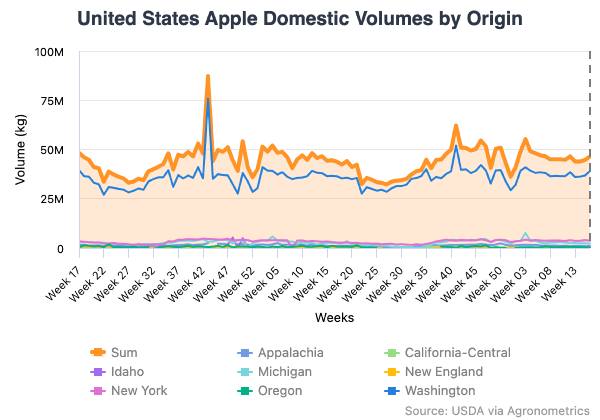
Source: USDA Market News via Agronometrics.
Export growth drives momentum for US apples
Heading into 2026, exports are one of the clearest signs of strength for US apples. The country shipped about 839 million kilograms of fresh apples in 2024/25, valued at about $1 billion.
That pace has continued into the current season: In the first half of 2025/26, exports reached about 454 million kilograms, up five percent compared to the same period last year and marking the highest mid-season volume in eight years
Mexico and Canada remain the dominant buyers of US apples, accounting for a large share of total shipments. Growth in these markets has been especially strong, helping offset declines in some smaller destinations. Beyond North America, the US retains a broad export footprint, with shipments spread across multiple countries.
Another notable trend is the rise of organic apples, which now represent a meaningful portion of export volume. This reflects changing consumer preferences globally, not just within the US.
Weather becomes the key variable
While market fundamentals are strong, the biggest unknown for US apples right now is the weather.
Dry conditions across much of North America are raising concerns about how the growing season will develop.
“There are droughty conditions present across North America. All of the dryness out there is a potential issue going into summer,” agricultural meteorologist Drew Lerner explained to ag-industry news outlet Fresh Plaza.
This dryness could influence both temperature and precipitation patterns in key growing regions. If high-pressure systems strengthen over already dry areas, they can intensify heat and limit rainfall, creating stress for orchards during critical growth periods.
Regional conditions show a mixed picture
Conditions vary significantly by region, and each area faces its own set of risks.
In the Pacific Northwest, one of the most important apple-producing regions, precipitation has been limited, and drought-like conditions are emerging. Although reservoirs are currently near full capacity due to rapid snowmelt, the long-term outlook depends on avoiding extended heat during the summer.
In the Midwest, particularly Michigan, cooler temperatures and regular rainfall could support crop development. However, frost remains a concern in certain areas, especially where crop development is further along.
The Northeast presents a more mixed situation. Some areas, especially in New England, are experiencing dryness, while key production regions have relatively stable soil moisture. Periodic cold snaps remain a risk, particularly as warmer weather has already pushed some orchards further into bloom.
In California, water supplies are currently in good shape for the 2026 growing season, even though snowpack levels are below average. That could become a longer-term concern, but for now, conditions are manageable.
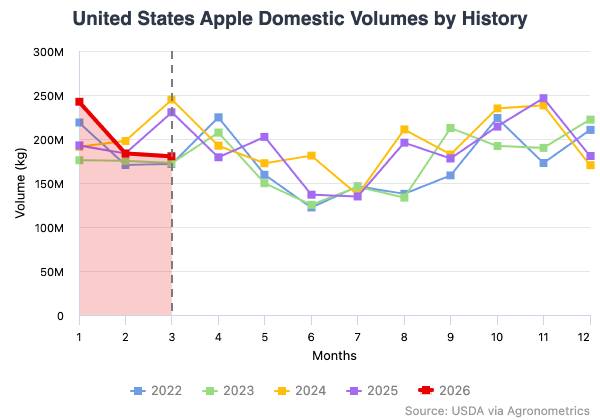
Source: USDA Market News via Agronometrics.
A hopeful but delicate outlook for the season ahead
Looking toward summer, the outlook for US apples suggests continued dryness in the west and more moderate, variable conditions in the eastern regions.
If temperatures remain within a manageable range and water supplies hold, the crop could still perform well. But prolonged heat or expanding drought conditions would quickly change that outlook.
The overall picture for US apples in 2026 is one of balance. On the one hand, there is clear momentum driven by strong exports and steady demand, while on the other hand, weather risks introduce uncertainty that could shift production outcomes.
The market is stable. The demand is there. But as always in agriculture, the final result will depend on conditions in the orchard.
*All images are referential; graphs courtesy of Agronometrics.
Related stories
Rising costs and inventory shifts pressure US apple growers
US apple crop 2025 set to be one of the largest in recent history