Soil-mapping tech offers massive water savings for California citrus
 Add Fresh Fruit Portal to Google
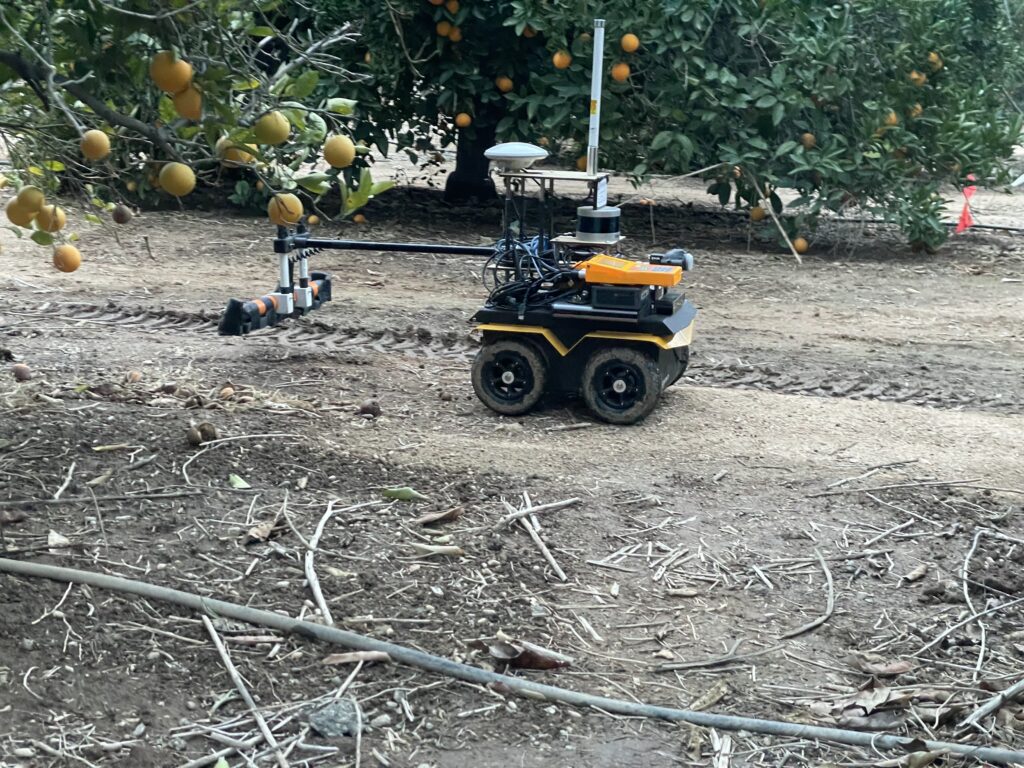
California citrus growers may soon have a new ally rolling through their orchards: a robotic soil-mapping system designed to show exactly how much water sits beneath each tree.
The technology could help growers fine-tune irrigation as the industry faces mounting pressure to reduce groundwater use under the Sustainable Groundwater Management Act (SGMA).
California agriculture uses roughly 40 percent of the state’s developed water supply, according to the California Department of Water Resources. Groundwater dependence has increased during drought periods, particularly in the Central Valley, where many citrus operations rely on wells for irrigation.
Furthermore, as of May 2026, the Golden State is transitioning away from a period of high reservoir levels toward a projected long-term loss of up to ten percent of its water supply.
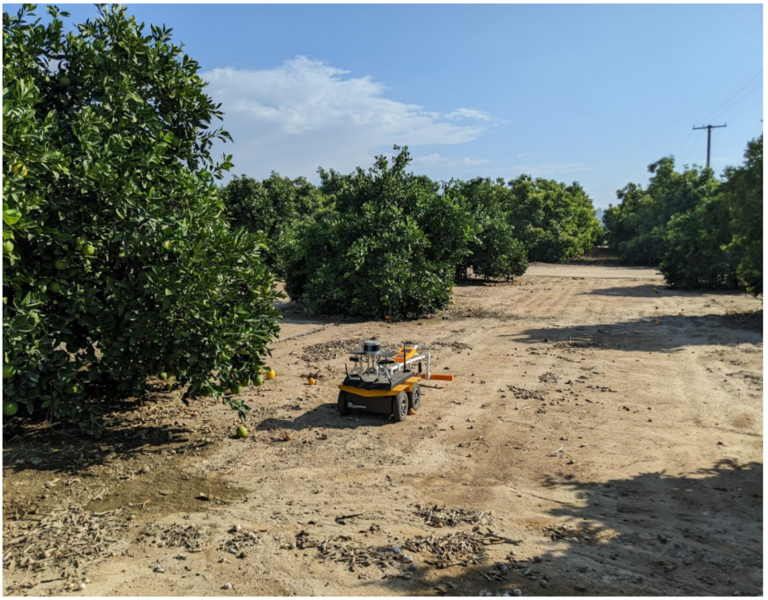
Photo by Aritra Samanta | UCR.
With this issue in mind, researchers at the University of California, Riverside (UCR), led by Elia Scudiero, associate professor and agronomist at UCR’s Environmental Sciences department, began searching for a more sustainable approach to orchard irrigation.
The project first took root in 2021 through a collaboration between Scudiero’s lab’s soil expertise and UCR’s Autonomous Robots and Control Systems (ARCS) laboratory.
With a multidisciplinary team now assembled, researchers spent the past five to six years refining autonomous navigation, soil sensing, and data modeling systems for orchard conditions.
However, the true visionary advice, Scudiero told FreshFruitPortal.com, came from the very citrus growers the research hopes to assist.
“They said, ‘It would be amazing to know what the water content level is for the soil wherever we are in the field’, but this is very intensive in terms of infrastructure and investments,” he explained. “Understanding the soil moisture patterns within a field can be a key tool to discern why certain trees are not doing so well.”
Scudiero explained that most citrus orchards contain major differences in soil water-holding capacity from one area—commonly referred to as a block—to another, making uniform irrigation inefficient.
“According to [SGMA] sustainability standards, farmers are using too much water. And it follows that, with the status quo of water use, they would need to retire half a million acres of land, some say more than that,” Scudiero said.
From soil-mapping to water management
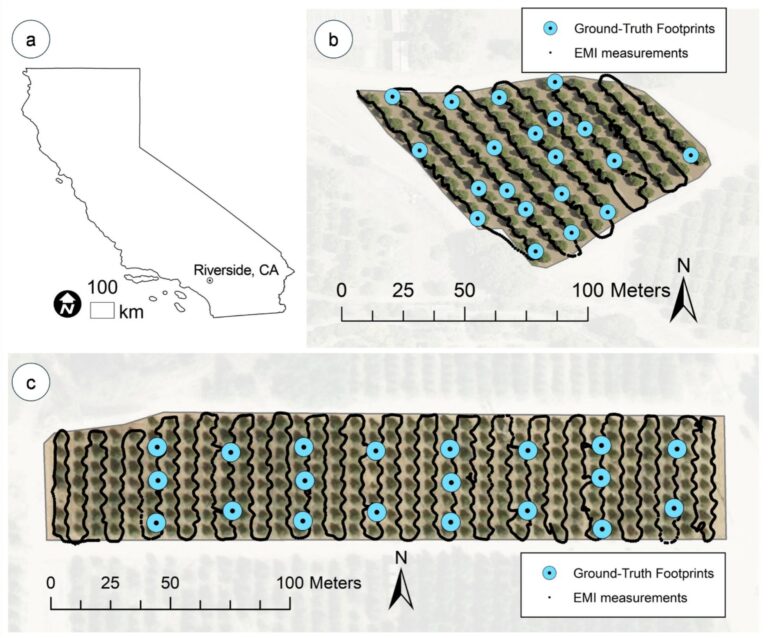
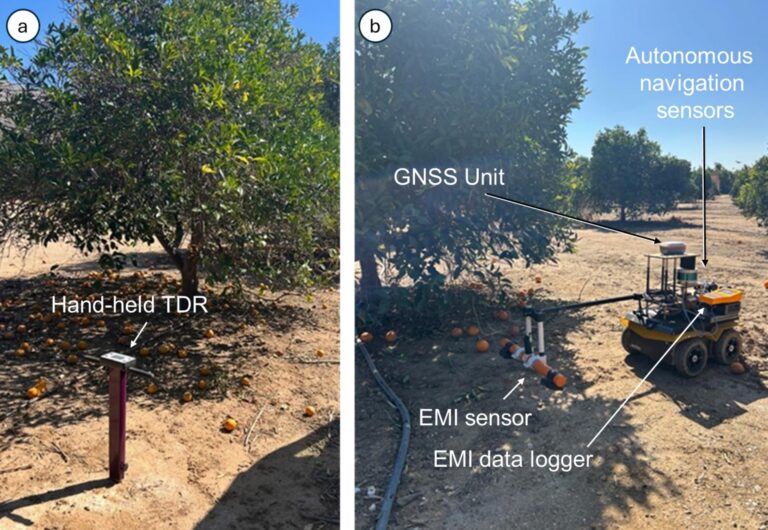
To address this issue, the research team developed a robotic system that travels beneath orchard canopies and continuously measures soil electrical conductivity near irrigation zones. The system combines those readings with existing in-ground moisture sensors already used by growers to generate high-resolution maps of volumetric soil water content across orchards.
Scudiero said the approach builds on traditional soil moisture monitoring, where growers often rely on only a few sensors to represent hundreds or thousands of trees.
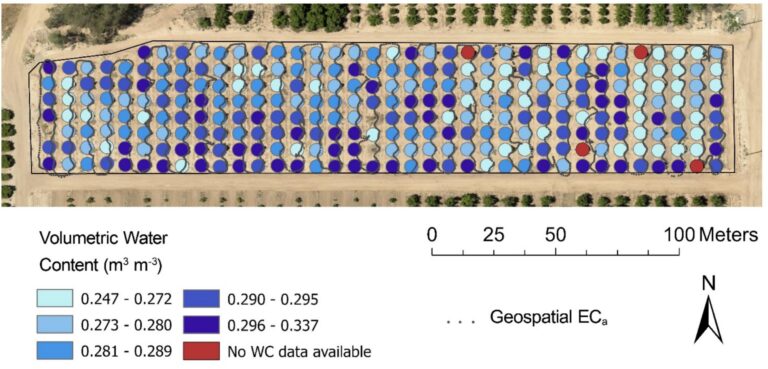
Unlike satellite imagery, which captures both trees and row middles, the robotic system measures soil conditions directly within the root zone where irrigation occurs.
Scudiero said the technology provides growers with a clearer picture of variability across orchards than current practices allow.
“When you're putting down these sensors that the farmers are already using, you need to pick:. You might have several hundred, if not thousands, of trees in an orchard, and you have to put down three sensors. Where are you putting those?” he explained. “Growers will most likely pick the average spots, because they have a very narrow vision of the moisture variability in that orchard”.
Adoption is still a work in progress
Scudiero believes this soil-mapping technology could eventually integrate into everyday orchard operations through service providers or sensors mounted on farm vehicles and all-terrain vehicles (ATVs).
“There are other sensors with the same performance that can be mounted on ATVs,” Scudiero said. “Farmers are checking irrigation systems weekly. They could simply have a soil moisture map at the end of an orchard run.”
Scudiero noted that lower sensor costs over the past decade have improved the technology’s commercial prospects, though adoption is still slow.
“At the moment, cost might still be a barrier,” he said. “Hopefully, in five years from now, this will already be adopted by several growers via service providers,” he said.
The next phase of the research will focus on demonstrating water savings and economic returns from irrigation scheduling based on the soil-mapping data.
“Then, we can save a lot of water without compromising the farmers’ profits,” Scudiero said.
*All images courtesy of Elia Scudiero | Main photo by Aritra Samanta, UCR.
Related stories
California citrus program secures $2 million in annual federal funding
California Citrus Mutual CEO: "Average pricing simply does not work for California producers"