Agronometrics in Charts: USMCA scrutiny puts North American produce trade in the spotlight

 Add Fresh Fruit Portal to Google
Each week, the series ‘Agronometrics In Charts’ examines a different horticultural commodity, focusing on a specific origin or topic and visualizing the trade market factors driving change. Check out our entire archive.
The United States-Mexico-Canada Agreement (USMCA), which supports approximately $1.6 trillion in annual trade among the three countries, is once again under scrutiny after US President Donald Trump said his country would do better without it.
Speaking to reporters, the Head of State said he would "rather not have the agreement" but could ultimately decide to sign it.
Come July 1, the three countries must decide whether they want to renew the agreement. If one decides against it, the withdrawal process, entailing a lengthy review and renegotiation period, would begin.
At the same time, trade officials from the United States and Mexico are holding discussions focused on what negotiators have described as creating a "level playing field" between the two countries. Agricultural organizations on both sides of the border are pushing for an extension of the agreement and continued duty-free trade for agricultural products.
Ag industry pushes for USMCA renewal
The uncertainty surrounding the renewal of the USMCA has drawn attention from the fresh produce industry, which has become increasingly integrated across North America over the past several decades.
Retail supply chains now depend on production from multiple countries to maintain year-round availability of fruits and vegetables, with growers, exporters and retailers operating across borders to balance seasonal production windows.
Mexico remains the United States' largest trading partner, with roughly 80 percent of Mexican exports destined for the US market, while Canada sends nearly 70 percent of its exports south of the border. Together, Canada and Mexico also purchase nearly one-third of all US exported goods.
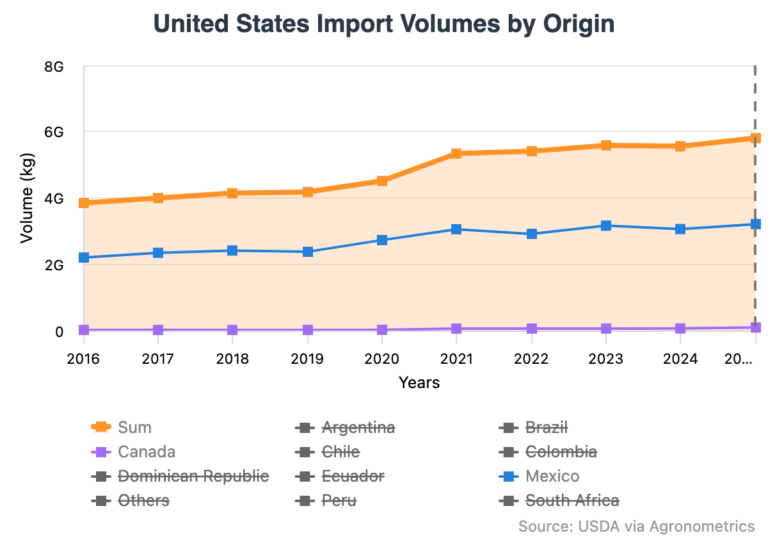
Source: USDA Market News via Agronometrics.
Industry groups have largely supported maintaining the USMCA's core framework. While discussions continue around agricultural competitiveness, market access, and regulatory alignment, organizations representing growers and agribusinesses have emphasized the importance of preserving predictable, rules-based trade throughout North America.
For the fresh produce industry, the review is not simply a trade policy discussion. Mexico plays a critical role in supplying the US market with products such as avocados, berries, tomatoes, peppers, and table grapes during periods when domestic production is limited. At the same time, Canada and Mexico are important destinations for US fruit and vegetable exports.
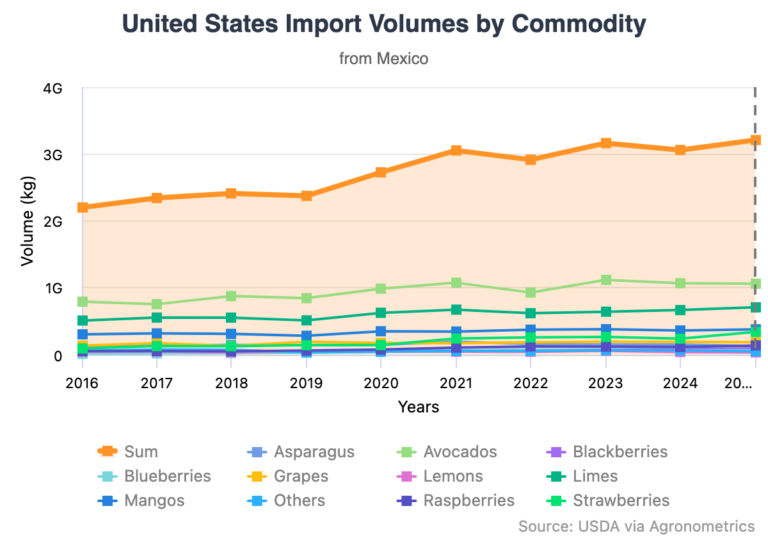
Source: USDA Market News via Agronometrics.
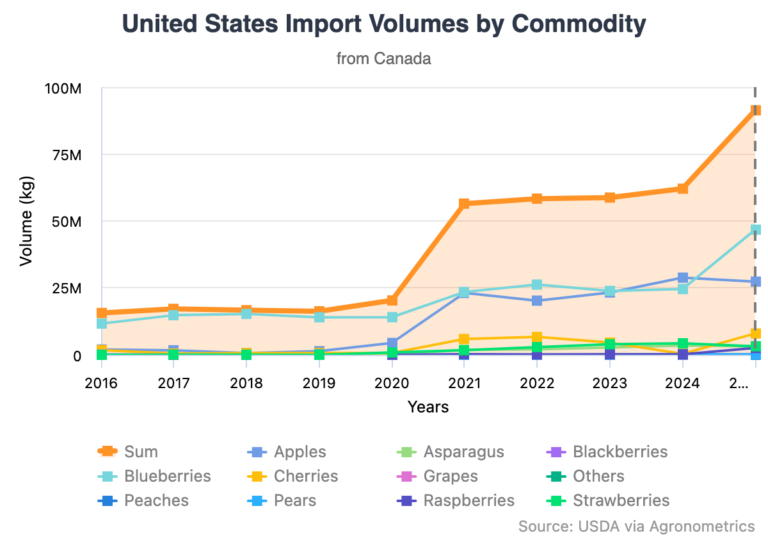
Source: USDA Market News via Agronometrics.
As a result, any significant changes to the agreement could affect production flows, market access, and supply chain costs across the region.
While a complete breakdown of the agreement appears unlikely, the ongoing negotiations introduce uncertainty for an industry that depends heavily on efficient cross-border trade. For now, the most likely outcome remains the preservation of the agreement's core structure with targeted modifications rather than a fundamental restructuring of North American produce trade.
*Images are referential | Main image by @State Department / Ron Przysucha | Graphs courtesy of Agronometrics.
Related articles
Produce giants unite under the Produce Coalition for USMCA
North American ag industry pushes for USMCA renewal
Washington raspberry sector backs letter urging specialty crop push in upcoming USMCA review