








Agronometrics in Charts: USMCA enters a decade of annual reviews, and fresh produce has plenty riding on it




Each week, the series ‘Agronometrics In Charts’ examines a different horticultural commodity, focusing on a specific origin or topic and visualizing the trade market factors driving change. Check out our entire archive.


The United States declined to renew the US-Mexico-Canada Agreement (USMCA) on July 1, with US Trade Representative Jamieson Greer confirming Washington would not extend the deal in its current form. The decision came after the pact's mandated six-year joint review. Washington's rationale was familiar: a push to reshore manufacturing and to narrow persistent goods trade deficits with its neighbors, which in 2025 totaled roughly $197 billion with Mexico and $48.3 billion with Canada.
The agreement does not end, however; it stays fully in force and now enters a decade of annual reviews, expiring in 2036 only if the three countries fail to reach a new arrangement before then. Mexico and Canada both backed a full 16-year extension, and the next US-Mexico bilateral round is set for the week of July 20 in Mexico City.
Source: USDA Market News via Agronometrics.
Source: USDA Market News via Agronometrics.
USMCA will continue on
It helps to recall what the USMCA is and why July 1 mattered. The agreement took effect on July 1, 2020, replacing the North American Free Trade Agreement that had governed the continent since 1994, and it carried over most of NAFTA's duty-free treatment for farm goods while tightening rules on autos, labor, and digital trade.
Together, the three economies move well over $1.6 trillion in goods across their shared borders each year. The deal was written with a 16-year lifespan and a built-in checkpoint six years in, a mandatory joint review at which the governments decide whether to lock in another 16 years.
That is the checkpoint that came due on July 1, and declining to renew is not the same as walking away. Rather than commit to a fresh long-term extension, the three countries default to yearly reviews, with the full 16-year renewal still on the table at any point, should all three heads of government choose to sign it, and any party is free to withdraw on six months' notice. In practical terms, then, nothing about the rules changed on July 1; what changed is the planning horizon behind them.
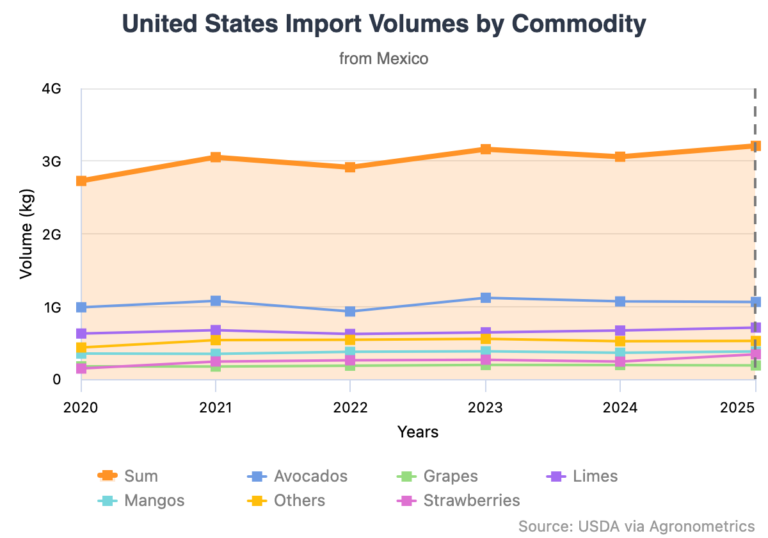
For produce, the stakes are hard to overstate. USDA figures put Mexico at roughly 51 percent of US fresh fruit imports and 69 percent of fresh vegetable imports by value, a dependency built on cross-border supply chains that move product north through the winter and shoulder seasons when domestic supply thins.
The trade data helps explain why farm groups on all three sides lobbied for an early, clean renewal. Since the USMCA took effect, US agricultural exports to Canada and Mexico have grown by 47 percent, compared with just 18 percent for the rest of the world, and the two remain the top markets for US farm goods, a position reinforced last year by a collapse in sales to China.
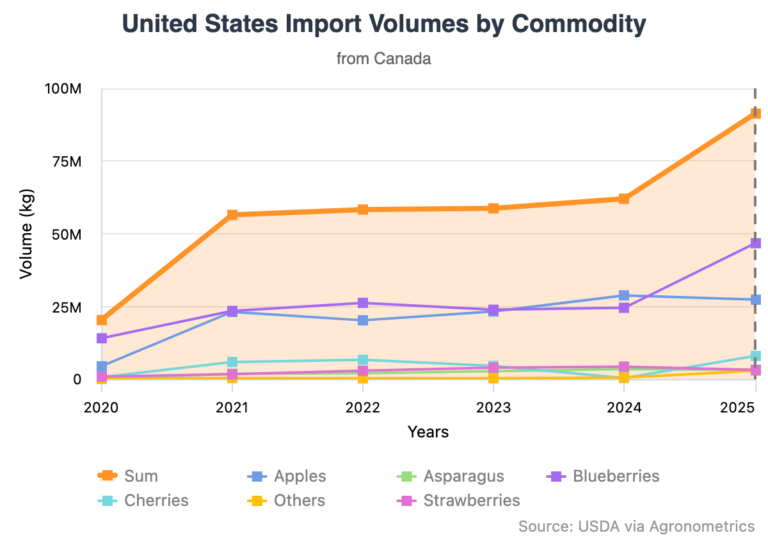
At the same time, trade with the two neighbors accounts for the bulk of the US agricultural trade deficit, at $24.5 billion in 2025: exports to Mexico reached $30.6 billion against $44 billion in imports, while exports to Canada were $28.2 billion against $39.3 billion in imports.
A recent Purdue University study estimated the deal has saved American households roughly $700 a year in food costs, largely through lower tariffs; without it, food tariffs would rise by an average of 7.4 percent.
That combination of market access and price stability is why nearly 350 organizations across the three countries, along with a letter signed by more than 2,300 farmers, pressed for an early commitment ahead of the deadline.
For now, the picture is continuity: tariff preferences, rules of origin, and duty-free access are unchanged, and the 16-year extension is deferred rather than lost. But the shift from a long-horizon deal to a recurring annual negotiation replaces certainty with uncertainty, and for a produce trade that plans plantings, packing, and cross-border logistics years ahead, that uncertainty is itself a cost.
Related stories
Opinion | Failing to renew the USMCA would increase tariff uncertainty and harm Americans
Agronometrics in Charts: USMCA scrutiny puts North American produce trade in the spotlight









Subscribe to our newsletter