


South African pears eye 2026/27 export rebound through blush variety pivot
 Add Fresh Fruit Portal to Google
South Africa’s fresh pear industry is forecast to bounce back in the 2026/27 marketing year. According to a November report by USDA’s Foreign Agricultural Service (FAS Pretoria), production and exports are expected to recover from weather- and logistics-induced dips in 2025/26.
While overall planted area has plateaued and is projected to edge slightly downward, producers are actively restructuring orchards, switching from well-established cultivars like Packham’s Triumph and Williams Bon Chretien to newer cultivars to boost returns.
“Growers are replacing some green pear orchards with blush varieties such as Forelle and the newer Rosemarie,” the document reads. “With this shift, producers aim to enter the market earlier in the season to secure better prices in European and other markets.”
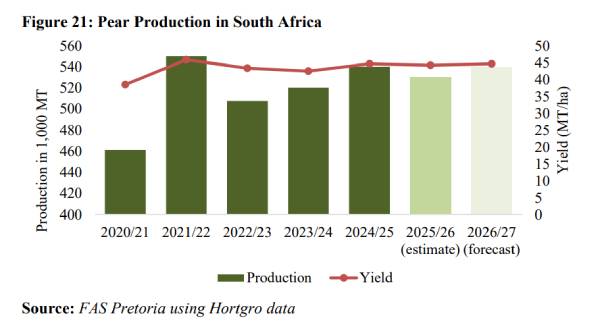
Image via FAS Pretoria
Orchard consolidation, blush transition, and an early season
Primarily concentrated in the Western Cape, where the Ceres and Langkloof East regions account for half of all pear acreage, South Africa's pear acreage has stabilized after climbing in the late 2010s.
Planted area held steady at 12,900 hectares (ha) across MY 2024/25 and MY 2025/26, before a projected 0.4 percent dip to 12,850 ha in MY 2026/27. This slight contraction reflects orchard uprooting and storm damage from heavy May 2026 rains.
“Growers are also focusing on precision farming techniques to enhance yields and fruit quality, redirecting resources away from expanding area,” FAS Pretoria said.
Crucially, the industry's varietal mix is evolving. Four cultivars represent nearly 83 percent of total plantings: Packham’s Triumph (31 percent), Forelle (31 percent), Williams Bon Chretien (15 percent), and Abate Fetel (5 percent).
However, acreage for green and brown pears is steadily declining as producers replace older blocks with blush varieties like Forelle, which currently accounts for 4,000 ha, up from 3,500 ha in the 2019/2020 marketing year.
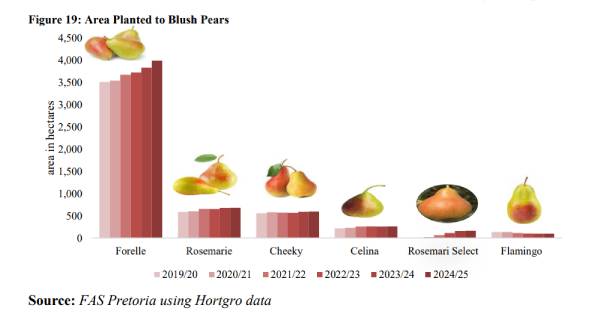
Image FAS Pretoria
Other blush cultivars, including Rosemarie, Cheeky, Celina, Rosemari Select, and Flamingo, remain small in volume and area, never reaching 1,000 planted hectares. However, except for Flamingo, these varieties have experienced sustained growth over the past five years, driven by high prices in the early European import season.
Adverse weather, including hail and flooding, is also shaping the season, resulting in smaller sizes and a two-percent decrease in the MY 2025/26 production estimate to 530,000 metric tons (MT).
For MY 2026/27, FAS Pretoria forecasts production to rebound by two percent to 540,000 MT, supported by ample irrigation water, improved farming practices, and higher-yielding trees. Following a warmer-than-usual 2026 winter, the upcoming harvest is also expected to kick off 10 to 14 days earlier than normal.
South Africa: Domestic absorption and minimal imports
Roughly 48 percent of South Africa’s pear crop is exported, while 15 percent is consumed fresh domestically, FAS Pretoria explains, with 35 percent processed into juice, concentrates, and purees, and two percent dried.
In MY 2025/26, weather curbed export-grade volumes, pushing domestic consumption up 12 percent year-on-year to 268,010 MT. This season, local demand is forecast to rise another one percent to 270,010 MT thanks to improved supply.
As the Southern Hemisphere's second-largest pear producer after Argentina, South Africa relies minimally on imports. Inbound shipments, primarily from China, fell from 30 MT in MY 2024/25 to an estimated 10 MT in MY 2025/26, and are expected to remain at that level in MY 2026/27.
Export recovery led by Europe
South African pear exports dropped 13 percent in MY 2025/26 to 262,000 MT, down from 300,000 MT in MY 2024/25. Smaller fruit sizes, higher logistics costs, and delays linked to the Middle East conflict were the main drivers behind this decrease.
Meanwhile, exports are forecast to recover by three percent to 270,000 MT in MY 2026/27, anchored by varieties such as Packham’s Triumph, Forelle, and Abate Fetel.
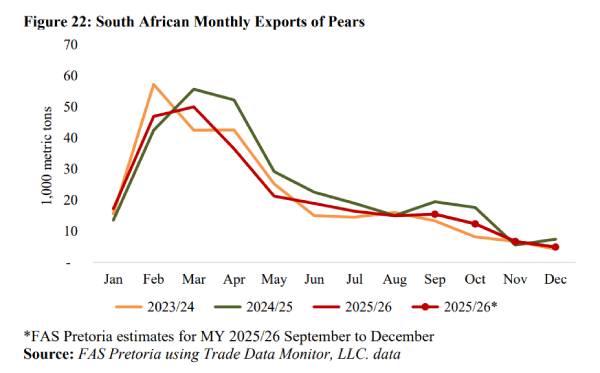
Image by FAS Pretoria
Nearly 61 percent of exports ship during the February-to-May harvest window. The European Union remains the top destination (27 percent share), where South Africa holds a dominant 43 percent import market share ahead of Chile and Argentina, bolstered by duty-free access.
Other key buyers include Russia (17 percent), the United Arab Emirates (12 percent), India (10 percent), and the United Kingdom (five percent), while shipments to the United States remain minimal at under 2,000 MT annually.
*Graphs courtesy of FAS Pretoria | Main image is referential via Shutterstock
Related stories
“The best is yet to come”: Optimism is driving South Africa's apple and pear industry
South African pome fruit sector posts nine percent revenue uptick