

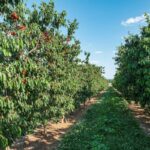
Early Chilean cherry growers preparing for harvest


Early Chilean cherry harvest is about to begin in the country’s main producing regions, with the industry preparing for another successful campaign in the Chinese market.

We spoke with expert cherry advisor Jorge Astudillo, who is currently working with Ovalle producers in Coquimbo, northern Chile, to discuss the upcoming season's projections and challenges. The cherry-growing area covers about 25 miles from the coast to the mountain range.
Astudillo explained that, from the recess conditions, orchard flowering response depends mainly on two factors: “The first is the date of application of hydrogen cyanamide and the use or not of technological packages that amplify the winter recess conditions.”
He indicated that, depending on whether they are used, homogeneous flowering with better sprouting can be observed, especially in those orchards that use the aforementioned technological packages.
In the case of cyanamide applications, the earlier the application, he said “we see an earlier flowering activation”.
Flowering and projections
Astudillo explained that flowering began in week 33 for Brooks, as it is a traditional variety, although a few days later than last season.
“We also found an orchard of Lapins, which received an application of early hydrogen cyanamide, with a very early flowering, even reaching petal fall almost a week earlier compared to the previous season,” he added.
Another aspect analyzed by the advisor is related to the accumulation of degree days, which “are at a third of what we had last year at the same date, due to weeks of low temperatures”.
He added that the Brooks variety is traditionally the earliest, and “should be more or less a week later than last year, which would allow harvests to be close to what the 2022 season was”.

When asked about the harvest projection, he said they should start after October 20.
“We had a good, rainy winter, with cold arriving very early in May, which allowed the start of bud-break and flowering to take place in a very good way,” he said.
As for the season’s projections, Astudillo commented: “We are going to have production in most of the varieties that are planted in Ovalle, among them the traditional ones such as Santina, Lapins, Brooks, Rainier, Glen Red and Royal Down, even Bing (which came mixed when some orchards were planted) and those that come from the new genetic programs such as Nimba, Pacific Red, Sweet Aryana, Cherry Cupid, Black Pearl, which will be very interesting, because it will allow us to know the phenology, the harvest dates of these varieties, the characteristics of their fruits and how they behave in our conditions.”
The threat of fruit flies

One issue that has certainly been a headache for growers in the region is the presence of fruit flies.
To address this situation, Astudillo explained that they are approaching it “as if China were blocked for air shipments”.
“Commercially, we are looking at other destinations where the fruit can be sent, such as Europe, the United States, the Middle East, Mexico or South Korea. It is the only alternative we see today for the earliest fruit, so that we can take advantage and ideally get the prices of prime fruit,” he stressed.
He indicated that last year they had the experience of sending early fruit to Europe, and that “returns were close to $12 per 2.2 lbs., which is not so low, considering that the average in general in previous seasons has been between $13 and $15 with sales in the Chinese market. Last year, orchards that managed to send fruit to China before the quarantine had returns of over 20 dollars”.
*Pictures courtesy of Jorge Astudillo.
Related articles: Chilean cherries close record-breaking 2023-24 campaign in China





Subscribe to our newsletter