
BRS Carina: The newly launched nectarine to expand Brazil's stone fruit supply in late November
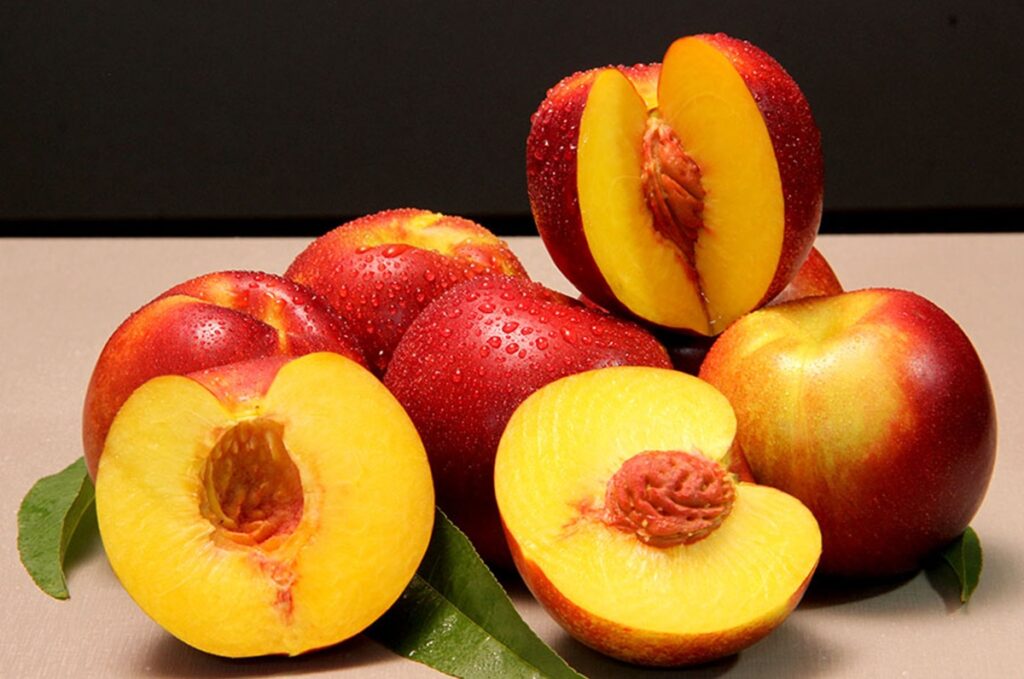

The Brazilian Agricultural Research Company (Embrapa) launched BRS Carina, a new nectarine cultivar developed for growing fruit in temperate climates. The cultivar stands out for its medium ripening cycle, its visual appeal, and its adaptation to the growing conditions of southern and southeastern Brazil.

The company emphasized that the main novelty of BRS Carina lies in its harvest window, which begins in the last week of November. This positions the fruit right after BRS Cathy (late October) and BRS Dani (early November), and before BRS Janita (second half of December), enabling it to complement the national nectarine supply.
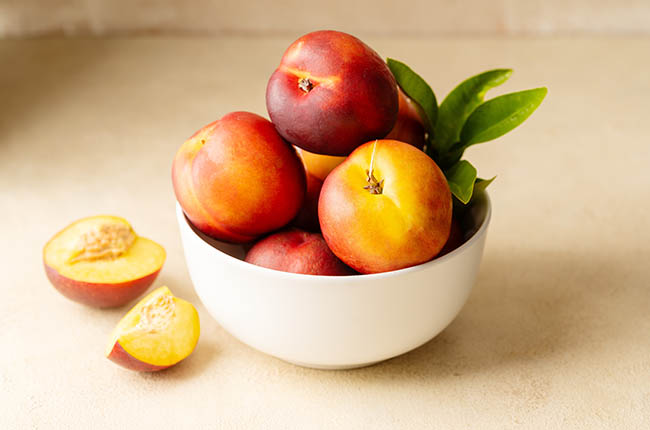
In addition to its production calendar, BRS Carina featured smooth, bright skin with intense red coloring, and sweet flavor with balanced acidity.
Embrapa indicated that its development responds to the need to diversify fruit production and generate new income opportunities for local producers. BRS Carina is also the result of an increased demand for nectarines, driven by the Brazilian market’s growing interest in the fruit.
Adaptation of BRS Carina and productive advantages
Assessed in different locations in southern and southeastern Brazil, BRS Carina showed good agronomic adaptation.
As explained by Rodrigo Franzon, a researcher at Embrapa Clima Temperado (RS), the variety will replace and complement older cultivars introduced from other countries.
"It is a more attractive fruit, with better coloring, better flavor, and, mainly, better adapted to the growing conditions of Brazil," said Franzon.
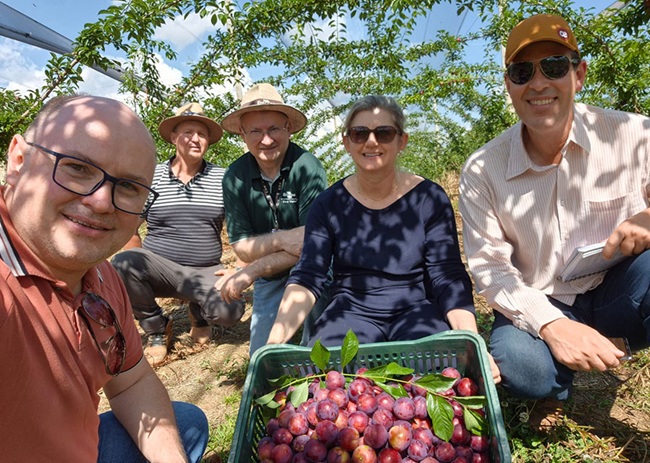
Official launch of the variety during a field day on the property of producer José Nichetti, in Rio Grande do Sul | Photograph via Embrapa.
BRS Carina, previously known as Necta 508, is a crossbreed between the Sunred and Rayon cultivars. It is adapted to the south and southeast regions of Brazil and requires between 200 and 300 chill hours (≤45°F).
The plants present medium vigor, with flowering generally happening between late July and early August. Harvest begins in late November, with variations depending on the growing area. BRS Carina has an average weight of 80 to 110 grams, a diameter of 5.5 to 6.5 cm, good firmness, and a soluble solids content of 11 to 17 Brix.
The skin is greenish-yellow, with more than 90 percent intense red coverage. The pulp is yellow, with possible reddish traces around the pit, which is semi-freestone. It presents a sweet-acid flavor and productivity exceeding 8 tons per acre, which can reach 12 tons per acre depending on management and the growing region.
Nectarine production and market in Brazil
Currently, Brazilian nectarine production cannot meet domestic market demand. The states of Rio Grande do Sul and Santa Catarina account for most of the production, which remains small compared to peaches.
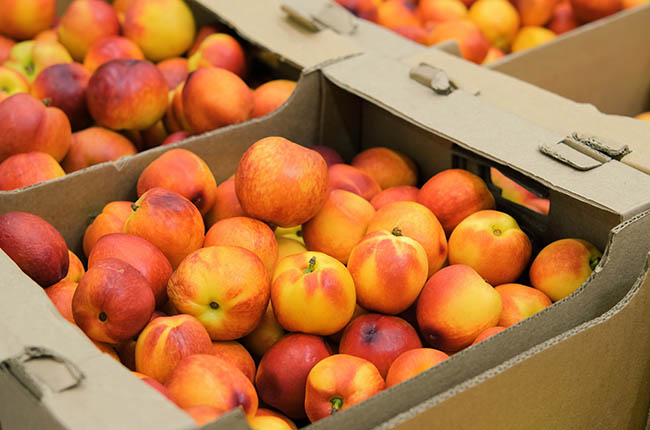
Between 2020 and 2024, Brazil imported an average of 5,450 tons of nectarines annually, a figure that in previous years exceeded 10,000 tons. One of the main factors limiting cultivation expansion was the scarcity of well-adapted, productive cultivars capable of producing high-quality fruit.
With the incorporation of new varieties developed by Embrapa, the landscape is expected to change, boosting national production and reducing dependence on imports.
Nectarine consumption in Brazil is on the rise, creating opportunities for both the domestic market and agricultural research to address logistical and climate challenges.
*Main photograph by Paulo Lanzetta via Embrapa; all other images are referential.
Related stories
China opens doors to multiple South African stone fruits in landmark agreement
European Union's peach and nectarine consumption to ramp up over the next decade



Subscribe to our newsletter