
Agronometrics in Charts: Driscoll’s on the essential need for Morocco’s shared blueberry data


The Morocco Data Club is a collaborative initiative launched by Agronometrics to advance market transparency in the Moroccan blueberry industry. The program consolidates weekly export data submitted by participating companies. Members gain access to timely insights on export volumes by destination, historical comparisons, and estimates of total market share coverage.

The initiative began as a closed group for contributing members to strengthen real-time visibility, improve decision-making, and bring greater discipline to one of the industry’s fastest-growing origins.
Maria Kattina Ipanaqué, Product Leader of Blueberries at Driscoll’s, spoke with Agronometrics at Fruit Logistica in Berlin about the launch of the Morocco Data Club and the value she believes it can bring to the Moroccan blueberry industry.
While category growth has been impressive, she believes the industry now needs to take the next step, starting with greater data availability and shared market intelligence.
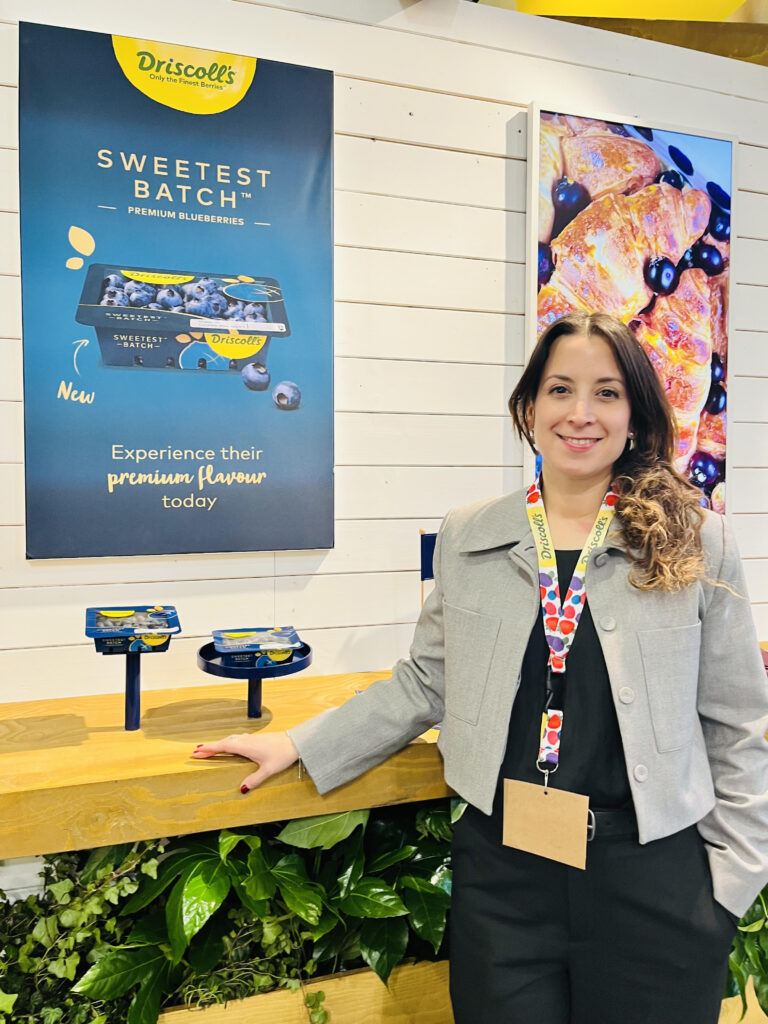
Kattina Ipanaqué - Product Leader at Driscoll's.
The data gap in Morocco
According to Ipanaqué, within Driscoll’s, blueberries are the category with the most market intelligence and data insights, thanks to the IBO Report. Additionally, reports from key industry players such as Peru and South Africa have set the benchmark for data quality.
In Peru, for example, forecasts are released before the season starts, making the projected shape of the volume curve public. As the season progresses, those projections are adjusted transparently. Detailed reporting, including varietal breakdowns, is shared through organizations such as ProArándanos.
“The bar is set very high when it comes to data intelligence,” Kattina explained.
That level of transparency allows strategy to be formed, tested, and adjusted in real time. Execution improves because the industry operates with shared facts.
When the calendar shifts to Morocco, however, the sentiment changes. “There is little to no timely data from Morocco,” she said. “It feels a little bit like walking into the dark.”
Currently, reporting often comes at the end of the season. While companies are navigating active programs, there is no consolidated in-season view. That absence of information triggers reactive behavior.
“When we lack information, we make our own assumptions in isolation,” Kattina said. “And that becomes reactive. High‑quality data enables reliable projections and plans. This is essential for both customers and our growers, as it supports strong category‑growth strategies and helps everyone anticipate rather than react."
The power of a shared market view

For Ipanaqué, a data-driven market view is not simply an input into strategy. It is the lens through which strategy is shaped.
Looking only at internal numbers provides only one side of the story. Collective data shows the full picture. That broader visibility allows companies to adapt and react in ways that ultimately lead to better outcomes across the overall industry.
The urgency is clear when looking at scale.
Peru now has more than 61,800 acres of blueberry production. Morocco has reached approximately 16,060 acres and has grown rapidly over the past decade. Now the industry needs to mature.
A fast-growing industry finding its footing
Morocco stands at what Ipanaqué describes as an inflection point.
The country’s growth has been extraordinary, with a compound annual growth rate of more than 20 percent over ten years, but the total industry remains highly fragmented. Numerous small players operate independently, and in some cases, act with a trading mentality in how fruit is commercialized.
“If you aggregate those smaller players, they become as big as the main players in Morocco,” she noted.
In more mature regions, consolidation tends to follow expansion. Morocco is likely heading in that direction. Additional acres, improved quality, commercial discipline, market integration, and consolidation will define the next phase.

South Africa provides an interesting comparison. With just over 7.4 thousand acres, it is smaller than Morocco, yet its reporting structures are stronger. Peru continues to refine its transparency year after year. The United States benefits from institutional reporting, such as the US Department of Agriculture and the US Highbush Blueberry Council (USHBC).
Importantly, these regions complement one another. Peru and South Africa learn from each other, and that creates healthy competition between the countries, as their seasons align sequentially. Morocco also complements Spain in the European window. The Hispanic country already benefits from established reporting mechanisms, further reinforcing the case that transparency strengthens, rather than weakens, competitive positioning.
Beyond Spain and Morocco, emerging origins such as Egypt and Türkiye may also play complementary roles.
Growing smarter
Morocco’s future growth will not be without constraints. In southern production areas, land, water, and labor availability will limit expansion. Climate pressures are already forcing adaptation and diversification. The industry will need to learn from these pressures and adjust structurally.
Within Driscoll’s global sourcing strategy, Morocco plays a crucial role. Through its partnership with Costa/African Blue, Driscoll’s has been expanding volumes. The origin is considered strategically important not just for timing, but for quality and long-term value.
At the same time, Ipanaqué acknowledged that varietal improvement is essential. Driscoll’s has, and will continue to focus on developing the best-tasting varieties while ensuring they are efficient to grow and resilient.
Why the Morocco Data Club is a “no-brainer”

For years, industry players have been asking for a coordinated data-sharing body in Morocco. The absence of such an organization has been a major gap.
“That’s what we’ve been lacking: the absence of a body,” Kattina said.
The launch of the Morocco Data Club addresses that void. She credits Agronometrics for stepping in to build the framework.
“For us, it is clear that we need to participate here,” she said. “It’s really a no-brainer.”
While participation carries a cost, she believes it will create a snowball effect. As more companies join, aggregated information will grow, and transparency will benefit everyone.
Setting the precedent with Morocco
When asked whether similar initiatives should be introduced elsewhere, Ipanaqué was pragmatic.
Peru is already covered. Southern Africa is covered. Summer production across North, Central, and Eastern Europe, around 74,130 acres, is largely local-for-local and may be harder to consolidate. Industry entities like the IBO are already helpful in quantifying fruit volumes at different times of the year.
There is also a broader strategic question around premiumization. Much of the global volume still relies heavily on public genetics. Advancing the category toward better-tasting varieties is the next frontier.
But for now, priorities for Driscoll's are clear. Before expanding data initiatives to other regions, Morocco needs to solidify its position.
“If we solidify Morocco as an industry overall, we set a good precedent for the future,” she said.
Morocco has proven it can grow. The next challenge is proving it can mature, with consistency, discipline, and a shared view of the market.
*All images are referential.
Related articles
Agronometrics in Charts: Achievements and prospects of Morocco's blueberry journey
U.S. and Morocco establish new bilateral container security partnership
Morocco's citrus production is on the rise with mandarins leading exports, USDA says









Subscribe to our newsletter