

Microwave sensors revolutionize peanut grading with real-time quality checks
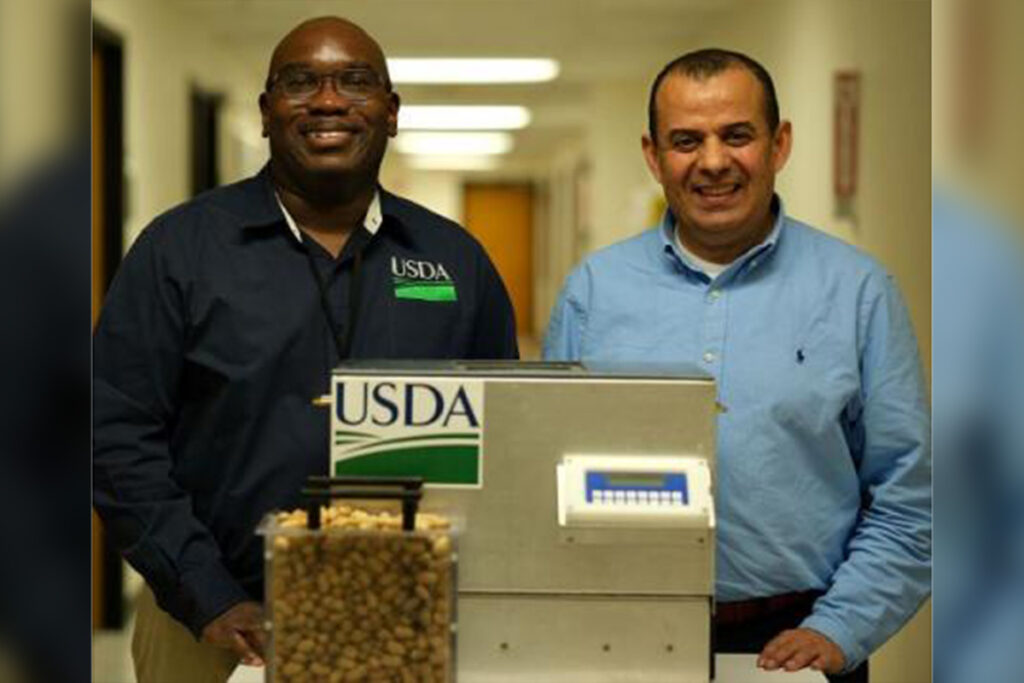

This story was originally published on the USDA Agricultural Research Service website in April 2026.

by Jessica Ryan, ARS Office of Communications.
United States Department of Agriculture (USDA) Agricultural Research Service (ARS) experts are modernizing the multibillion-dollar peanut industry by developing microwave-based sensors that quickly capture and accurately measure multiple quality attributes of unshelled peanuts.
This technology will help the US peanut industry achieve significant savings in time and money when grading peanuts for quality.
The research was spearheaded by Research Electronics Engineer Samir Trabelsi, former Research Agricultural Engineer Stuart Nelson, and Research Agricultural Engineer Micah Lewis from the US National Poultry Research Center’s Quality and Safety Assessment Research Unit, in Athens, GA.
Optimizing the peanut-grading process with microwaves
The project aims to help peanut inspectors who perform the labor-intensive task of checking the nuts’ physical characteristics, such as kernel moisture content, size, meat content (how much edible kernel is inside the shell), and quality.
Referential image
Moisture content, in particular, is a major attribute for peanut quality since the fruit must be dried after harvest to a safe moisture level below 10.49 percent before grading and storage. If kernels are too moist, they cannot be sold as they can develop mold and toxic compounds known as aflatoxins. Conversely, if the kernels are too dry, their quality is diminished, and they cannot be sold.
Currently, peanut kernel moisture content is determined at the end of the grading process after cleaning, through visual inspection, sizing, and shelling about 500 grams of the peanut sample. Of those, 250 grams are tested for moisture with an official moisture meter.
ARS developed microwave sensing technology to determine peanut kernel moisture content without shelling them. By moving this step to the front of the grading operation, it’s possible to skip the rest of the process when moisture is high, significantly saving time and labor.
According to Trabelsi, over the last few years, a benchtop in-shell moisture-sensing system operating at a microwave frequency of 5.8 GHz was developed into a commercial product and is now available to the peanut industry. In recent field testing, the system was found to track the oven-drying method with an average error of +/-0.5 percent.
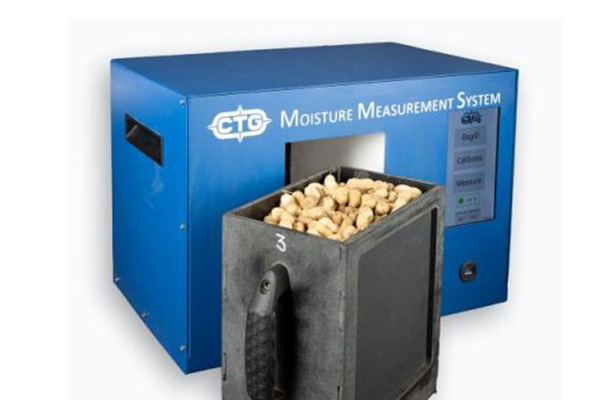
Image by Jerry Heitschmidt, courtesy of USDA ARS.
In October 2025, the USDA’s Agricultural Marketing Service approved the benchtop moisture-sensing system for use with clean in-shell samples. The agency is evaluating additional data to approve the system for use with samples that contain foreign material.
Alternative microwave uses in the peanut value chain
The same technology was applied to monitor the drying process.
“The current method for checking moisture during drying involves taking samples every few hours, cleaning and shelling them, and testing with an official meter,” said Lewis. “This process is slow and doesn’t provide real-time data, which can lead to inefficient drying, wasted energy, and quality issues.”
To accelerate the process, ARS researchers developed a real-time peanut drying monitoring system that measures moisture in unshelled peanuts every 12 seconds using a single microwave frequency.
“It’s a quick and nondestructive process,” said Lewis. “It also allows for continuous monitoring of drying conditions with Wi-Fi-enabled technology.”
Referential image
Researchers are also studying new ways to use their microwave technology to measure other attributes in peanut grading.
In a 2025 study, the researchers used the same microwave technology to measure bulk density (how heavy peanuts are for their size) and meat content, two additional and important attributes in peanut grading. They found that their method was accurate and much faster than traditional grading, reducing processing times by up to 60 percent.
Researchers are also looking to apply their technology to other in-shell nuts such as pecans, walnuts, pistachios, and almonds, as well as cereal grains. The experts say they’re also looking into using this innovation to determine moisture content in poultry litter.
“Our vision is to have a ‘one-stop’ instrument that farmers and inspectors can use for inspecting their crops,” said Trabelsi.
*Main photo by Lily Lofton, courtesy of USDA ARS; all other images referential unless stated otherwise.
Related stories
More pollination hours and better hive health—the science behind Beeflow technology









Subscribe to our newsletter