Southern Hemisphere citrus forecast: Production down 6 percent, exports expected to rise 4 percent

 Add Fresh Fruit Portal to Google
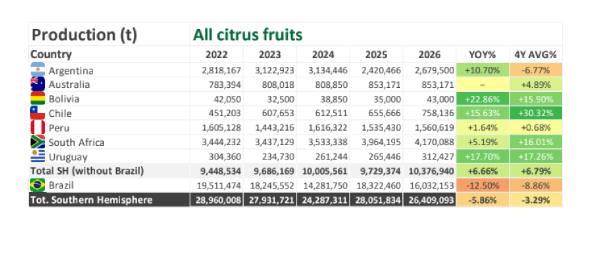
During the World Citrus Organization's 7th Annual General Meeting, the industry shared the preliminary citrus forecast for the upcoming Southern Hemisphere season. Projections included numbers from producing countries such as Argentina, Australia, Bolivia, Brazil, Chile, Peru, South Africa, and Uruguay.
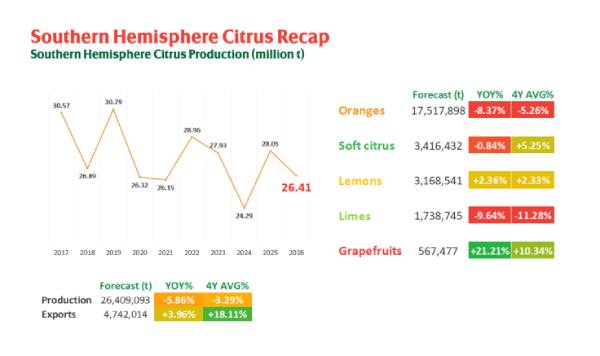
Citrus production is expected to decrease by nearly six percent year on year, to an estimated 26,409,093 tonnes.
Exports, however, are expected to continue increasing, with a projected growth of four percent compared to 2025, reaching 4,742,014 tonnes.
These first estimates will be revised following the publication of the Fundecitrus forecast for Brazil on May 8th, 2026.
Citrus forecast: Oranges, lemons, and limes see contractions
In the Southern Hemisphere citrus forecast, orange production is forecast to decrease by over eight percent compared to 2025, to 17,517,898 tonnes. Soft citrus will only decrease slightly by less than one percent to 3,416,432 tonnes.
Lemon production is estimated to shrink by a little over two percent to 3,168,541 t in total, while limes will see a much more dramatic contraction of nearly 10 percent, totaling 1,738,745 tonnes.
On a more positive note, grapefruits are forecast to reach 567,477 tonnes, a more than 21 percent jump from 2025's total.
The challenges facing the Southern Hemisphere citrus industry
In a press release announcing the citrus forecast, the World Citrus Organization emphasized the citrus community's deep concern about the direct and indirect impacts of the Middle East crisis in the region and beyond. These, they say, will strongly impact logistics costs, availability, and the access and costs of agricultural inputs such as fertilizers.
Consumption trends also remain a concern.
The industry body said that last year’s Southern Hemisphere trade boom did not reflect stronger demand for citrus but rather a supply shortage in the Mediterranean basin, which presented a significant opportunity for Southern Hemisphere producers.
For the region's new season, the organization recommended a more careful approach to supply in Europe and the Middle East, where consumption drivers will need to be monitored.
*Graphs courtesy of the World Citrus Organization.
Related stories
World Citrus Organization forecasts dip in Northern Hemisphere citrus output for 2025–26
Florida citrus challenges freeze woes with new (and improved) forecast
South African citrus exports projected to grow up to 5 percent in 2026