Pioneering AI model “cracks” the secrets of peanut flavor code
 Add Fresh Fruit Portal to Google
The quest for the perfect peanut just found a new ally. Researchers at the University of Georgia (UGA) are giving breeders a massive technological leap forward with a pioneering machine-learning model that serves as an ultra-efficient, data-driven "taste tester."
Flavor—a trait that largely dictates success in the snack aisle—has historically been a bit of a guessing game in agricultural breeding, as even tried-and-true cultivars can present discrepancies. That’s where Joonhyuk Suh's team comes in.
“Flavor evaluation is currently one of the slowest and most expensive bottlenecks in peanut breeding,” said Suh, assistant professor in UGA’s Department of Food Science and Technology. While human sensory panels remain the gold standard, Suh explained to FreshFruitPortal.com that they require large samples that typically aren’t available until late in the breeding pipeline—often after years of field selection.
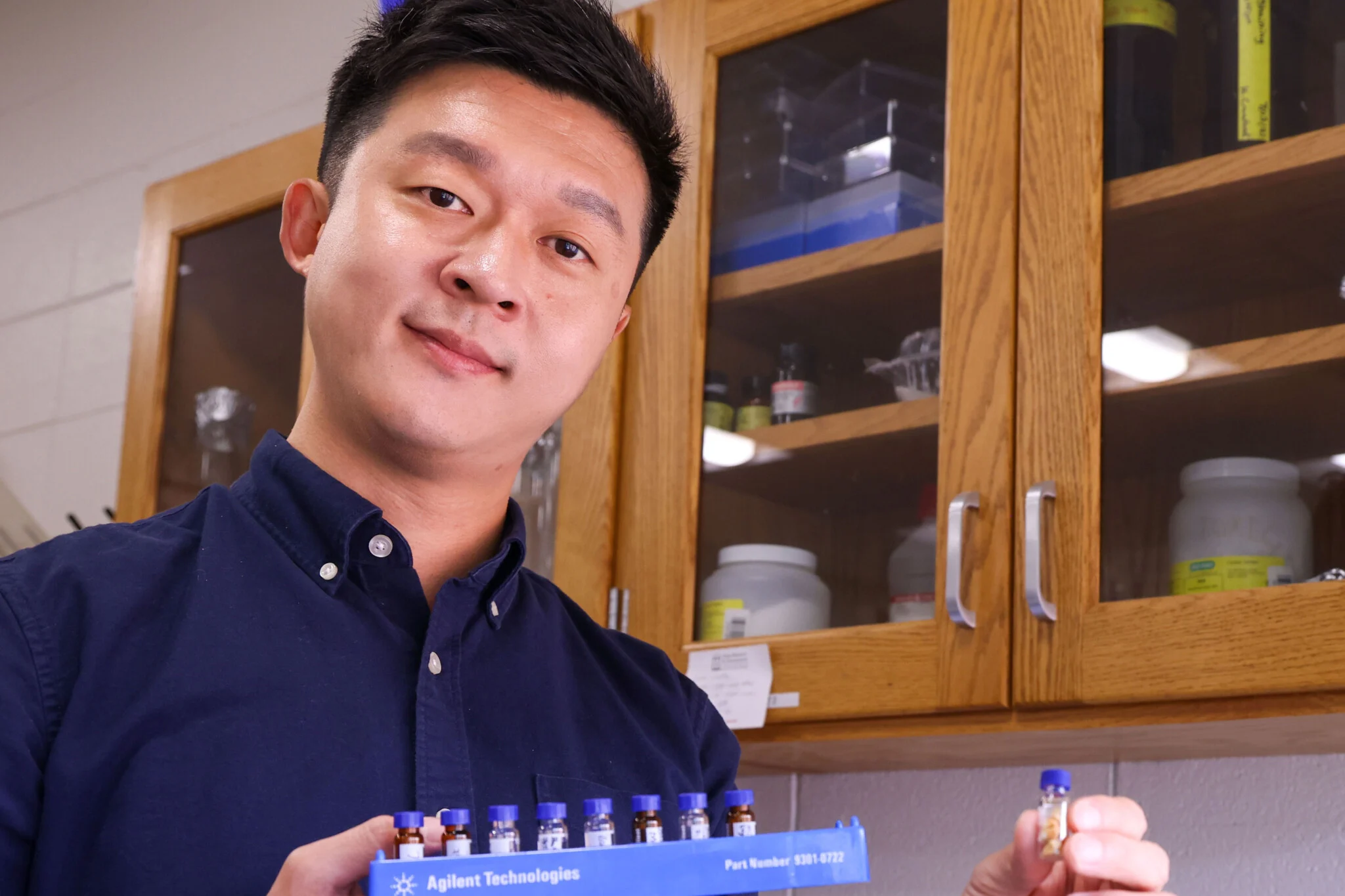
Photo by Caroline Newbern | UGA
A multi-disciplinary collaboration, Suh’s project promises to cut development costs and accelerate the delivery of consistently flavored peanut varieties, fundamentally transforming how one of the state’s most profitable crops is bred.
“People often picture a researcher working alone in a lab, but this project has been the opposite,” Lee said regarding the model’s development. “Our team brings together food chemistry, sensory science, machine learning, and peanut breeding, fields that might not seem like obvious partners.”
Thanks to this integrative approach, the model can predict a roasted peanut's full flavor profile years in advance of traditional methods by analyzing the precise chemical fingerprints in raw peanuts.
The goal is to give breeders a faster way to sort through hundreds of experimental peanut lines during the earliest stages of development, when only tiny sample sizes are available.
According to the United States Department of Agriculture, the US produced approximately 6.1 billion pounds of peanuts in 2025, with Georgia accounting for roughly half of the national production.
Roasting up a data-driven peanut tasting
Environmental conditions, genetics, maturity, and post-harvest handling all influence peanuts’ chemical profile before roasting begins, further complicating efforts to predict flavor outcomes.
“The biggest challenge is that peanut flavor is not the product of one or two chemical compounds, but of a complex mixture of compounds and their relative levels,” Suh explained.
Suh said the team uses chemical profiling alongside sensory panel data and machine learning to identify patterns linked to favorable roasted peanut flavor.
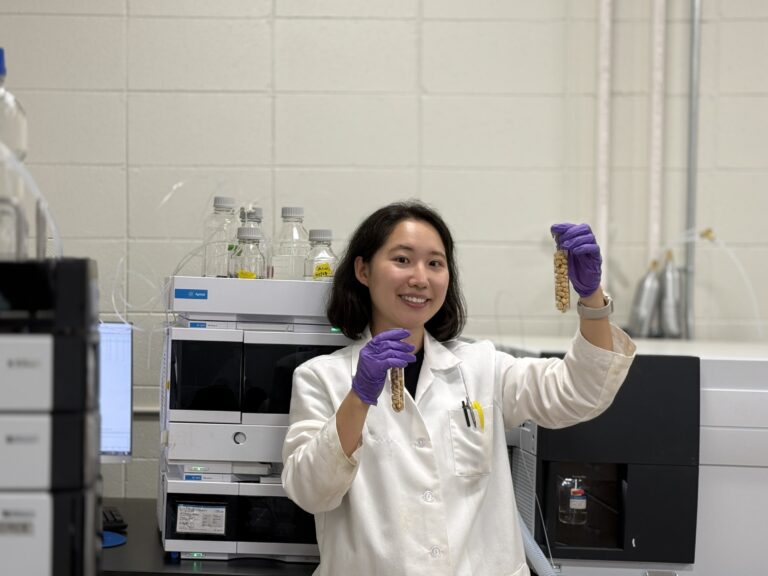
Photo courtesy of Namhee Lee.
The project has already identified several pyrazines, a class of naturally occurring or synthesized nitrogen-containing compounds associated with roasted and nutty flavor notes, as well as sugars and amino acids that contribute to the development of flavor precursors. Suh said the team continues refining which compounds serve as the most reliable predictive markers across cultivars and growing seasons.
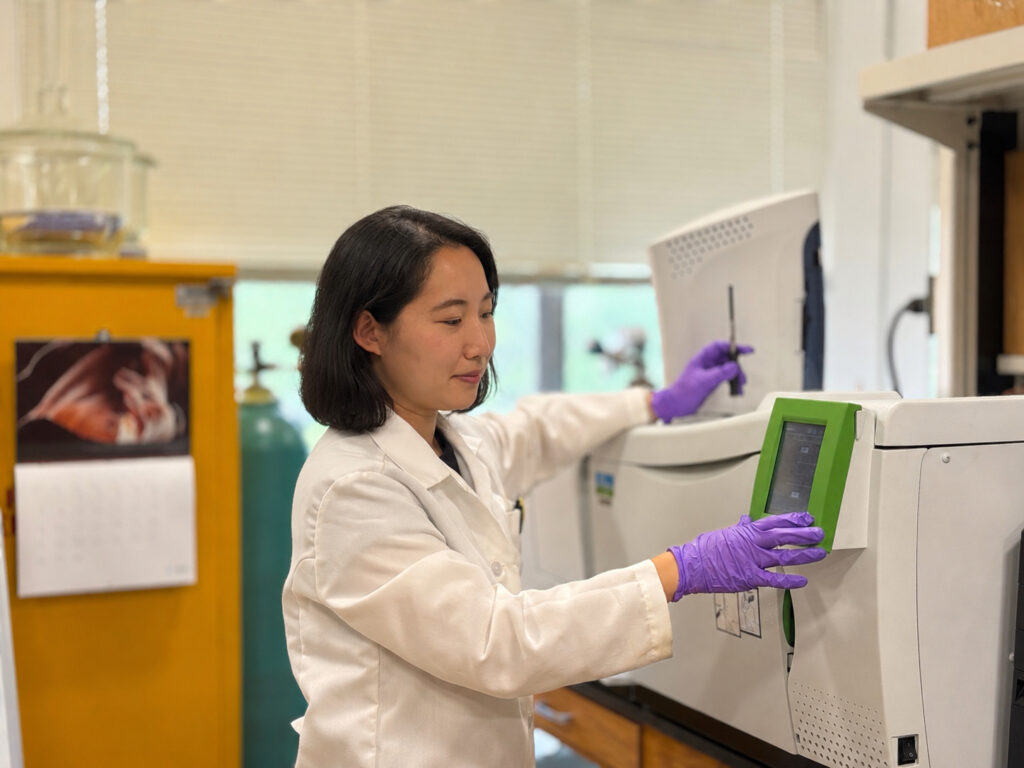
Namhee Lee, a graduate researcher in Suh’s lab who led much of the project’s analytical and modeling work, said one of the hardest parts of the project was perfecting the extraction method for identifying and tracking the flavor markers.
“Roasted peanut aroma comes from compounds that disappear fast once they're released, so you have to carefully tune the temperatures, timing, and conditions to catch them before they're gone,” she stressed.
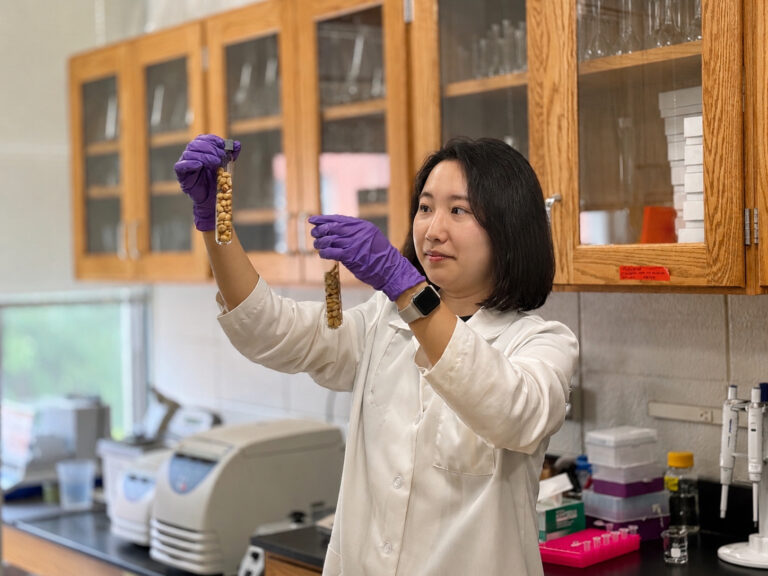
Photo courtesy of Namhee Lee.
The work also suggests the possibility of predicting roasted peanut flavor from raw peanut data prior to roasting.
“If that holds up, it could make screening even faster and simpler, because you wouldn't need to roast every sample before analyzing it,” said Lee.
These findings could directly influence decisions made in the field, a contribution that, Lee said, is incredibly meaningful for her at a personal level.
“What has meant the most to me personally is realizing that my work as a food chemist can directly contribute to peanut breeding. Seeing that connection has given me a real sense of pride as a scientist,” she said.
Cracking the flavor code
Another key feature of the project is that the model does not need perfect accuracy for early-stage screening to become commercially useful, Suh explained.
“What matters most is its ability to ‘rank and discriminate’ among breeding lines reliably,” he said.
The research could help breeders eliminate lower-potential varieties before committing years of resources to field development and sensory testing.
“It could give breeders and researchers a faster, more objective, and scientifically grounded way to compare flavor differences across varieties at those early stages, when sensory evaluation isn't yet practical,” Lee said.
Suh said the framework could eventually extend beyond peanuts into other produce and specialty crop breeding programs where flavor remains difficult to measure early in development.
“I am confident that our framework is broadly transferable,” Suh said. “Any crop or fruit where flavor is a complex function of many compounds, and where sample quantities at early breeding stages are too small for traditional sensory evaluation, is a strong candidate.”
*All uncredited photos are referential. | Main photo courtesy of Namhee Lee.
Related stories