Agronometrics in Charts: 2026 retail food prices hold steady as farm-level returns weaken
 Add Fresh Fruit Portal to Google
Each week, the series ‘Agronometrics In Charts’ examines a different horticultural commodity, focusing on a specific origin or topic and visualizing the trade market factors driving change. Check out our entire archive.
The latest USDA Economic Research Service (ERS) Food Price Outlook, released June 25, positions fresh fruit as the most stable category in the produce aisle.
Retail fresh fruit prices rose 0.6 percent from April to May 2026 and stood 2.1 percent above year-ago levels. For the full year, ERS projects retail fresh fruit prices to rise two percent, within a 95-percent forecast range of a 0.3 percent decline to a 4.4 percent gain.
The picture diverges one stage upstream. Through the first four months of 2026, the prices growers received for fruit declined year-over-year, down 12 percent in January, 8.5 percent in February, 10.4 percent in March, and 6.2 percent in April. A 5.7 percent month-over-month increase in May returned the farm-level series to positive territory, at 3.9 percent above the prior May.
Even so, ERS still forecasts farm-level fruit prices to close 2026 down 3.6 percent on the year.
Stable retail prices mask volatility
This divergence, modest gains at retail against softer returns at the farm gate, is the central dynamic in the release. Retail pricing typically absorbs the volatility that first reaches growers, as packing, cold chain, transport, and merchandising costs constitute a large, relatively fixed share of the final consumer price.
For producers, the implication is less favorable: the early-year weakness was material, and a single strong month does not offset a full-year forecast that remains negative.
The data also carries a forward signal. Because producer prices sit upstream of consumer prices, the Producer Price Index typically leads the Consumer Price Index. The four-month decline at the farm gate has not translated into lower retail prices, indicating that downstream costs are absorbing the movement.
May's 5.7 percent increase nonetheless warrants attention: should it prove a durable shift, it could push retail fruit prices toward the upper end of the 2026 forecast range. For now, fresh fruit remains stable at retail but is under pressure at the farm gate.
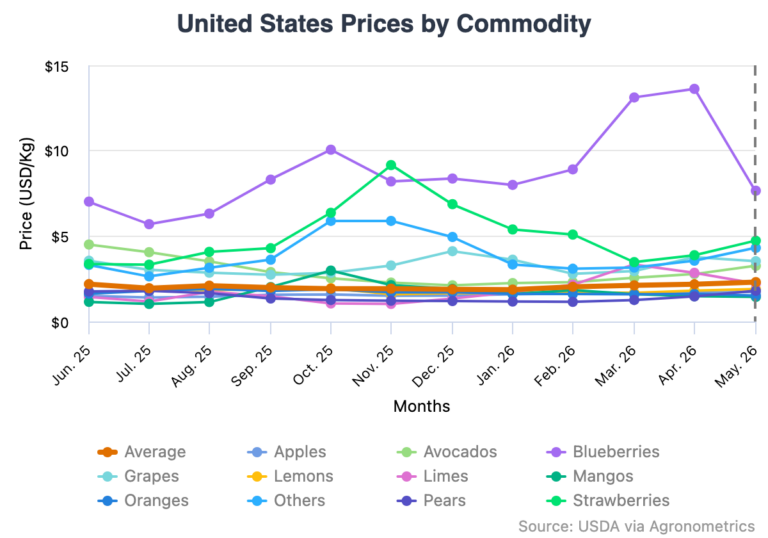
Source: USDA Market News via Agronometrics.
*All images are referential; graph courtesy of Agronometrics.
Related stories