US apple industry rallies for legislative relief as labor costs reach critical levels
 Add Fresh Fruit Portal to Google
United States apple growers are looking to Washington for a little more breathing room as labor costs continue to squeeze orchard economics.
USApple Vice President of Communications Lyndsee Gibbons told FreshFruitPortal.com that the organization is in full support of the Securing Agriculture’s Workforce Act (SAWA), introduced by Pennsylvania Republican representative G.T. Thompson.
The proposed legislation seeks to codify changes to the H-2A program, including a methodology that limits year-on-year increases in wage rates and accounts for housing and transportation costs provided by growers.
“For specialty crops, especially apples, which are highly labor-intensive, at least 60 percent, and in some cases more, of total production expenses go toward labor. Given the rapidly increasing labor costs we've seen over the last 10 years, this has resulted in a truly unsustainable position for many multi-generational family farms,” Gibbons stressed.
The industry has become increasingly reliant on H-2A workers because of the concentrated nature of the apple harvest, Gibbons explained. She noted that growers often need large numbers of workers during a relatively short harvest window, making it difficult to assemble a sufficient domestic workforce.
Gibbons said the bill initially attracted about 50 co-sponsors from both parties, including lawmakers representing major apple-growing states such as Michigan, New York, and Washington.
The legislation still needs Senate action and would need to pass during the current congressional session.
US apples chase retail momentum
Labor woes come as growers also face difficult decisions over orchard investment. Apple trees and grafts usually take years to reach production, meaning growers must make variety decisions well before they know how consumer and retail demand will pan out.
The industry itself identified retail engagement and category development as the second-most important investment area for the next five years in a live poll conducted during the Industry Outlook presentation event last month. It ranked only behind production practices.
Apples have increasingly lost front-of-store space to berries and imported produce, according to USApple’s report. Gibbons said the sector remains vigilant of changing trends.
“We are exploring ways to ensure apples remain top-of-mind, whether by developing more effective point-of-sale signage or leaning into different seasons throughout the year,” she noted. “Those conversations are happening daily among marketers and those working with retailers.”
While packing automation, artificial intelligence, and robotic harvesting continue to lead research efforts to improve orchard management and refine production, Gibbons said growers' decisions have also been influenced by consumer behavior.
“Our industry is closely tracking consumer health priorities, such as fiber intake, protein, 'real food,' and GLP-1s, which are influencing how retailers market and sell food. This was a significant topic of discussion at the conference,” she said.
Balancing varietal strategy and export growth
While the internet might feel differently, Red Delicious remains the second-most-produced apple variety in the US, accounting for 12 percent of projected volume cited in the Outlook report. The variety retains an important role in export markets, particularly Mexico and India, where demand remains stronger.
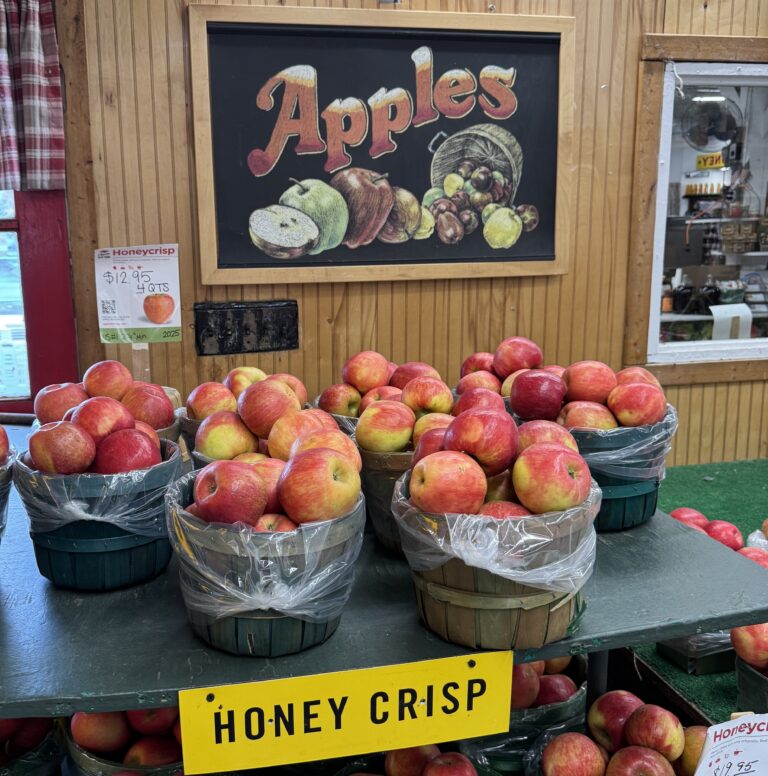
“It travels well, because it has a bit more hearty exterior than other varieties, like a Honeycrisp,” Gibbons said, but noted that production has continued to decline.
The executive stressed the breadth of the apple category gives retailers opportunities to serve consumers across multiple price points, from more affordable offerings to premium varieties.
USApple and industry marketers are looking at point-of-sale programs, seasonal promotions and efforts to keep apples visible beyond the traditional fall selling period.
The upcoming crop is expected to be somewhat smaller, according to Gibbons, although she said production remains substantial. Regional conditions vary, with some growing areas recovering from drought while others experienced cold snaps that could shift a greater share of fruit toward processing.
“A larger percentage of that fruit will likely go to processing this year rather than the fresh market. But we are seeing strong processing prices, which serve as a great release valve that allows some of the product to move in that direction,” she said.
On the export side, Mexico and Canada remain the industry's most important markets. The neighboring countries account for 39 and 19 percent of US apple exports, respectively. Gibbons said maintaining access to those markets, including through the US-Mexico-Canada Agreement renewal process, remains a priority.
“India is definitely a market that we're excited to keep growing after those tariffs were removed a couple years ago,” the executive said.
USApple is also seeking progress in Japan, where non-tariff trade barriers currently prevent US apples from entering the market, Gibbons said.
“Some officials from Japan visited Washington state last year to observe our harvest and post-harvest processes. Japan is a market that already successfully imports cherries, so we believe it is a natural fit,” she emphasized.
As the new crop moves into stores, the sector is looking for strong early-season movement while also emphasizing year-round consumption.
“We are looking forward to another strong crop with plenty of high-quality apples for consumers to enjoy in the year ahead,” Gibbons concluded.
*Images courtesy of USApple.
Related stories