Northwest cherry season closes with volumes below initial forecast due to weather disruptions
 Add Fresh Fruit Portal to Google
Industry body Northwest Cherry Growers finalized the 2026 season tally for the 5-state producing region at 18,201,275 (20 lb. equivalent) boxes. The result is slightly below the lower end of the estimate issued in May, which put the sector’s expectations between 18.4 and 19.2 million boxes.
That forecast was already revised down from the first round published in April, which put the region’s production for the year at up to 21.5 million boxes. The update, the industry body explained, was mainly due to weather disruptions, which hit orchards repeatedly throughout the season in the form of frost, wind, and rain.
In an end-of-season report released by Northwest Cherries on October 8th, the industry body was adamant that, given the multiple weather disruptions hitting the producing regions, the industry was pleasantly surprised by the final tally.
“The 2026 cherry season was anything but predictable,” the industry body wrote. “Crop estimates shifted throughout the season as weather took its toll, leaving many expecting a much smaller final crop. But when the season wrapped and the final numbers were tallied, the result surprised us all.”
Northwest Cherries reported “strong fruit quality across the board,” and consistency across size, sugars, and firmness.
West Coast cherry supply is down
Although they’re different regions ruled by different growers’ associations, the cherry industries in California and the Northwest are intimately related. The end of the Golden State season overlaps with production from its neighbors to the north, which keeps momentum going at retail and sets pricing for the remainder of the season.
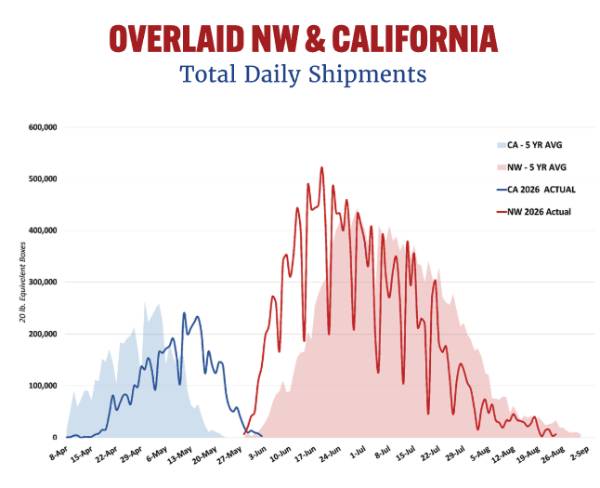
Image by Northwest Cherries
This year, however, weather disruptions hit California hard. Warm temperatures at the end of the winter woke trees up ahead of time, and unforgiving rains and frost decimated the state’s production and fruit quality.
California closed its season with 5.55 million boxes, putting West Coast supply for 2026 at 23.2 million boxes. For the past three seasons, the region's combined output had surpassed 28 million boxes, putting this year’s tally 17 percent below the recent average.
Changing cherry dynamics in the Northwest
With an abrupt end to the California season in June (when packout was 965,231 boxes lower than the same month the previous year), overlap with the Northwest campaign this year was minimal.
However, a shifting trend in the 5-state region kept momentum going at retail, as producers are increasingly moving more fruit volume at the start of the campaign.
“Over the past two seasons, more than 2.4 million boxes have shipped within the first 14 days,” Northwest Cherries said in its report. “This is about 71 percent more volume than five years ago.”
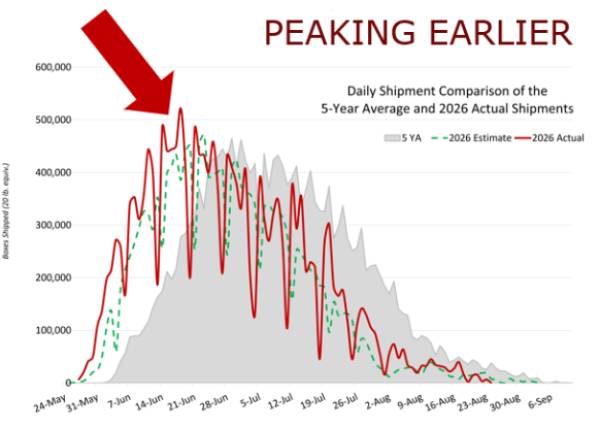
Image by Northwest Cherries
According to the industry body, this poses a marketing challenge needing strategic planning to front-load retail promotions and prepare retailers to move fruit as promotable volumes build. This, the organization said, will help create strong momentum for the remainder of the season.
In the same vein, Northwest Cherries called on the industry to support and educate retailers on the correct promotion of cherries.
“Retailers need to be reminded to monitor their displays, and when the product begins to look tired and old, it needs to be removed,” the organization said. “We cannot have old product regardless of origin sitting on the shelves. This will not help repeat purchases.”
What hasn’t changed are exports. The region historically ships around 30 percent of its cherries abroad, and both destinations and market shares remained roughly unchanged this year. Canada is the largest international buyer of Northwest cherries (10 percent), followed by Asian countries, which slightly increased their participation this year. China increased its market share from four percent to six percent, while Korea doubled theirs from two to four percent.
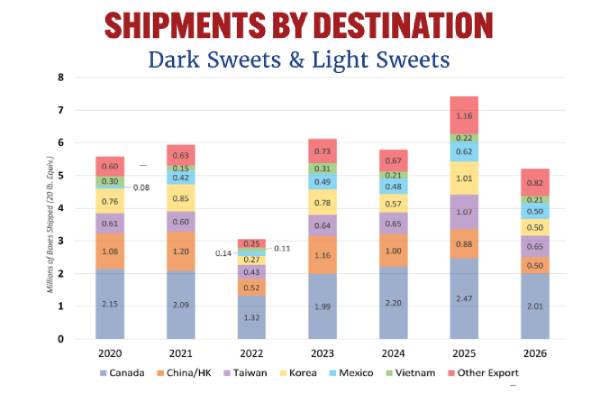
Image by Northwest Cherries
*All graphs courtesy of Northwest Cherries.
Related stories
Weather abnormalities and quality issues bring California’s cherry season to an abrupt end