




Chilean cherry sector defends top spot with a focus on quality and Ice & Snow Festival in China

 Add Fresh Fruit Portal to Google
Writing and reporting by Macarena Bravo | Lee esta noticia en Español
With shipments running below last season and arrivals peaking earlier than usual, the Chilean cherry sector is doubling efforts to stay on top. The Andean country is turning to aggressive promotion and quality-focused production to defend its leading position in China.
Last year, Chile exported nearly 471,000 metric tons of cherries by week 52, equivalent to about 1.04 billion pounds. This was more than 85 percent of the projected volume for the season, according to data firm Decofrut.
Weather-driven early harvests pushed the shipping peak forward by about ten days. This forced exporters to adjust logistics and confront heavy arrivals in late December and early January, traditionally a slower demand period in China.
Chilean fruit guild Frutas de Chile President Iván Marambio says shipments this season will trail last year’s volumes, a shift that required rethinking supply chain planning.
Ice & Snow Festival puts Chilean cherry sector in the winter spotlight
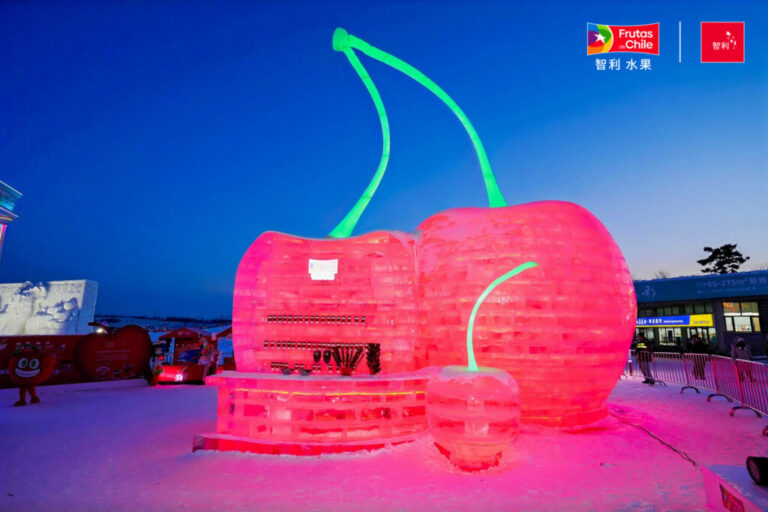
To support demand, the industry launched the Chilean Cherry Ice & Snow Festival, a promotional campaign tailored to the Chinese market, which ties cherries to winter sports, outdoor activities, and health-focused consumption.
“It's not just a single event, but a comprehensive effort with multiple activities in different cities,” Marambio says.
The campaign began in December and will run through the end of January as the second phase of the Chilean Cherry Committee’s China strategy. According to the organization, it includes retail activations, digital and social media outreach, livestreaming, influencer collaborations, and traditional media exposure, with support from supermarkets, e-commerce platforms, and specialty fruit retailers.
The goal is to encourage immediate consumption, reinforce cherries’ premium positioning, and strengthen consumer confidence.
Frutas de Chile officially launched the festival at Ice & Snow World in Changchun. Chile’s ambassador to China, Pablo Arriarán, led the event alongside local officials and representatives of the China Chamber of Commerce for Import and Export of Foodstuffs.
“Economic and cultural exchange between our countries has flourished since the Free Trade Agreement came into force in 2006,” Arriarán says, adding that cherries have become one of the main pillars of bilateral trade, with exports approaching $3.3 billion during the 2024–25 season.

The launch featured cherry-themed ice sculptures, tastings, interactive exhibits, and evening shows. Chinese actress Ma Sichun, narrator of the documentary Sweet Miracle, was also present. Organizers describe the film as the most-watched fruit documentary in China in 2025.
Claudia Soler, director of the Chilean Cherry Committee, says the festival aims to stimulate consumption in early January, focusing on higher-income consumers seeking premium products linked to health and well-being.
Promotional messaging highlights flavor and eating experience, as well as attributes such as low glycemic index and the fruit’s potassium, magnesium, and anthocyanin content.
Lower volume, firmer fruit
According to Decofrut, Chilean cherry shipments to China are down three percent from the same point last season, while total shipments to the Far East are down about six percent.
Decofrut President Manuel José Alcaíno attributes the decline to production decisions and weather, rather than weakening demand. He cites early pruning of early varieties to prioritize size and firmness, which reduced yields per acre, along with weather conditions that affected fruit set.
The result, he says, is larger fruit with better transit performance and improved competitiveness, even at lower overall volume.
Prices under pressure as arrivals stack up

Heavy arrivals in late December weighed on prices. Julio Ruiz-Tagle, Asia & Americas manager at D-Quality Survey, says imports during week 52 exceeded last year’s levels.
“Today, it is possible to get a true snapshot of the market: there is plenty of stock and supply exceeds demand, which explains why prices remain stable but at lower levels than last season,” Ruiz-Tagle says.
He estimates that about 4,000 containers of Chilean cherries arrived in China during the first week of January. In major wholesale markets such as Shanghai, Putian, and Wuhan, daily movement ranges from 160 to 180 open containers, with roughly 50 to 60 percent selling each day. At that pace, clearing existing inventory could take up to 22 days, continuing pressure on pricing.
Ruiz-Tagle notes a key difference from last season: “Today, prices are low, but the fruit is moving. Last year, with low prices, the market was practically paralyzed. That is a significant improvement.”
Related stories
Copefrut puts quality first as Chilean cherry season hits midpoint
Chile's first seaborne cherry shipment sails to China on the Cherry Express service
Chilean cherry sector looks to the US market amid higher supplies
Chile's cherry season expects smaller yield but better fruit
Chilean cherry sector set for record 2025-26 season, targeting new markets beyond China










