Mexican mangoes: How the tropical fruit has conquered North American hearts and palates
 Add Fresh Fruit Portal to Google
By Francisco Seva Rivadulla, International Agri-Food Journalist
In the realm of global agro-commercial flows, the relationship between the Mexican mango industry and the North American market is among the most successful and solid in recent decades.
This alliance uniting the Aztec country with its neighbors to the north, the United States and Canada, has not only positioned Mexico as the undisputed leading supplier of the tropical fruit but has also become the financial backbone for thousands of local families.
A partner of historical dimensions
The North American market is, by far, the main destination for Mexican mangoes, absorbing nearly 90 percent of total exports.
The countries’ geographical proximity is not just a logistical advantage but also an ecosystem of mutual trust in which American and Canadian consumers have integrated Mexican mangoes into their daily diet as a basic product.
For the 2025-26 cycle, projections indicate that demand will continue to rise. The dynamism of this market enables Mexico to ship north more than 65 million boxes annually, generating an economic benefit exceeding $500 million.
Precision logistics and geographic advantages
The great strength of this relationship lies in border efficiency. Unlike other South American competitors depending on long sea voyages, Mexican mangoes arrive on consumers’ tables only days after harvest.
A robust infrastructure connecting the region allows for seamless land transportation. This, in turn, guarantees freshness, as fast truck distribution allows the fruit to be cut at its optimal point of maturity.
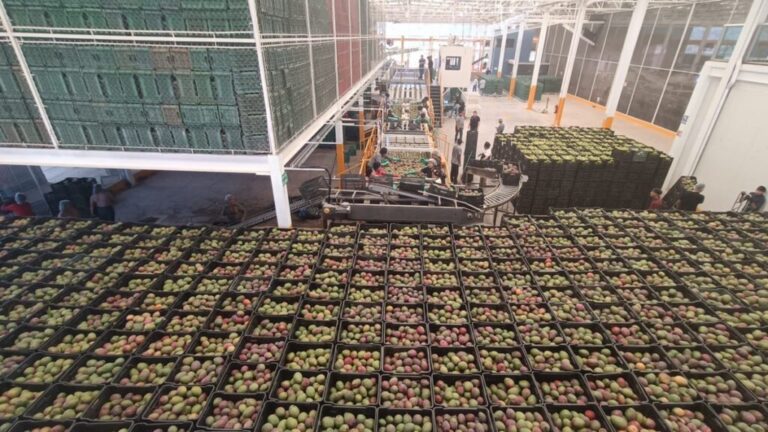
Image courtesy of EMEX
But proximity is only part of it. The vastness of the Mexican territory, paired with optimal weather patterns, enables the Aztec country to provide a steady stream of fresh mangoes across the US and Canada year-round.
The Mexican mango industry: An engine for modernization and employment
The demanding North American consumer has driven a true technological revolution in the Mexican countryside.
To comply with the market’s high standards, producers have gradually adopted innovations such as hydrothermal treatment plants, state-of-the-art facilities that ensure the fruit's health, and modern irrigation systems necessary to maintain competitive sizing in the face of climate challenges.

Additionally, local growers have invested in obtaining international certifications. These are key to opening new markets, guaranteeing food safety, and elevating the value of the harvest.
In this way, North America has become more than a destination for Mexico, proving to be a true ally that has pushed the local mango industry to reach world-class operational maturity. This has helped guarantee economic stability for the Aztec country, setting a horizon of sustained growth for its agro-industrial sector.
Related stories
Mexican mango's global triumph: How diversification fuels international growth
Mexican mangos’ biggest challenge remains market diversification