








Fusarium wilt resurfaces in North Florida watermelon fields




Fusarium wilt has returned across North Florida’s watermelon fields this season.


However, researchers with the University of Florida’s Institute of Food and Agricultural Sciences (UF/IFAS) have noticed that infected plants are behaving differently this year, sending mixed signals to watermelon growers.
However, researchers warn we shouldn’t celebrate Fusarium wilt's sudden disappearance, since its dormancy is due to the weather not being to its liking, but that won’t last long.
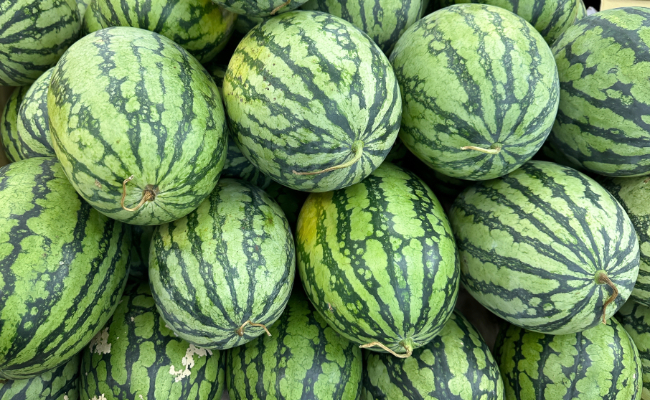
Fusarium Wilt is sending mixed signals
To look further into this behavior, researchers added inoculum to their trial site to study how the disease develops across different watermelon varieties and throughout the season.
So far, the trials are acting as early warning signs, and growers in the region report seeing the same symptoms in their fields.
Dufault says they’re easily recognizable by most growers: yellowing and wilting leaves, dying vines, discolored stems, and patches of dead plants in the field.
But this year, the difference is that some watermelons seem to get better on their own.
Despite this being masked as recovery, Dufault warns that it is not good news, as the pathogen is still there, just likely dormant.
Studies from the University of Florida, University of Georgia, and Clemson University show that Fusarium wilt is a bigger problem in watermelons planted early in the season. This is partly because soil temperatures in March and April usually stay below 86 degrees Fahrenheit, which helps the pathogen thrive.
Right now, air temperatures in North Florida are in the 80s, and the forecast shows little change. This means the soil probably will not get warm enough to keep the fungus in check.
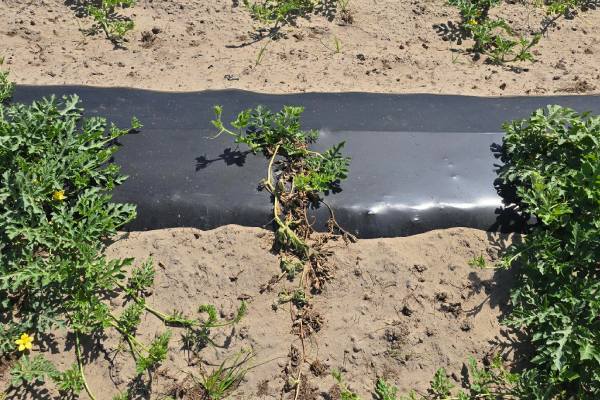
Image by Nick Dufault | UF/IFAS
Early intervention may be the more promising lever
In recounting the university’s efforts, Dufault is clear about what growers can and cannot do once symptoms show up.
UF/IFAS has evaluated tools such as prothioconazole (Proline) applied through drip irrigation, and while it has shown potential to delay the progression of Fusarium wilt in some cases, results have been inconsistent across environments and locations. The academic emphasized that fungicide intervention is not a standalone solution, so grower expectations should be calibrated accordingly, as environmental conditions and disease pressure play a major role in whether any treatment works.
If plants are already collapsing, chemicals probably will not bring back yield in those spots, Dufault said. However, they might help protect plants that have not yet been infected.
UF/IFAS research plots are testing early foliar fungicide sprays, including treatments in transplant flats and at planting. The team has consistently observed that these steps delay disease onset by about two weeks.
And this delay is significant, as it might mean the weather might not be as favorable for the pathogen, lowering the number of cases and helping protect yields.
However, Dufault was adamant that this is just one tool, not a cure.
The bigger picture hasn't changed
Since Fusarium wilt is mainly a problem to manage before the season starts, not during the season, Dufault said the best ways to manage the disease remain the same: opt for pathogen-resistant varieties when possible, use resistant rootstocks, choose fields carefully (field history is important), fumigate soil in high-risk areas, and adjust planting times when possible.
Dufault says the pathogen is "persistent, adaptable, and capable of causing damage” even when there’s a good knowledge about planting and growing systems. Keeping track of it this season helps growers prepare for next year.
*All images are referential unless stated otherwise.
Related stories:
Most US melons are kicking off 2026 with strong prices and plenty of optimism










Subscribe to our newsletter