








Mexican avocados chart a strategy beyond the United States



Written and reported by Macarena Bravo | Lee esta noticia en Español


The avocado is the star of Mexican fruit exports, especially in the United States, its main destination. However, despite its undeniable success north of the border, the sector is seeking to expand into other markets while maintaining competitiveness and quality standards.
FreshFruitPortal.com spoke with the CEO of the Association of Avocado Producers and Export Packers of Mexico (APEAM, for its acronym in Spanish), Luis Javier de la Rocha, who explained that his industry cannot rely solely on the United States: “It is our main market, yes. But we need to open new commercial routes that give us stability and long-term growth.”
To address this challenge, APEAM has charted a clear strategy for international diversification, with Asia—and particularly Japan—as one of its main targets.
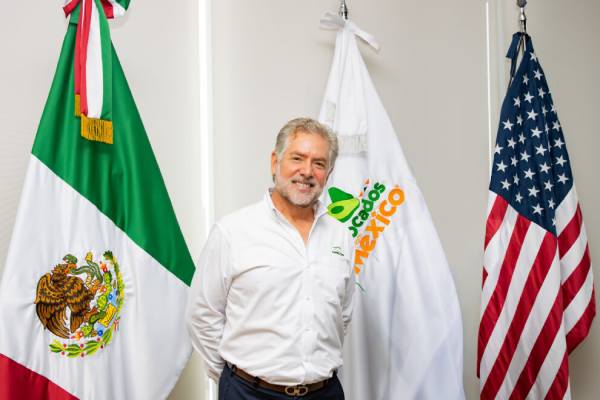
Luis Javier de la Rocha | APEAM
Currently, Mexican avocados have a limited presence in Asia. Although the landscape is gradually changing, De la Rocha explained that the industry has faced a combination of logistical, regulatory, and institutional hurdles that impacted export agility.
“Today, we are working much more aligned with the Government. We cannot move forward alone,” the executive said. “The avocado industry is strategic for the country and requires a public policy that supports its growth.”
Japan, a key high-potential market
APEAM's expansion strategy has the Land of the Rising Sun as a priority market, but this goal doesn’t come without its challenges.
De la Rocha explained that the Japanese consumer is highly demanding and perceives avocado as a premium product. To address this marketing scenario, APEAM has deployed a global strategy covering the entire value chain, from production to the final consumer.
“Our focus is clear: guaranteeing quality, strengthening the relationship with importers, and educating the consumer. All under a robust traceability system,” he said.
The head of APEAM highlighted an on-site activation carried out between March and April, during which Mexican avocado was featured in 170 restaurants in Japan, with dishes specially designed to integrate the fruit into local gastronomy. This has been complemented by ad campaigns in the media, collaborations with influencers, television presence, and consumer tastings at retail.
De la Rocha commented that the cultural challenge is not negligible.
“The Japanese consumer is conservative, especially in traditional preparations like sushi. Introducing the avocado requires time, adaptation, and a lot of work with chefs and distributors,” he said.
Fortunately, De la Rocha says feedback has been positive from both culinary professionals and consumers. This has allowed the organization to adjust its strategy and move forward with the fruit’s mass distribution, aiming to move past its status as an exclusive food.
Quality, traceability, and sustainability
Another pillar of APEAM's strategy is product quality, guaranteed through traceability and control systems across the entire logistical chain. From harvest to final destination, the organization seeks to ensure optimal conditions, including critical aspects like the cold chain.
“We detected opportunities for improvement—even in developed markets like Canada, for example—in temperature management during distribution. And we intervene there with direct training. It's not about pointing out errors, but about supporting the entire chain,” De la Rocha explained.
APEAM is also working to reinforce the idea of co-responsibility among producers, exporters, and importers, a key factor for sustaining the reputation of Mexican avocado worldwide.
Additionally, the industry is also emphasizing sustainability and accountability, which APEAM recognizes as a structural requirement for operating in international markets.
The executive commented that one of the most relevant advances is the legal formalization of the zero-child labor commitment, promoted by the industry itself in conjunction with the Mexican Government. This regulation is complemented by labor standards seeking to guarantee decent conditions for thousands of workers in the sector.
“Sustainability is not just environmental. It is also social. We want every worker to have access to housing, health, education, and a dignified life,” De la Rocha emphasized.
In parallel, APEAM, along with the country’s environmental authorities, has implemented a zero-deforestation agreement. The framework aims to mitigate the ecological impact of avocado production expansion in the country and includes reforestation programs, territorial monitoring, and the efficient use of water resources.
The APEAM representative says his industry is moving toward a triple certification system—phytosanitary, labor, and environmental—that seeks to differentiate the product in markets where consumers increasingly value the origin and production conditions.
An industry-wide outlook for avocados
De la Rocha knows his industry’s challenges all too well, but when it comes to expanding the scope to include other producing countries, the executive proposes a vision of complementarity.
He says that countries like Peru, with a strong presence in Japan, are not Mexico’s direct competitors but its indirect allies in consolidating avocado consumption.
“The most important thing is that the consumer has permanent access to the product,” he explained. “If one country cannot supply at a certain moment, another must do so. That is how markets are built.”
The APEAM representative emphasized that the challenge will be to maintain the balance between growth, sustainability, and the opening of new markets. A path that, according to the executive, does not allow for setbacks.
“Without sustainability, there is no industry, and without diversification, there is no stability. That is the path we are building,” he concluded.
*All images are referential unless stated otherwise.
The second edition of the Global Avocado Summit will be held on November 11, 2026, at the Monticello Casino Events Center in Santiago, Chile. Organized by the Chilean Avocado Committee and Yentzen Group, the meeting seeks to bring together the main players in a growing industry.
The event has established itself as a key space for addressing commercial and sustainability issues in the industry, bringing together producers, exporters, buyers, certifiers, and innovators to analyze the sector’s challenges and opportunities.
For more info, contact
events@yentzengroup.com
Related stories
Mexican avocado industry on track for exponential 2026 growth
Mexico formalizes Protected Geographical Indication standards for Michoacán avocados
Avocados From Mexico sets the bar high with 2.5B reasons to believe








Subscribe to our newsletter