Redder, glossier, and more profitable: Can titanium dioxide improve apple quality?
 Add Fresh Fruit Portal to Google
By Gordon Brown, Scientific Horticulture specialist with Apples and Pears Australia Limited (APAL).
The first thing consumers do to decide if they will buy fruit is to look at its appearance. Chinese consumers generally like full-colored red apples that are clean, undamaged and glossy, although they don’t want their apples waxed to improve their appearance.
As growers, it is possible to improve red coloration by exposing fruit to extra sunlight, by pruning and using reflective cloths, or using ethephon close to harvest.
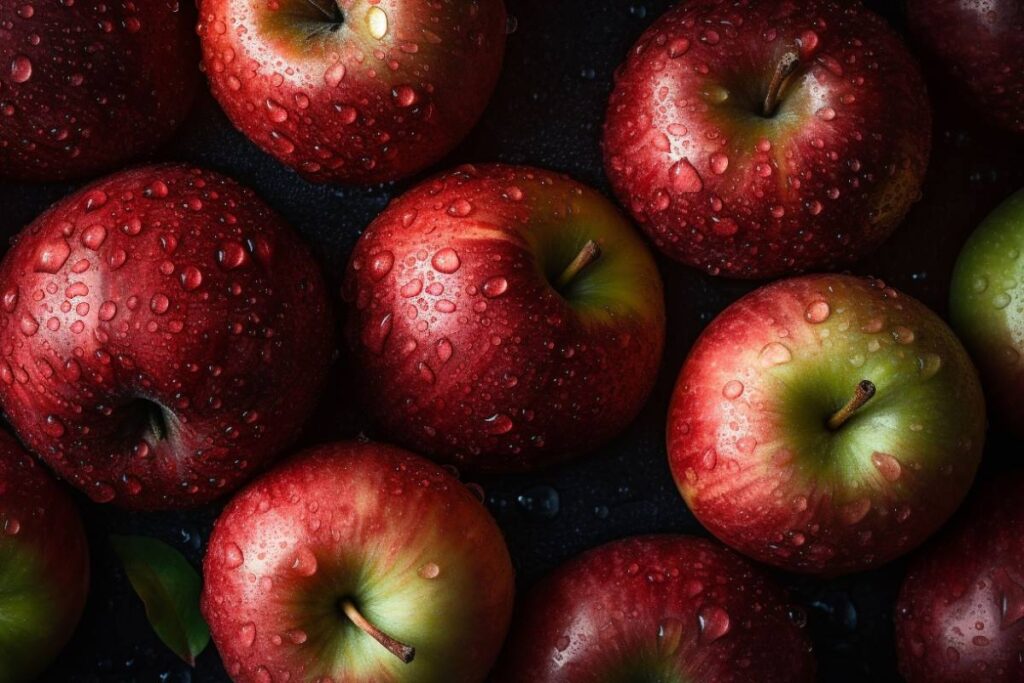
Referential image via Shutterstock.
While these practices improve color, unfortunately they have disadvantages such as cost and potential issues with poorer quality due to sunburn and advanced maturity.
In the search for other useful treatments, Chinese researchers have explored the potential of titanium dioxide, as used in sunscreen products, to improve apple color and other fruit quality characteristics.
Nanoparticle titanium dioxide has been safely used as a colorant and whitening agent for more than five decades. It is commonly added to a variety of products, including coffee whiteners, condiments, confectionery, baked goods (to enhance whiteness), processed seafood and fruit products (for color improvement), as well as toothpaste and beverages. It is typically present at around five percent in sunscreen products.
In Europe, titanium dioxide was banned in 2022 for use in food due to safety concerns. In the same year, Food Standards Australia New Zealand reviewed it and found no evidence of genotoxicity, toxicity, or carcinogenicity, so it is still permitted here.
Researchers in Shandong, China, compared the impact of titanium dioxide and ethephon treatments on fruit color and quality.
Using titanium dioxide to improve fruit color
In the field trials on both Royal Gala and Red Chief apple trees, a nanoparticle titanium dioxide spray (1kg/1000l) was applied at five-day intervals for the month prior to harvest.
During two seasons, four applications were made to the Royal Gala trees and three to the Red Chief trees. At harvest, fruit firmness, sugars and acidity were measured to assess impacts on fruit internal quality.
In addition, the red skin color was characterized, and the epidermal layers of the fruit were studied with an electron microscope.
For this article, the averages across both seasons for the Royal Gala trees will be studied. Identical trends were observed for the Red Chief trees.
No effects on fruit maturity
The researchers observed that ethephon reduced fruit firmness by 17 percent and acidity by 11 percent, while fruit sugars were marginally increased. These measures of fruit maturity all indicate that the preharvest ethephon treatment slightly advanced fruit maturity.
This was not the case for the titanium treatment, where there were only minor reductions in all measurements, suggesting that fruit maturity was not affected by this treatment.
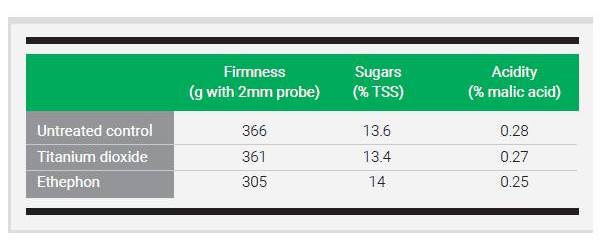
The average level of fruit firmness, sugar content and acidity for Royal Gala averaged across two seasons after application of either titanium dioxide or ethephon to the trees. Fruit firmness was measured with a 2mm diameter probe rather than the 10mm probe used in Australia. (Graph courtesy of APAL)
In China, blush area is the most important character of red-skinned apples that impacts consumer desire to purchase the fruit.
Averaged across the two seasons, preharvest application of both products dramatically increased the red coloration surface area of the fruit. Titanium dioxide was not quite as effective as the ethephon spray, with increases of 32 and 53 percent, respectively.
As well as the area of red coloration, the depth of red coloration is also important for consumer acceptance of apples in China. This was instrumentally measured, and it was found that both the titanium dioxide and ethephon increased the quantity of red pigmentation three-fold, resulting in an elevated and similar intensity of red coloration.
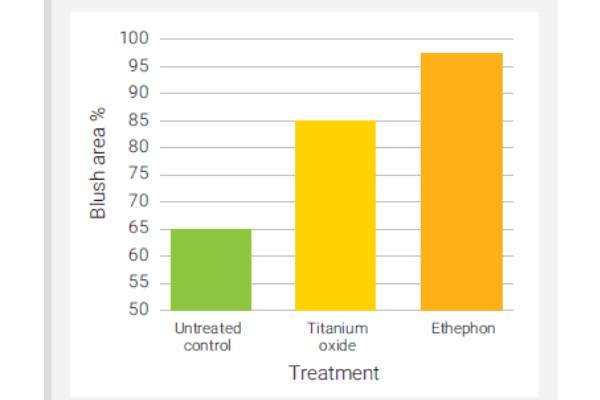
Surface area of fruit covered in red blush, with preharvest titanium dioxide or ethephon application averaged across two seasons. (Graph courtesy of APAL)
As mentioned earlier, the glossiness of the fruit is also important for consumer satisfaction. In this trial, glossiness was measured with a gloss meter and, although this instrument is not designed for use on curved surfaces such as fruit, it showed that the titanium dioxide increased the fruit glossiness by 23 percent to a gloss unit of 10.6.
It should be noted that not only is a gloss meter designed to work on flat surfaces, but its response also is not very sensitive to gloss units below 10. However, this response for titanium dioxide is similar to results in other publications by the research article author, indicating this change is real.
The gloss units for a carnauba-waxed apple are not available. However, for indicative purposes, the shine on an eggplant fruit returns a gloss unit of around 15 units.
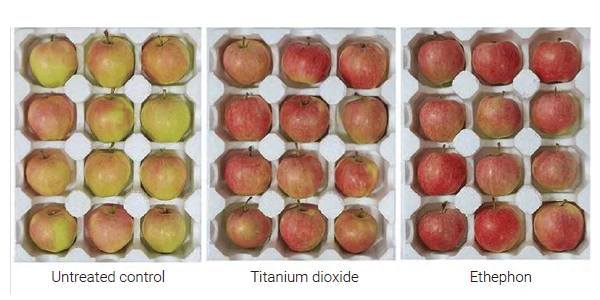
Red colouration of Royal Gala apples after preharvest application of titanium dioxide or ethephon (year 1 of trial). (Image courtesy of APAL)
The glossiness of apples is related to the natural wax on the skin surface. This research went on to study the cuticle with an electron microscope, and this revealed several impacts of titanium dioxide application on the fruit skin. These results may be more important to cherry growers than apple growers as there is potential for this treatment to have an impact on rain splitting of the fruit.
Significantly, the preharvest titanium dioxide application increased both the number of epidermal cell layers (by 50 percent) and the quantity of cuticular wax on the surface of the fruit (by 33 percent).
Ethephon also had these impacts but to a lesser degree (11 and 25 percent increases, respectively). Hence, these treatments both improved the strength of the skin as well as the waterproof protective coating on the skin of the fruit. This means that there will potentially be fewer stalk end punctures and subsequent decay, and less water loss from the fruit during storage.
A potential helper for apple exporters unlocking the Chinese market
The application of titanium dioxide to apple trees in the month prior to harvest increases fruit red coloration, with minimal impact on fruit firmness, sugars, or acidity.
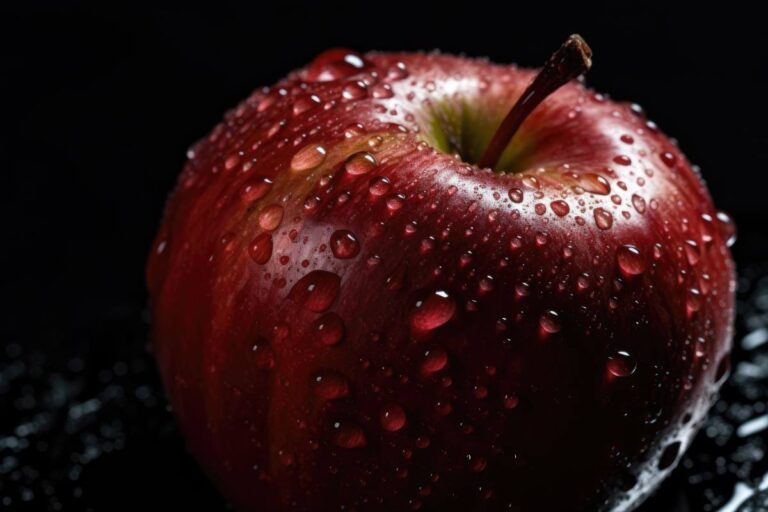
Referential image via Shutterstock.
In addition, this treatment increases the quantity of cuticular wax on the skin, which imparts a slight improvement in the glossiness of the fruit as well as additional epidermal cell layers, which may lead to tougher skin.
In contrast, preharvest ethephon application has a similar impact on fruit coloration, but this is associated with a slight advancement of fruit maturity and a smaller effect on the fruit skin epidermis and cuticle.
This story was originally published in the Winter 2026 edition of AFG, the Apples and Pears Australia Limited (APAL) magazine.
Related stories
Australia's Soluna apples make landmark entrance into China
China's wax apples target premium supermarkets in Europe and the Middle East