


Composting in the age of fertilizer scarcity: Nothing wasted, everything gained
 Add Fresh Fruit Portal to Google
Nana Nikuradze's composting journey wasn't straightforward. She was trained as a Germanist, not an agronomist. But after having children, she decided that she wanted to grow healthy food for her family. So when she and her husband began growing vegetables, farming became her main work.
"I always wanted to bring healthy produce to my family," she says. "Later, I wanted to bring it to other people too."
©FAO / Guram Saqvarelidze
Nana, with her husband and three children, manages one hectare of farming land in Samtredia, western Georgia. There, they grow sweet peppers, eggplant, tomatoes, chili peppers, melon, and corn among other crops. In good years, the surplus is sold at the market in Kutaisi, the nearest, largest city.
Composting: a sustainable way to grow
For most of her eight years farming, Nana cultivated in a traditional way, continuing the work started by her parents and husband.
Her approach started to change two years ago when she joined a Farmer Field School supported by the European Union and the Government of Sweden. The schools were part of the European Neighborhood Program for Agriculture and Rural Development (ENPARD IV), implemented by the Food and Agriculture Organization of the United Nations (FAO).
The Farmer Field Schools focused on using plant protection products safely and efficiently, training farmers on soil health, managing seedlings and water effectively, reducing crop waste through composting, and supporting organic production.
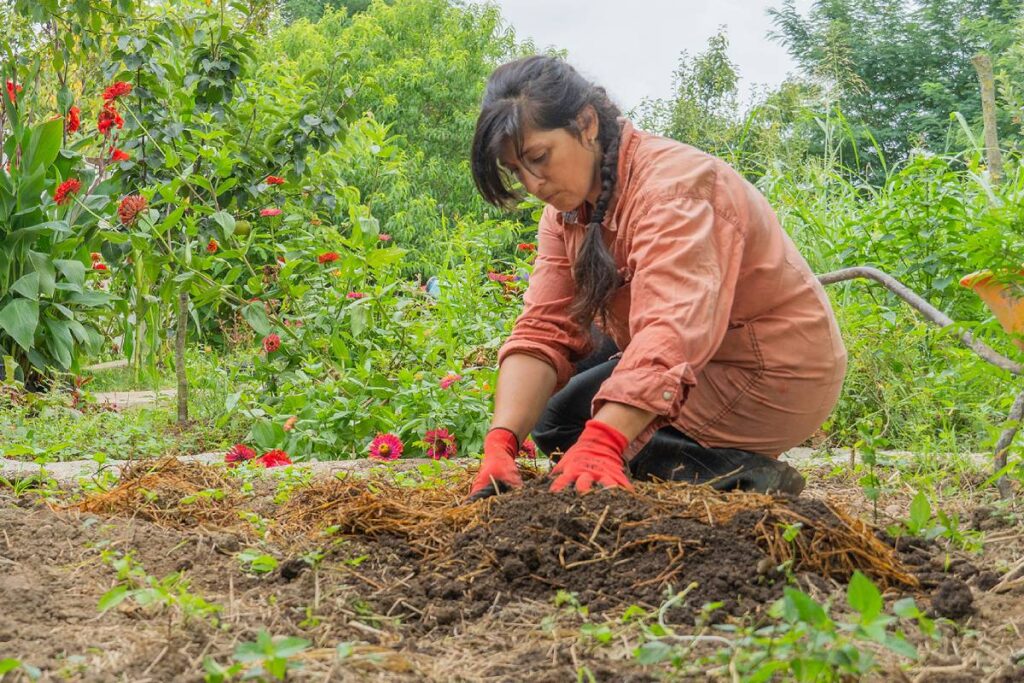
This year, for the first time, she is producing her own compost, with crop residue, straw, green plant matter, and manure from her small dairy herd, layered and left to break down into a biofertilizer.
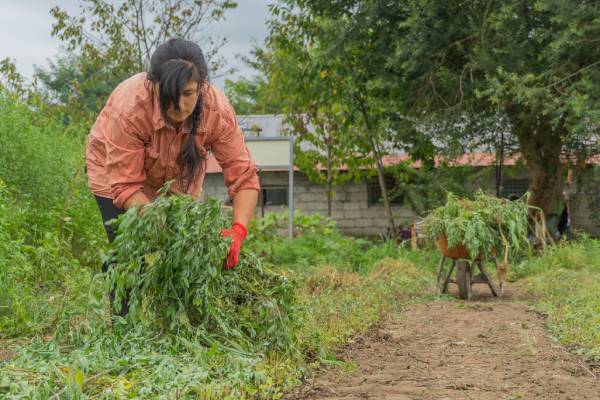
©FAO / Guram Saqvarelidze
"My goal is to replace 100 percent of the chemical fertilizer with healthy, organic compost and produce even healthier food," she says.
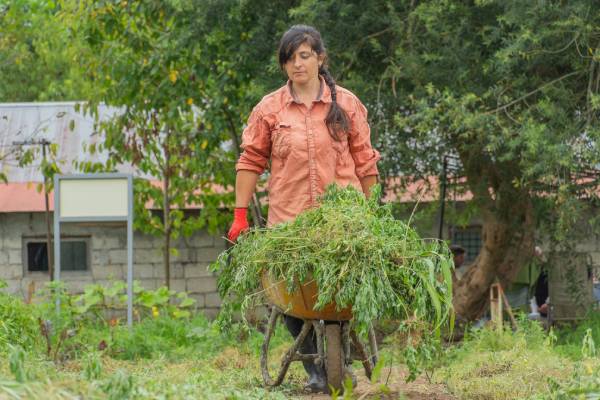
Composting is also, she points out, a new way to look at waste. Farmers in her village once burned crop residues and other leftover plant material rather than valuing them as a source of nutrition for the soil.
"It destroyed the biomass in the soil, and it killed useful insects too," Nana says. What used to go up in smoke now goes back into the ground, through composting, cutting fertilizer costs while, she says, producing safer food.
Nana uses almost no pesticides, herbicides, or insecticides, partly because she keeps several bee colonies for pollination and won't put them at risk. When pests appear in her plot, she and her family deal with them by hand, using pheromone traps she received through FAO's Farmer Field School.
"Some yield may be lost without the application of chemical inputs, but what is gained is soil, beneficial insects, and produce that stays free of pesticide residues,” says Rati Kharshiladze, an FAO Agronomy and Extension Specialist. “That is not a one-season result: it is something that compounds over years. The longer the practices are maintained, the stronger the benefits."
Looks different, tastes better
Her produce, grown with composted biofertilizer, doesn't always look like what shoppers expect, though.
"My broccoli isn't as large as what's grown with chemical fertilizer," she says. "But it has a wonderful smell and taste." The same goes for her watermelon and melon, she adds, which feature a smaller size and a better flavor.
She thinks that this prejudice in produce’s appearance is really a gap in consumer awareness, and she would like to see it closed and get more support for farmers producing with compost and without chemical inputs.
On her hectare of land, she hopes to eventually build a few small guest cottages and welcome visitors to see, and take part in, the way she grows food. She imagines guests picking vegetables alongside her, watching her cook traditional Georgian dishes with what they've just harvested and trying their hand at building a compost pile of their own.
"Whatever I do here, I'd want to share it with them too," she says.
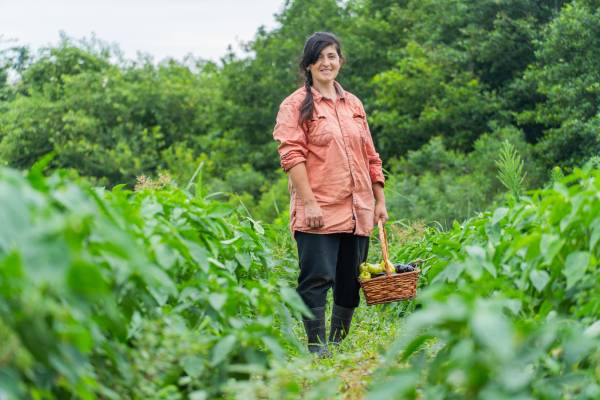
©FAO / Guram Saqvarelidze
Alongside the guest cottages, she plans to grow her small dairy herd and add a modest chicken flock. That, she says, would be enough for visitors to see something of what life in a Georgian village actually looks like.
"I believe a country stands on healthy, well-tended villages," Nana says. “We take what used to be waste and turn it into new energy, into biofertilizer. That's why I want people from the city to see what a village really is, and how much it can offer when it has support."
The ENPARD program has reached more than 1,500 crop farmers across Georgia through field trainings. Aiming to reduce rural poverty, ENPARD supports the development of Georgia’s agricultural potential and creates economic opportunities for rural populations. Since 2021, the Program has been working on improving food safety in the country, with additional support from the Government of Sweden and the Czech Development Agency.
This story was originally published by the Food and Agriculture Organization of the United Nations.
*All images by ©FAO / Guram Saqvarelidze
Related stories
4 ways healthy soils build better cities: From food to climate resilience