Canada’s betting big on a high-tech ag future

 Add Fresh Fruit Portal to Google
Amid a drastic redrawing of North American trade relations, Canada has decided to take the reins of its productive future and heavily invest in its own food system.
Back in June, the Great White North announced an ambitious CA$3.2 billion plan called the National Food Security Strategy. Under the “More Choice. More Control. More Canada” motto, the program seeks to fund initiatives that help keep fresh produce prices low by providing shoppers with more local choices and reducing the country’s dependence on imported foods.

Image via Shutterstock
This latter objective has become increasingly important, as trade relations with Canada’s main commercial partner, the United States, have worsened dramatically in the last two months.
The erosion of the North American food system
Tensions between Ontario and Washington have been palpable during the second Trump Administration, as the president publicly threatened harsher tariffs on Canada and even referred to the country as “the 51st state.”
The shift was compounded in July when the US decided not to renew the US-Mexico-Canada Agreement (USMCA). The trade deal, announced during the first Trump Administration, had become the backbone of the region’s trade relations, creating an intimately interconnected supply chain among the three countries. This infrastructure became especially critical for the fresh produce industry, with many companies achieving year-round sourcing thanks to their presence all across the region.
By the end of August, after weeks of heated negotiations, Canada ended trade talks after American envoys presented conditions that, according to Ontario, would weaken Quebec's French-speaking identity. The White House swiftly responded by imposing 50 percent tariffs on Canadian cars, trucks, and steel, which will go into effect in January 2027.
“On Trade, and in other ways, also, they are among the worst Nations in the World to deal with,” President Trump wrote on Truth Social after the announcement, The Associated Press reported. “They feel entitled, and yet, WE DON’T NEED CANADA, THEY NEED US! They do 95% of their business with the U.S., with us, the exact opposite!”

Image via Prime Minister of Canada on Facebook
Canadian Prime Minister Mike Carney was praised for putting his foot down to what the international media labeled as bullying behavior from the United States. However, the turn of events is not without challenges, as Canadians have been increasingly dealing with food inflation (31 percent since 2020) and price hikes due to geopolitical hurdles and climate change.
According to government data, Canada is the world’s 11th-largest importer of ag-products and food, with the US as its biggest trading partner for the segment and the source of around half of its imports.
Strengthening Canada’s food systems
Although committed funds in the National Food Security Strategy are set to be spent over the next ten years, Canada has made notable investments in recent weeks that align closely with the program.
On September 10, Canadian authorities announced an investment of up to CA$1.7 million for local company Vivid Machines through the AgriScience program.
“This funding will support the development of cutting-edge computer vision and machine learning technology to help grape growers improve harvests and detect crop diseases early,” the announcement read.
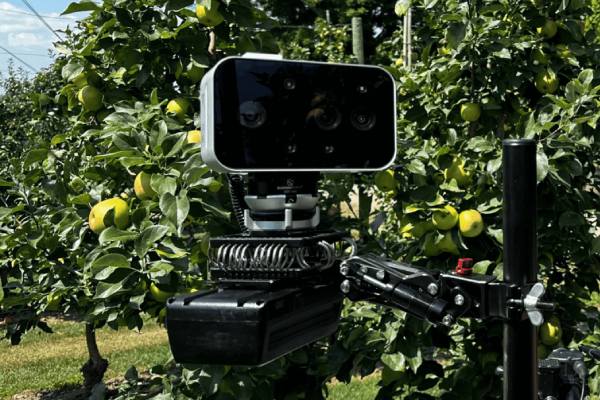
Image via Vivid Machines
The specific objective is to upgrade the company’s AI-powered Vivid XV camera technology and expand its use from apple orchards to grape vineyards. According to Vivid Machines, the platform will provide growers with real-time insights to protect their crops and reduce chemical use.
“By supporting the right technology, we help safeguard the crops that support our communities and local economies,” said Canadian Minister of Agriculture and Agri-Food, Heath MacDonald, in a statement.
Only a week later, the North American government announced a new investment, this time, for the development of sustainable fertilizer technology. The funds, granted through the Agricultural Clean Technology Program and totaling nearly CA$2 million, went to Lucent Bio, a Burnaby-based company that in 2022 has already received up to CA$1.3 million to develop its Nutreos seed technology.
In association with A&L Canada Laboratories, Bureau Veritas Canada, and Simon Fraser University's Chemistry Department and 4D LABs, the firm is developing a biodegradable alternative to plastic coatings for controlled-release nitrogen fertilizers.
According to the announcement, the biopolymer is made from surplus starch fertilizer, helping plants use nourishment more efficiently, effectively “reducing both greenhouse gas emissions and fertilizer costs.”
“Support from the federal government allows us to improve this work faster and brings us one step closer to putting a Canadian-developed solution into the hands of growers," said Lucent Bio co-founder and Chief Science Officer, Farah Nour.
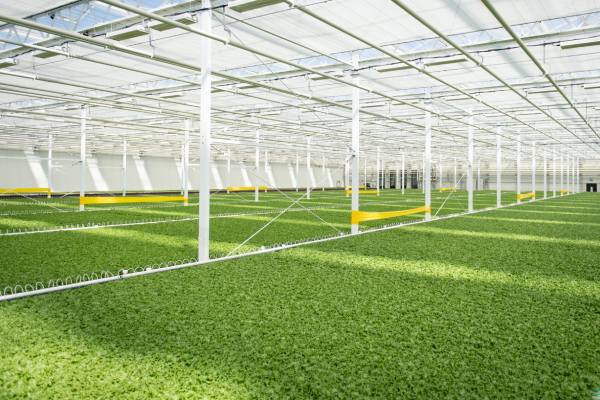
Image via Haven Greens
Finally, on September 17, the Canadian government announced CA$5 million for family-owned Kinghaven Farms, adjudicated through the AgriInnovate Program, to adopt and customize automation and climate control technologies.
The grant will fund the installation of an innovative end-to-end mobile gully system that enables higher precision and faster cultivation at the company’s newly built controlled-environment agriculture (CEA) greenhouse, responsible for producing up to 2 million kilograms of leafy greens every year. The result will be reduced labor costs and better efficiency.
“By enabling year-round cultivation of fresh produce while offering greater control over growing conditions [...] Canada is reducing reliance on imported produce and strengthening its domestic food supply,” said the government in a statement.
According to government data, Canada's greenhouse industry is a critical part of local agriculture, contributing CA$3.4 billion in farm-gate sales and over CA$2.5 billion in exports in 2024.
CEA technologies will account for CA$750 million of the total investment in Canada’s National Food Security Strategy, with MacDonald calling this cultivation approach “key” to building a “resilient, stable food system” in the country.
*Main image via Shutterstock.
Related stories
US-Canada trade war could leave a lasting mark on American farms
Canada scores major PVR win over Staccato cherry trees
Pollination woes are reducing blueberry volumes, yields, and profits in British Columbia