



Global blueberry exports set to surpass one million metric tons as supply calendars fill, says Rabobank
 Add Fresh Fruit Portal to Google
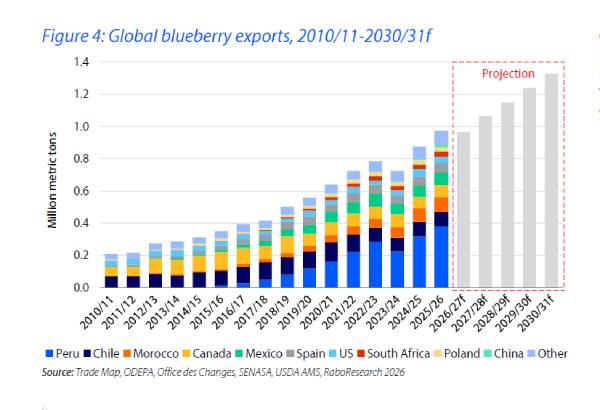
Global fresh blueberry exports are poised to exceed one million metric tons in the 2027/28 season following a temporary dip in 2026/27, according to Rabobank’s latest industry update.
In its November 2026 report, RaboResearch notes that while El Niño will weigh on Peruvian output in the short term, maturing plantings, varietal renewal, and yield improvements could lift global exports to approximately 1.3 million metric tons by 2030/31.
Across key regions, supply windows are increasingly overlapping: North America is seeing heavy fall and winter volumes alongside a projected 2027 domestic rebound, and further south, producing regions are preparing for a new wave of varietal-driven growth. Meanwhile, across the pond, Europe’s import calendar is growing more crowded, while China is rapidly emerging as a net exporter in Asia.
“As supply gaps narrow, competitive advantage will migrate toward better eating quality, reliable execution, and lower delivered cost during key market windows,” the Rabobank analysis reads.
North American supply shifts and rebounds
In the United States, blueberry availability has expanded most sharply from August through February, propelled by rising Peruvian shipments, while Chile’s relative market share has declined. March and April remain the least crowded months as Southern Hemisphere volumes taper off, leaving Mexico as the primary supplier bridging the gap to the domestic harvest.
Although Mexican expansion slowed after 2022/23 due to pest pressure, rising labor costs, and the removal of less-competitive acreage, US-bound exports rebounded in 2025/26 despite lower planted area, with total production holding near 90,000 metric tons.
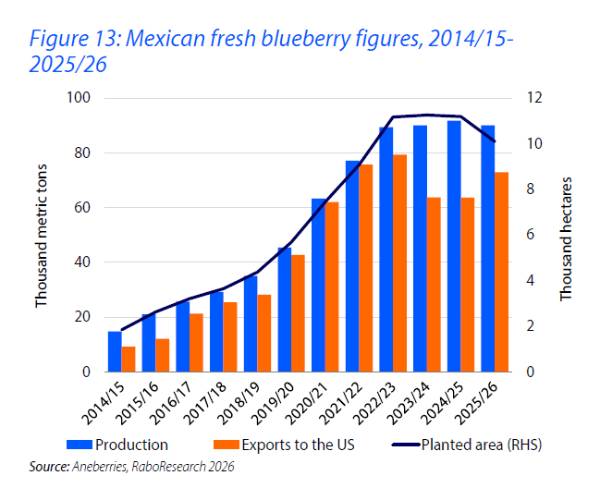
“Mexico’s future competitiveness will depend less on acreage expansion and more on adopting cultivars that improve marketable yield, fruit quality, harvest efficiency, and shelf life,” the assessment says.
Meanwhile, adverse weather curtailed US domestic production in June 2026, bringing total highbush output to 667.3 million pounds. However, Rabobank forecasts a 10.5 percent rebound to 737.2 million pounds in 2027, led by recovery in Washington, Oregon, Georgia, Michigan, New Jersey, and Florida.
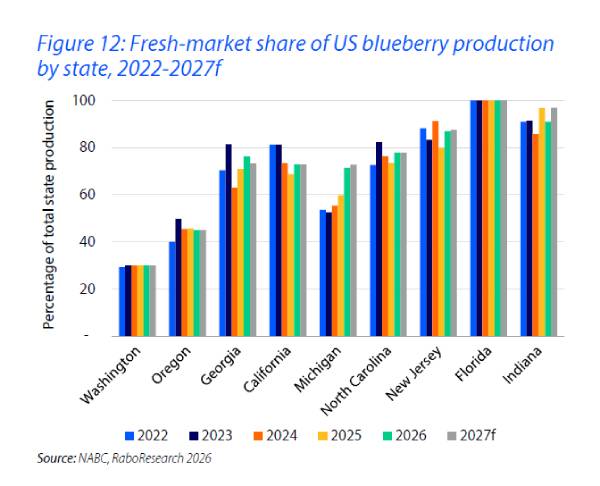
Production models remain regionally distinct: Washington and Oregon focus heavily on processing and, alongside California, account for most US organic volume, with California leading at a 37 percent organic share. Meanwhile, eastern and southern states direct most of their fruit to the fresh market.
Europe and Asia navigate crowded windows and shifting trade flows
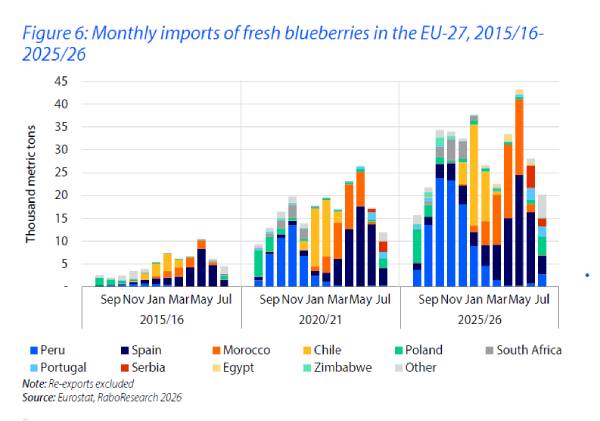
Across the Atlantic, EU-27 fresh blueberry imports have surged over the past decade, particularly from September through May. Peru has driven growth from September to January, while Morocco and Spain anchor the March-to-May spring peak.
However, as Peru extends shipments into early winter and Morocco adds volume ahead of and alongside Spain, South Africa, and other smaller origins, traditional seasonal windows are narrowing.
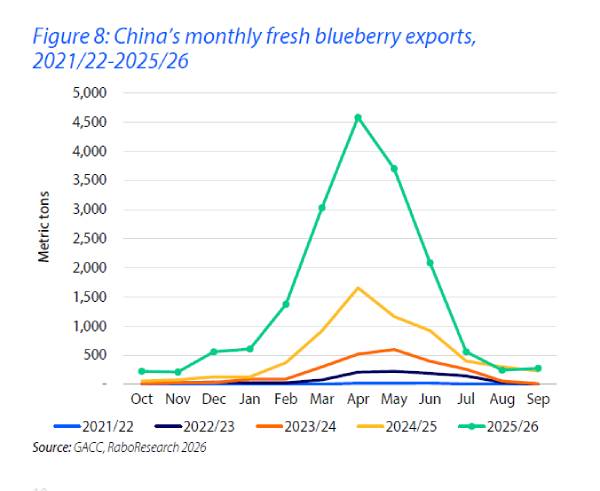
In Asia, China is rapidly reshaping regional trade flows. With domestic production reaching 565,000 metric tons in 2025, China has become the world’s ninth-largest fresh blueberry exporter, surging from 115 metric tons to 17,500 metric tons over five seasons.
While 61 percent of exports occur between March and May, with Kyrgyzstan emerging as its top destination in 2025/26 alongside Hong Kong, Russia, Singapore, and Malaysia, expanding year-round domestic supply is pressuring Chilean and Peruvian imports from August to January.
Rabobank projects China could become a net blueberry exporter by 2027/28.
South America’s varietal renewal
Finally, South American fresh blueberry exports have more than tripled over the past decade, spearheaded by Peru.
Although El Niño is expected to dampen Peruvian output in 2026/27 and potentially 2027/28, the Andean country’s planted area has reached nearly 72,000 acres, and growing adoption of proprietary varieties underpins medium-term expansion.
In Chile, planted area has stabilized after five consecutive years of decline as growers replace older orchards with newer genetics: Proprietary varieties accounted for 35 percent of Chilean fresh exports in 2025/26.
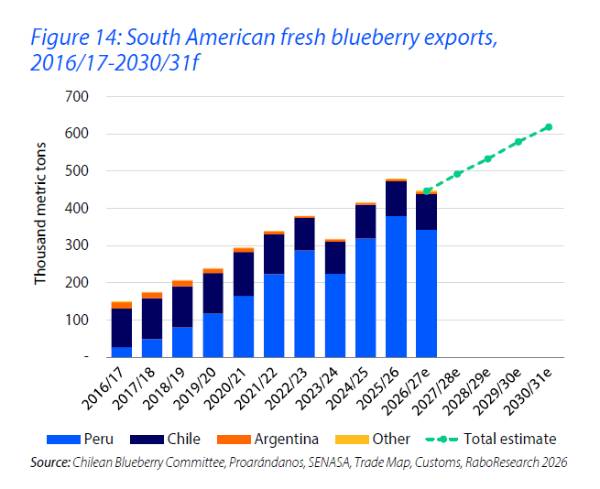
Coupled with measured expansion from emerging regional suppliers such as Colombia, Ecuador, and Brazil, Rabobank expects South American fresh blueberry exports to surpass 600,000 metric tons by the start of the next decade.
*Graphs courtesy of Rabobank | All images are referential
Related stories
Weather hits Peruvian blueberries hard: Export forecast falls over 20 percent year on year
Domestic blueberry prices drop in China, but high-end sales channels remain resilient
New Chilean blueberry varieties to score 39 percent export uptick