


Agronometrics in Charts: Labor costs now consume up to 70 percent of US apple growers' wholesale price

 Add Fresh Fruit Portal to Google
Each week, the series ‘Agronometrics In Charts’ examines a different horticultural commodity, focusing on a specific origin or topic and visualizing the trade market factors driving change. Check out our entire archive.
United States apple growers are experiencing one of their most financially challenging seasons in recent years as falling wholesale prices, rising labor costs, and severe weather pressures squeeze profitability across major production regions.
Despite remaining the world’s second-largest apple producer behind China, the American apple sector is facing mounting concern about whether current economic conditions can remain sustainable for growers.
The industry contributes an estimated $23 billion annually to the US economy, supports more than 150,000 jobs, and generates nearly $1 billion in export value each year. Yet many orchard operators say those strong national figures no longer reflect conditions on the ground.
Tight margins squeeze apple growers
Recent analysis by USApple shows that average wholesale apple prices have dropped by roughly 23 percent from peak levels recorded during the 2023/24 marketing cycle. At the same time, production costs continue to rise at a pace that many growers say outstrips returns.
Chris Gerlach, Vice President of Insights at USApple, described the current situation to Fruit Grower News as a “critical inflection point” for the industry, noting that labor costs alone are consuming an increasing share of grower revenue.
According to Gerlach, H-2A-related expenses now account for between 60 percent and 70 percent of the average wholesale price per box paid to growers. By comparison, labor represented closer to 40 percent of the price per box in 2013. The widening gap between production costs and market returns has left many operations struggling to maintain profitability.
The one-year return on income and capital reportedly declined another 10 percent this season, reinforcing concerns that growers are losing money simply producing and marketing a crop under current conditions.
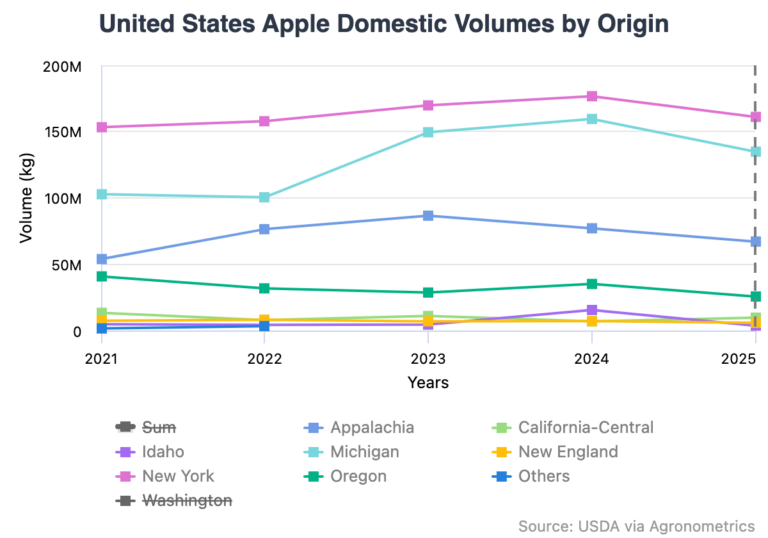
Production forecasts for the 2025/26 season also point toward reduced national output. Major apple-growing states, including Washington, New York, Virginia, Oregon, and California, are expected to post lower production volumes. Virginia is projected to experience the steepest decline, with output down approximately 30 percent.
Nationally, apple production is estimated to remain about four percent below peak levels achieved during the 2023-2024 season. Meanwhile, orchard acreage continues to shrink. Since 2022, the top seven apple-producing states have collectively removed around 4,000 producing acres, with Washington accounting for roughly 3,000 acres this year alone.
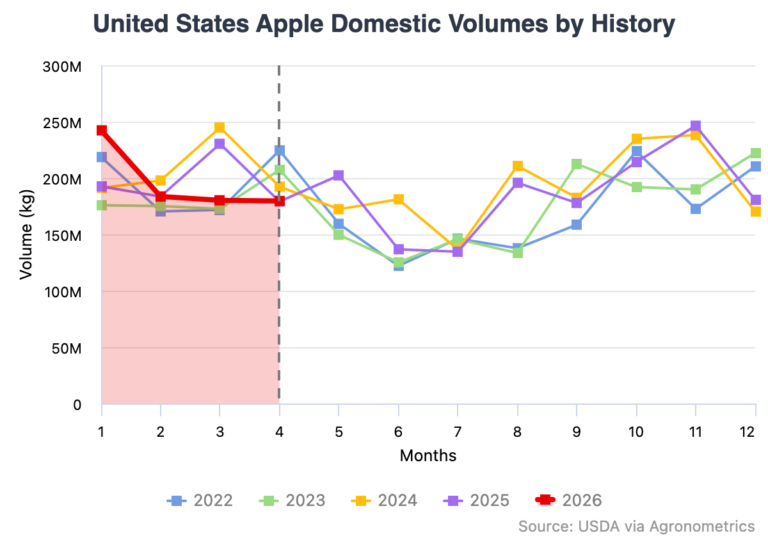
Source: USDA Market News via Agronometrics.
Weather disruptions have added another layer of uncertainty. A late-April freeze across the Mid-Atlantic and upper East Coast exposed orchards to overnight temperatures averaging between 10 and 18 degrees Fahrenheit below historical norms during critical bloom and bud development stages. Apple growers in Pennsylvania, northern Virginia, and New York’s Hudson Valley experienced some of the most severe impacts.
Source: USDA Market News via Agronometrics.
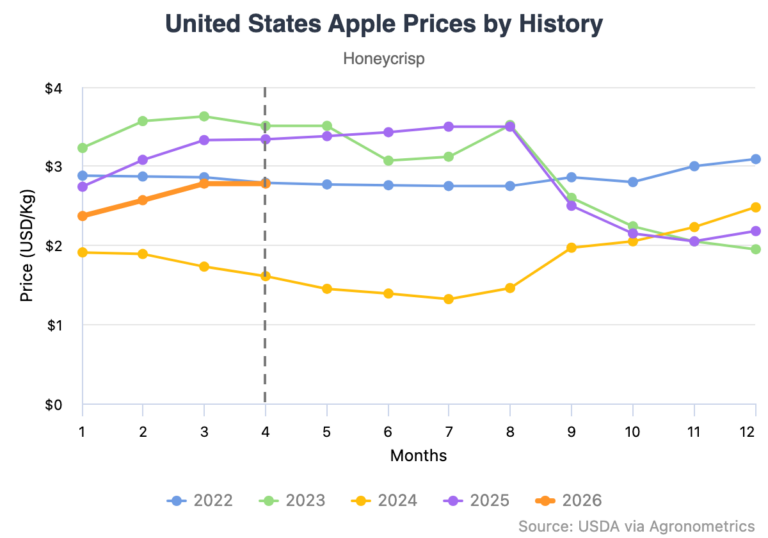
The premium Honeycrisp segment illustrates the growing imbalance between supply and pricing. Wholesale Honeycrisp prices are down 24 percent year-over-year, even as storage volumes increased 53 percent, suggesting many growers are delaying sales in hopes of stronger market conditions later in the season.
Source: USDA Market News via Agronometrics.
Source: USDA Market News via Agronometrics.
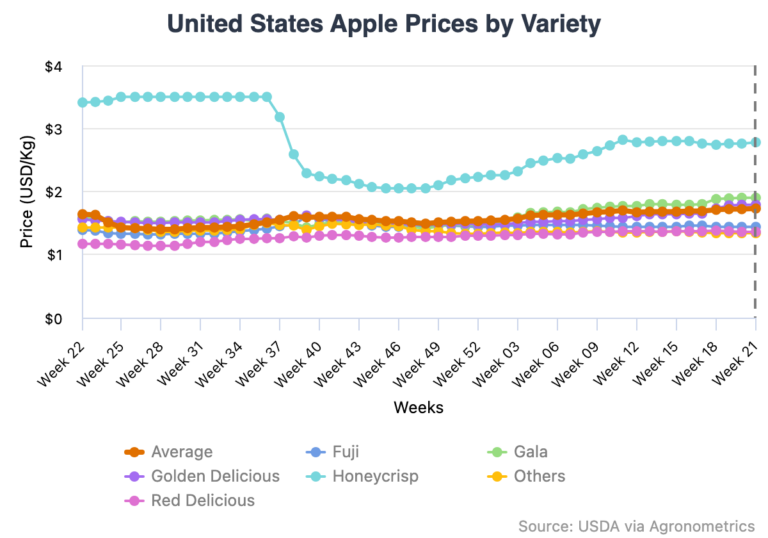
Granny Smith prices have also softened, while inventories have risen. In contrast, Gala and Red Delicious have posted firmer pricing performance.
Input inflation continues to intensify operational pressure across the supply chain. Nitrogen fertilizer prices increased 31 percent year-over-year, phosphorus-based fertilizers rose 11 percent, and diesel fuel costs climbed 62 percent compared to last season.
Transportation costs have become especially burdensome for Western apple growers. Shipping a truckload of apples from Yakima to Los Angeles now costs approximately $400 more than last year, while shipments to East Coast markets have increased by nearly $1,000 per load.
Looking ahead, industry groups expect weather volatility and production uncertainty to remain major concerns through 2027. USApple officials say they are actively advocating for expanded disaster relief support for specialty crop growers, including earlier crop insurance payments and additional financial assistance mechanisms designed to help orchard operations manage climate-related losses.
For many growers, however, the broader concern extends beyond a single difficult season. With shrinking margins, rising labor dependence, and increasing climate risks, the industry faces growing questions about how long current production economics can remain viable without significant market or policy changes.
*Images are referential | Graphs courtesy of Agronometrics.
Related stories
Rising costs and inventory shifts pressure US apple growers
Crunch Time Apple Growers confident in 'amazing' 2025 crop despite record US market challenges
China's Shandong apple growers face challenges as heavy rains impact crop quality and prices