Leading companies in the sector confirm in Peru the potential of Green Motion’s new generation of avocados and rootstocks

 Add Fresh Fruit Portal to Google
Green Motion Avocados (promoted by the University of California, Riverside (UCR) and the Spanish company Eurosemillas) is not only the largest avocado breeding project, but its members also provide the largest network of experimental fields ever seen, in this case to accelerate the development of the new generation of varieties and rootstocks that will soon be entering the market.
This was evidenced during the 2nd Seminar organized by Green Motion Avocados, held last June in Trujillo (Peru). It was attended by 60 producers, representatives of leading companies in the sector, and nurseries from countries in both the northern and southern hemispheres linked to this alliance.
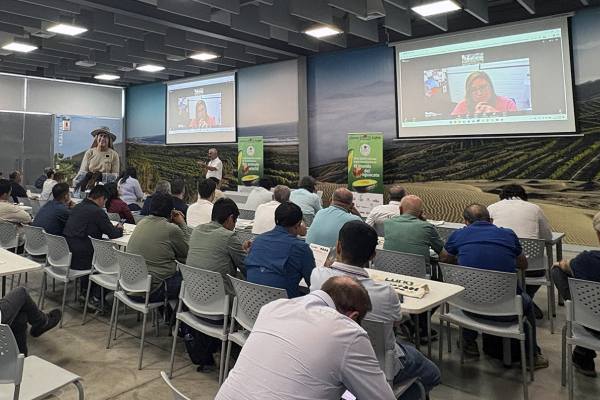
The two-day event featured presentations, discussions, and visits to orchards, during which participants exchanged experiences on the cultivation of these Hass-like varieties and rootstock selections, which are currently only available to members of this platform.
Indeed, in one or perhaps two years’ time, following the launch of Luna – the first variety promoted by this platform – three more will follow. These new avocado varieties, together with the five rootstocks that are also being tested, will make it possible to expand cultivable areas and the harvest window and to develop more intensive production systems with a smaller water footprint. Two of these rootstocks will also be commercially available in the near future.
“The tests carried out by the UCR are now complemented by experiences shared from regions across eight countries in the northern hemisphere and six in the southern hemisphere, under highly diverse harvesting schedules, climatic conditions, cultivation practices and soil types,” said the director of Green Motion Avocados, Javier Cano.
In particular, the agronomic performance of the three varieties in the Green Motion Avocado program, which will probably be launched on the market between 2027 and 2028, was presented. These are two avocado varieties that would extend the Hass season by several months, with fruit of similar quality. One – UCR V01 – is a later-ripening variety; the other – UCR V02 – is an earlier-ripening variety; and work is also underway on a third variety – UCR V03 – which produces smaller, ‘bite-sized’ fruits but with an exceptional flavor, making it of interest as a gourmet product.
Green Motion Avocados looks to better production

Another objective for Green Motion was to outline the distinct approaches to increasing productivity through intensive or semi-intensive cultivation methods. Experiences and planting designs implemented over recent years with Luna were shared; its type B flowering trees are well known for their very upright growth habit, which facilitates this method and also produces fruit that is indistinguishable from Hass. Furthermore, the prolonged overlap in the flowering periods of both varieties was highlighted in both the northern and southern hemispheres, which significantly boosts the productivity of these plantations.
The performance of the five rootstock selections developed by the UCR was also evaluated. Of these, trials with two of these rootstocks are at a more advanced stage. These are UCR R01, which is of particular interest as it is semi-dwarfing – suitable for intensive plantations – resistant to Phytophthora, with favourable performance under conditions of chloride, salinity and alkalinity, low alternation and good productivity; and the UCR R02 rootstock, which is of, equally resistant to the aforementioned fungus, with moderate alternate bearing, and a yield, as in the previous case, comparable to that of Dusa; its most distinctive feature is its ability to adapt better to highly saline conditions. In fact, according to the latest data released by the UCR, the latter’s tolerance to salinity and active lime is even higher than that of the Antillean rootstocks developed in Israel.
*All images courtesy of Green Motion Avocados | Eurosemillas.
Related stories
Chilean avocado crop scores 10 percent production uptick, slashes previous record