Agronometrics in Charts: US-Canada trade war could leave a lasting mark on American farms

 Add Fresh Fruit Portal to Google
Each week, the series ‘Agronometrics In Charts’ examines a different horticultural commodity, focusing on a specific origin or topic and visualizing the trade market factors driving change. Check out our entire archive.
The escalating trade war between the United States and Canada is putting new pressure on American farmers, raising equipment costs and limiting market access while squeezing the budgets that decide what goes into the soil.

US President Donald Trump announced the measures in July, issuing proclamations under Section 338 of the Tariff Act of 1930 that authorized 50 percent tariffs on a broad range of Canadian imports worth roughly $20 billion (CAD$27 billion).
Negotiations to avert them collapsed in mid-August, and the tariffs took effect on August 22. Canada answered three days later with a matching package: tariffs of 15, 25, and 50 percent on more than 700 American products, calibrated to mirror the US rate on equivalent goods and scheduled to take effect September 8.
Farmers are caught in a broader US-Canada dispute
Canada's list was not built around agriculture; it mirrors the US schedule line for line, but it includes food and farm products. Dairy and seafood carry a 25 percent rate, alongside agricultural equipment, steel, appliances, pulp and paper, and electronics.
Canada is the second-largest market for US agricultural exports after Mexico, taking $28.4 billion worth in 2024. At the same time, agricultural supply chains operate in both directions. Live cattle, processed foods, machinery, and farm-equipment components regularly cross the border.
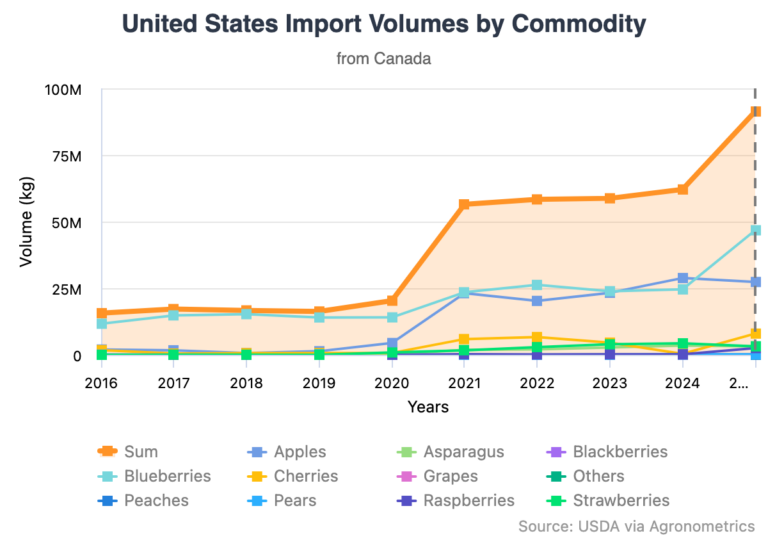
Source: USDA Market News via Agronometrics.
*Main image is referential | Graphs courtesy of Agronometrics
Related stories