








Agronometrics in Charts: The truth behind Honeycrisp apples' relentless price climb




Each week, the series ‘Agronometrics In Charts’ looks at a different horticultural commodity, focusing on a specific origin or topic, and visualizing trade market factors that are driving change. Check out our entire archive.


Honeycrisp apple prices are rising again as limited late-season supplies, strong demand, and high production costs converge ahead of the next harvest window. Inventories are now projected to run out as early as July.
The fall boom pulled forward what should have been the spring supply, and prices have risen accordingly.
An inherently expensive fruit variety
Released to commercial growers by the University of Minnesota in 1991, the variety's signature crunch comes from unusually large cells that rupture when bitten, the same characteristic that makes it bruise easily during harvest and handling.
Because of its thin, delicate skin, Honeycrisp cannot be harvested with two hands the way hardier varieties like Red Delicious can. Pickers must use one hand to pull the fruit and the other to snip the stem, or it will puncture neighboring apples when packed. This alone roughly doubles the labor time per bin compared to conventional apple picking.
The challenges don't stop at harvest. Orchards typically have to sweep through Honeycrisp trees up to five times per season as the fruit ripens at uneven rates. Additionally, trees tend to bear fruit in alternate years, requiring significant additional labor to achieve consistent annual production.
And despite all that care, as much as 35 to 45 percent of harvested Honeycrisps are downgraded to juice, a drastically lower-value use, as they don't meet the cosmetic standards retailers and consumers expect. Most apple varieties achieve a packout rate ranging between 80 and 90 percent, while Honeycrisp typically achieves 65 percent at best.
All of this means that, even in a good year, the "Moneycrisp" is one of the most expensive apples to bring to market.
The Honesycrisp 2024 crop shock
What turned an already-premium variety into a market story was the dramatic collapse of the 2024 Honeycrisp crop.
Washington State saw Honeycrisp volumes fall roughly 32 percent in 2024, with Midwest holdings down nearly 40 percent. Unit sales plunged 70 percent, yet prices didn't immediately spike. They actually fell, bottoming out near $1.50/kg, or about $0.68 per pound.
With packing contracts and storage costs creating pressure to move fruit, and retailers shifting promotions to other varieties, growers accepted lower prices rather than let apples sit. The result was unsold fruit chasing a shrinking pool of buyers.
The reckoning came in 2025. As storage supplies tightened and demand held firm, prices surged to nearly $3.50/kg by mid-year, a near-tripling from the trough.
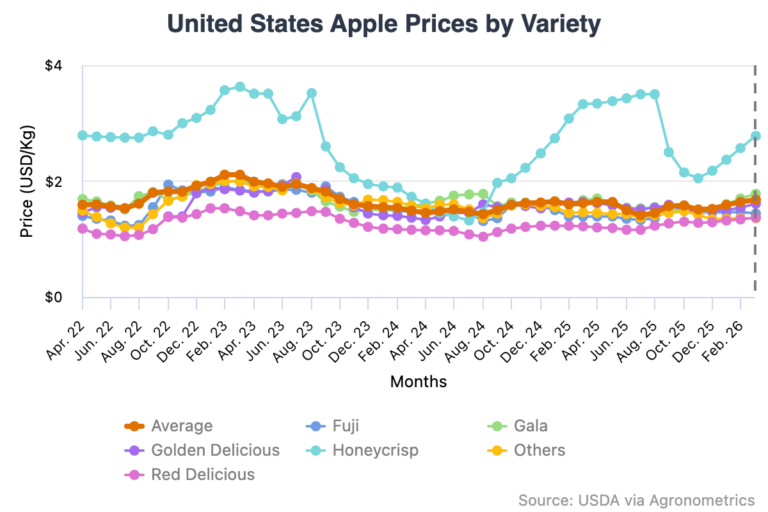
Source: USDA Market News via Agronometrics. (Agronometrics users can view this chart with live updates here)
The 2025 harvest looked promising, as the USDA forecasted it up six percent compared to 2024, with organic Honeycrisp volumes expected to rebound 40 percent. But retailers, locked into aggressive fall promotional programs, sold through inventory far faster than anticipated.
By December, the industry had proportionally moved more fruit than in any recent season, at lower prices, leaving little for spring and summer.
Long-term factors impacting pricing
Beyond any single harvest, longer-term pressures keep Honeycrisp prices elevated.
Labor costs per bin have risen 127 percent over the past decade under the H-2A guest worker program—a burden Honeycrisp bears more than any other variety, given how labor-intensive it is to grow. For the 2023 crop, 99 percent of many Washington growers' net returns went to labor alone. The break-even wholesale price for Honeycrisp sits around $35 per box; export-friendly varieties clear at $25. Tariffs have further limited how much Chilean fruit can realistically fill the gap.
For now, April 2026 sits in a familiar and uncomfortable spot on the Honeycrisp price calendar—the late-season climb, after fall's new-crop relief has faded and before the next harvest arrives.
Monthly data from Agronometrics shows this pattern has repeated consistently: prices peak in spring, ease when the new crop hits in October, then begin rising again through winter. The season's domestic supply is thinning, imports are constrained, and the next fresh crop won't arrive until late summer at the earliest.
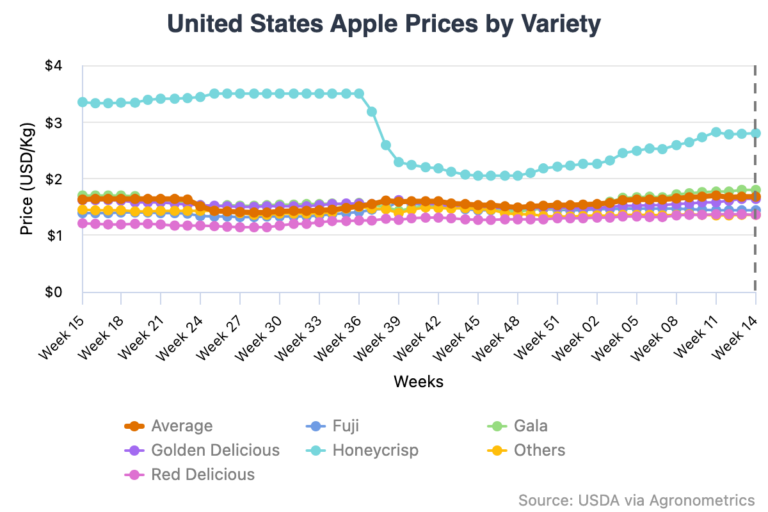
Source: USDA Market News via Agronometrics. (Agronometrics users can view this chart with live updates here)
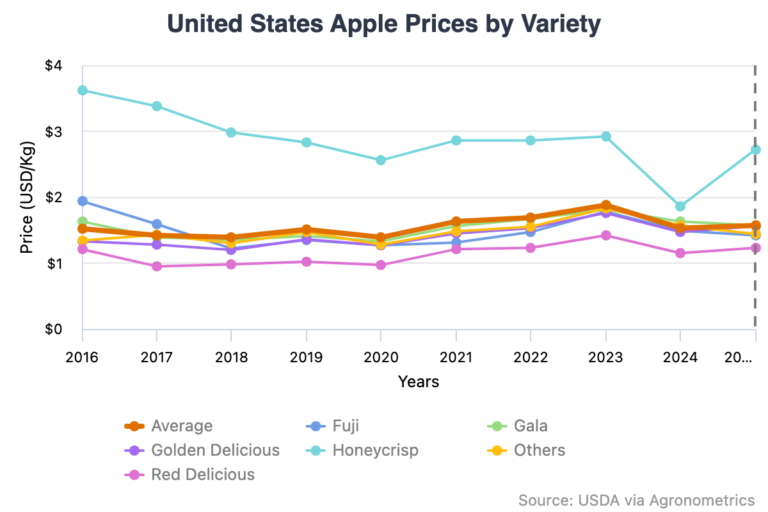
Source: USDA Market News via Agronometrics. (Agronometrics users can view this chart with live updates here)
Related articles:






Subscribe to our newsletter