Agronometrics in Charts: California berry harvest hits full stride, raspberries leading growth
 Add Fresh Fruit Portal to Google
Each week, the series ‘Agronometrics In Charts’ examines a different horticultural commodity, focusing on a specific origin or topic and visualizing the trade market factors driving change. Check out our entire archive.
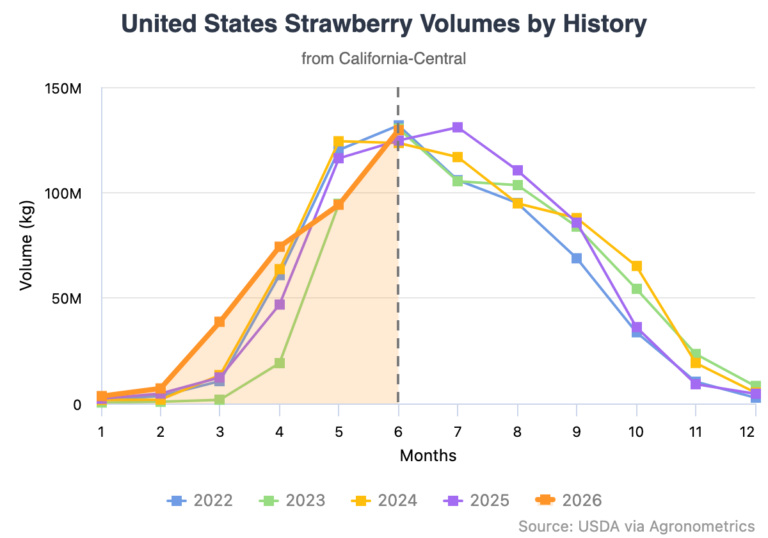
California's berry season has entered its peak production period, with abundant strawberry and raspberry supplies flowing from the Central Coast after a season that shifted rapidly from record-early harvests to weather-driven volatility.
Source: USDA Market News via Agronometrics.
Warm winter temperatures accelerated crop development across California's key growing regions, causing harvest windows in Watsonville, Salinas and Oxnard to overlap and generating significantly higher early-season volumes than in 2025. According to Gem-Pack Berries, March heat waves complicated production forecasts before supplies stabilized as the industry moved into its summer peak.
University of California Cooperative Extension advisor Mark Bolda likewise attributed the unusually early season to record February temperatures, while the California Strawberry Commission said cooler weather during April and May temporarily slowed production before quality and volumes recovered toward the end of May. Naturipe Farms also reported that the spring production peak it had anticipated never fully materialized, illustrating how unpredictable weather compressed what is typically a more gradual production curve.
The California Strawberry Commission expects production to remain strong through the summer, forecasting weekly shipments of approximately 7 to 8 million trays through August while planted acreage continues to expand in 2026.
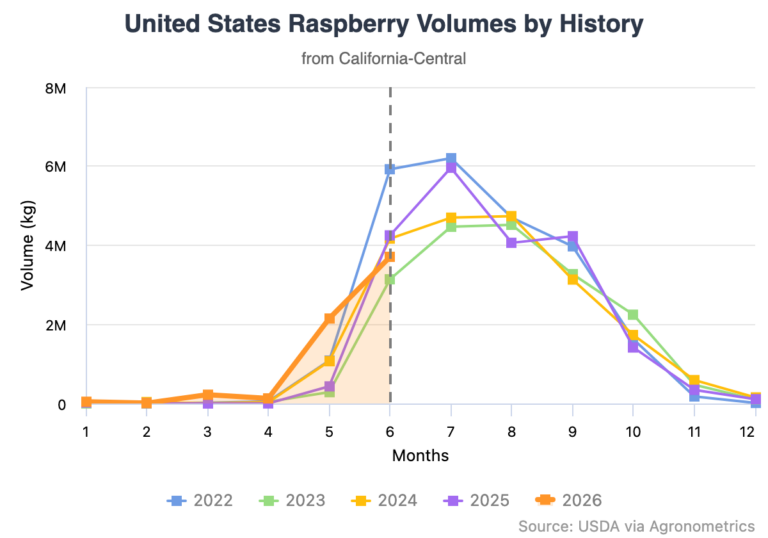
Although strawberries remain the largest category, raspberries are becoming the industry's fastest-growing segment.
Source: USDA Market News via Agronometrics.
California Giant Berry Farms reported that its Watsonville raspberry season started earlier than normal because of accelerated plant development and is expected to continue through November before transitioning back to Mexico.
The increasingly integrated North American supply chain has become an important advantage for berry marketers. According to the USDA Foreign Agricultural Service, Mexico is expected to increase total berry production by four percent in 2026 through investments in improved genetics, modern production systems and harvest timing, allowing suppliers to maintain nearly year-round availability for US retailers.
Varietal innovation is also reshaping California's strawberry industry
Gem-Pack says roughly 70 percent of its strawberry production now comes from Alturas, a day-neutral variety developed for Fusarium resistance. This season, the company also introduced Carpinteria, a high-yielding variety with larger, firmer fruit designed for long-distance shipping. The California Strawberry Commission expects continued adoption of varieties that improve yields, disease resistance and post-harvest quality as growers face rising production costs and increasingly variable weather.
Together, those investments in genetics, production technology and supply-chain coordination are helping California maintain its leadership in the industry. While strawberries continue to dominate retail shelves, 2026 is increasingly shaping up as a year in which raspberries have become the standout growth story, supported by strong consumer demand and expanding production on both sides of the US-Mexico border.
*Top image is referential via Unsplash. | Graphs courtesy of Agronometrics.
Related stories
Raspberries in the UK reach record sweetness levels, consolidating demand boom